Possibility, Protection, & the Gathering of Points
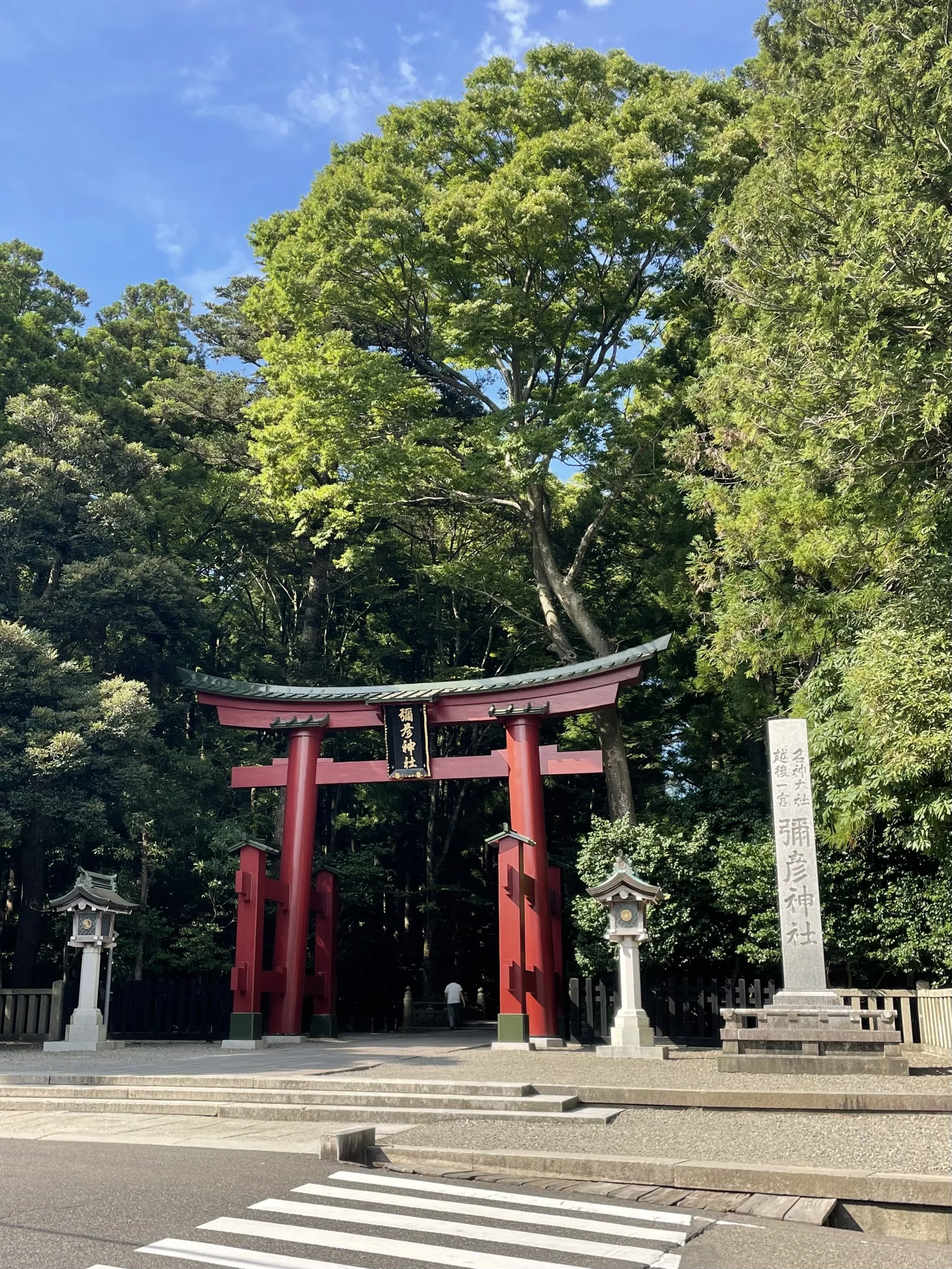
a large torii gate south of Niigata - I love the interplay between the gate and katsura tree to the right of the frame
Ours is an age of measurement. What’s your credit score? Your FICO score? Your BMI? Your league on Duolingo? Did you get your ten thousand steps today? Eight hours of sleep? Do you even know your sleep score? Have you counted your calories? Your weight? Your sodium? Your screen time?
There is a strong belief that if a factor can be measured, it can be improved, and that life can be reduced to ever upgradable units. That it can become a sort of game. Something to be won.
I find this scorekeeping tedious – steps, calories, sleep score (sleep score?) – because the aim is not to share information which might be of value – or at least of interest – to the listener, but establish one’s own worth or superiority.
“I meditated for fifteen minutes today. I’m a very mindful person.”
“Well I meditated for twenty, so you see I am at least a full five minutes more mindful than you.”
“Yes, but I meditated twice as hard as usual, so really it’s as though I meditated for half an hour.”
In every action, the aim drifts further and further from enjoyment and fulfillment, and towards one upmanship and the gathering of points – even if only against the self – until gathering points becomes the point. Money – for being countable – is the shortest shorthand there is for wealth and worth. The clearest indicator that one is – or is not – winning the game.
Now we’re often told there is no cruder topic to drag into daylight. And I certainly agree when money is used to establish and assert hierarchy, as a means of keeping score. “There are more zeros in my bank account than yours, therefore I am a more important person.” I assure you, there are plenty of zeros in my bank account as well, it’s just that most of them come after the decimal.
But I understand the obsession with money counting – especially for Americans – as I suspect its root comes from latent desperation. We cannot reliably trust our institutions or communities to come to our aid in time of need. Dollars are, regrettably, the best defense in times of crisis.
And it is for this reason of security that I am a great fan of frank discussion of finance, in much the same way that I believe one should always be aware of their health. I don’t think scorekeeping is all that helpful, but neither should ever be ignored. Both function as a reservoirs of protection and of possibility. And for one purpose alone can I completely agree with this point gathering and scorekeeping system: as a measure of potential. Once having established some numbers, what do the figures permit?
So here are some figures from mine.
At present I have around $70,000 in total financial assets – the exact amount varies based on the day – in savings, checking, retirement, and investments. I hold no real estate, and minimal possessions (none of which are particularly valuable, probably not even worth a thousand dollars put together). No income to speak of at present, but also no debt or outstanding, repeat expenses such as rent, mortgage, or a car payment. Since arriving in Japan on July 2nd, I have spent around $3,000 total, or around $60 a day. The favorable exchange rate helps a lot, but I also travel quite cheaply. Lodging is camping, hostels, capsule hotels, very occasionally it is couch surfing. Meals are convenience stores, public markets, grocery stores, and lunch counters. Entertainment is a bicycle ride, a stroll in the park, a hike to a mountain, a visit to the local castle or museum, podcasts and e-books. Souvenirs are photos and memories. Based off present habits, I could travel for another 3 years.
I don’t share all this to brag, or proselytize – “See how I did it! You can too!” – but to remind myself that money is indeed a form of power. Not over others, but over one’s own life. It is the current that runs the machinery. And at my wattage, while the machine will never run all that fast, it will run for years. This is the protection and possibility afforded by these figures. The potential.
American attitudes tend to run quite binary and in opposite directions when it comes to money. It is the root of all evil or else greed is good. It is to be amassed or to be avoided. And as the dollar is among the largest of U.S. exports – being the global reserve currency of choice – these attitudes could hardly be considered purely American anymore. For all our blast and bombast and bombings, our empire is a largely invisible one, our hands at rest upon the dollar at the center of the world. (Though that is not at all to say it is a benevolent one. (“Pay no attention to the man behind the curtain!”))
I think the statement “Americans are a money obsessed people” is a broadly true one. And Americans I meet in Japan often mention the relief of not having to think about money while here, as though Japanese attitudes were somehow different. What my fellow countrymen really mean is they are enjoying their vacation. Personally from my own observations I don’t find the Japanese to be any less money conscious – or any less obsessive – it’s just in another direction.
Generally, the U.S. favors the generation and expenditure of money. (“The business of America is business,” as Calvin Coolidge quipped) whereas Japan favors financial reserves, which is not the same as saving, or even thrift. It is simply not spending.
A small example:
In 2025 I applied for a Japanese student visa. As the visa prohibits working for earned income, I would need to prove sufficient finances to support myself for the two years of the program : ¥8 million JPY or about $50,000 USD. (Done.) I had been sure to secure free lodging via a work-exchange at a guesthouse, and included a note from the manager in the application, as further indication that as I would not be paying rent, I would have more than enough means to support myself.
The school then requested two years’ worth of bank statements. (Also done). Five years of tax forms. (well…alright). And then a full employment history going back to high school with relative wages for each position. At that point I withdrew my application. It seemed far in excess of what I felt was required for a language study program and it became clear that there was no amount of assurance I could offer to convince Japanese immigration I would not default and “burden the system.” If I wanted to learn Japanese, I decided it would be easier to just teach myself.
As a possible alternative, I had considered the business manager visa – a self-sponsored visa for people who want to start a business in Japan. By this route, I could earn income while studying on my own. When I looked, the rate had been a steep but doable ¥5 million JPY (~$35,000 USD) that self-starters must deposit in a Japanese bank before setting up shop. However the figure was raised in October of last year to ¥30 million (~$200,000 USD). The stated reason for the increase was the same as the scrutiny on student visas: “burden prevention.” And far beyond my means besides.
In some ways, it was a relief. I could now stop considering Japan as any kind of full-time option. A locked door is as good as an open one when it comes to determining just where one ought to go.
I enjoy exploring the tension between Japanese and American attitudes in most things, and draw freely from wherever seems more applicable or attractive. Wealth is no exception. (As I’m sure you’ve gathered from the name of this business and of this blog) I think the Japanese do many things well, and often better than us: their transit, their cleanliness, their eagerness to direct tax revenue to public investment – such as infrastructure, education, and healthcare – rather than international military exploits, corporate subsidy, galas, and gilt picture frames. But I find them tremendously, almost ludicrously risk averse. Certainly when compared to Americans. To be completely reductive about it, if money affords both possibility and protection, the Japanese put their emphasis on protection, whereas Americans emphasize possibility. It is in this aspect in which the average American has one particular advantage over the average Japanese: we are relentless optimists, and we never seem to outgrow it no matter how old we get. We can go to ruin and come back again as many times as we choose.
Oh, I don’t think we’re bright-eyed at all when it comes to the nation as a whole – which always seems to be going straight to hell no matter when we happen to live – but we ourselves will always stand safe upon the shore, immune to the draw of whatever vortex our fellow countrymen spiral down. No matter how low our own luck may run we never quite believe that it ever runs out. The needle could hover at zero for years without ever touching E.
We’re wrong of course. Logically we have to be. But improbably, I can’t believe we aren’t right. F. Scott Fitzgerald was largely correct, even oracular, in his observations, but almost inconceivably ignorant when he wrote there are no second acts in America. There is almost nothing we love more than a rags to riches story no matter how many times the arc repeats. (Or at the very least, we reserve high praise for the derring do of the narrow squeak.) We never tire of reinvention. Fitzgerald ought to have written his line about Japan instead, where there is undo pressure from the youngest of ages to get it right on the first try. In Japan, if you’re not locked into a stable career by the age of thirty-five, you may as well be dead. There’s just no hope for you, buddy. (Which may explain the reluctance of Japanese immigration to consider my own visa application. At the age of 42, I’m a revenant from the underworld, a voice from beyond the grave.) Second chances happen somewhere else.
The Japanese-American standup comic Atsuko Okatsuka observed that any Japanese person living abroad has probably done something very wrong at home. Not criminally negligent, perhaps. But certainly something to render them eternally unemployable. (Pursuing an art degree. Becoming a comic.) My understanding is that the Japanese are every bit as competitive as Americans when it comes to measurement, it’s just the accounting starts earlier, and with increasingly less forgiveness as the years go by. (If you have access to the streaming service Kanopy via your local library, I highly recommend the documentary “The Making of a Japanese” about early education in Japan) Whereas we are perfectly fine with the idea of playing catchup at forty. Or sixty. Or dare I say eighty. American literature has its foundation in the pulpit and the accountant’s desk, both of which profess belief in an infinitely perfectible enterprise, and by extension an infinitely perfectible self. We know we won’t live forever but we can always fly just a bit closer to the sun. If you just tick those numbers up a tad bit higher…
What we’re exercising in this folly of accounting is a sense of control. As though one’s circumstances were entirely up to the self. Higher numbers equal better people. I waited for my marshmallow, therefore I can’t be eaten by a tiger.
But even though I reject the whole idea of gamifying one’s life into points - I can’t tell you how much contempt I have for a sleep score. If you’re tired take a snooze - I also think this eternal optimism, more than anything, is what finally convinced me, no matter how far I run, whatever the color of my passport, however reluctant I may feel about it, however much I admire Japan – or France, or Mexico, or any other country – I will always be American - at least culturally - whether or not I return. A second act is always possible (or third or fourth) even if there is no constitutional guarantee. It is for the individual to pursue. Or not. The bank balance may hit zero some day, but the luck will never run out. (Vegan tigers.) I know this is a form of exceptionalism, but some things just cannot be helped.)
And the reverse is one to which I don’t think I can ever reconcile myself. To be told what I want is not possible, to be told where and how to conduct myself. I am very aware that other countries play by other rules, but I do not wish to ever be diminished for the privilege of residency. I do very poorly with ‘you will find that simply cannot be done.’ I was attempting to prove to Japanese Immigration how clever I could be. That I could always find a solution and so they need not worry so much. Which was precisely why they were worried. They did not want someone clever, they wanted someone conventional. Cleverness means at least occasional disregard for rules.
This, even more than the difficulty of mastering an unrelated language, turned me off the idea of pursuing a living here full time. I lead a highly unorthodox and self-determined life, which is fine in the States. Each time I come back, no one ever asks to see my bank balance or proof of employment as a condition of residency and re-entry. (Though I am sure this is surely purely the privilege of citizenship. I doubt the U.S. would be anywhere near so forgiving if I were a foreigner.) Whereas other Americans talk of the relief of not having to think about money while visiting Japan, for me it is the opposite. In Japan, I can be welcome only so long as I keep it moving, my wounded wallet open, hermorhaging yen into the economy. In America, the great financial furnace, I can sit unbothered by the flames, my dollars quietly my own.
I don’t expect to stay on the road for three years, even if my present finances allow. I doubt I’ll even stay in Japan the full ninety days, as permitted by my current visa. (Though I may still return this year, once my present allotment runs out in September. This is yet to be decided.) I know that I am wealthy in ways unrecognized by either the U.S. or Japan– relatively healthy, relatively young (alright, so more than halfway towards eighty, but it is still reasonable to expect there are decades ahead), multilingual (not always fluently, but at least functionally - in that I can manage '“yes, no, please, thank you, very large beer” in five languages, so you know, the basics), resourceful, and savvy in the ways of stretching coin.
None of this will get your visa fast-tracked, by the way. Governments expect numbers. Plenty of zeros before the decimal and not after. Quantifiable, taxable assets. (Just how do you tax savvy?) But these too are assets worth adding to the reservoir of possibility, of which money is the shortest of shorthands, the most imperfect measure of wealth.
Off the measurable assets, I could travel for three years. Or, let’s say two years comfortably, as there are always surprises. This is the protection. Off the immeasurable assets, I could travel forever. Or till age and exhaustion finally run out, or I at last fly into the sun. (The possibility.)
I don’t have to. I probably won’t. But it’s nice to know as I consider not only “what is presently permitted?” but “what is not expressly forbidden?” Which is a much more interesting question anyway, much harder to satisfy with any kind of points. So much more exciting to attempt to figure out.
~C