Tigers Above - Tigers Below
Probably a lot of you are familiar with the Stanford Marshmallow Experiment. To recap, a young child between the age of three and six is left alone in a room with a marshmallow. If the child can wait fifteen minutes without eating the sweet, they will receive a second marshmallow.
In the original 1972 study, children who successfully completed the experiment engaged in distraction. They talked to themselves, played imaginary games, sang songs, or – as one child heroically elected – curled up and took a nap until the clock ran out. Children who ate the marshmallow were excused.
Ostensibly, the experiment was to determine at what age children understand the concept of delayed gratification. That patience yields reward. But as with so many of these studies, the true experiment was not in what the researchers found, but in what the public came to believe.
Subsequent studies conducted years later found that the children who could await the second marshmallow scored higher on SATs, attended more prestigious universities, and as adults earned higher incomes, had higher credit scores, more favorable body mass indices, shinier hair, and more aesthetically pleasing genitalia. Meanwhile the children who could not wait, had lower standardized test scores, lower enrollment at higher education or else went on to vocational schools, defaulted on loans, joined bowling leagues, drove secondhand motor vehicles, and lost hair in desirable places while gaining hair in bodily undesirable ones.
Alright, I’ve made some of those findings up. But only some and I shan’t say which. However the absurdity is in part to reveal the biases of the research and my contempt for how the Stanford experiment still gets bandied about as proof of the value of unexamined restraint. So let’s examine it now, and maybe it’s best to start with some questions. Who were the children involved? Just how did Stanford get their hands on so many at once?
Well…Stanford has a daycare. All participating children had parents employed at Stanford University, from whom they enjoyed a robust, stable income and a reliable network of services – such as health insurance, retirement plans, and private daycare – while living in one of the most affluent of addresses - Palo Alto – in the richest state – California – in the richest country – the United States. Children raised in such circumstances – which is to say, free from want or surprise – had every reason to believe when an authority figure said, ‘in fifteen minutes there will be another marshmallow’ that in one quarter hour there would indeed be another marshmallow. (Or at least they had no more reason to doubt the word of Stanford than their parents did when that same institution promised ‘in thirty years there will be a pension.’)
As for the subsequent findings, is it any surprise that the children of Stanford employees went on to do well for themselves, attend select universities, and then in turn earn high incomes as well? (No word on the shinier hair or more streamlined privates, which were not included in subsequent study, but body mass and credit scores were) And what’s often omitted is that while perhaps the children with lower impulse control attended less prestigious higher education – let’s say University of Michigan rather than Princeton – they still did dramatically better than children elsewhere – which is to say, all those poor unfortunate saps whose mommies and daddies didn’t work for Stanford.
Fine, so maybe I made up the parts about hair loss and bowling leagues, but the children with less impulse control did not do statistically any significantly worse than the ones who waited when it came to measuring income and health later in life. In other words, the children from privilege went on to be privileged.
But what the young participants understood at the time – and what I think most people intuit even though it is never explicitly said – is that the experiment is a game, which can be won only by those who wait.
So let’s assume a different group of children. Perhaps ones from a less affluent circumstance, whose parents do not enjoy stable incomes and reliable social services. Children attended by untrustworthy adults who fail to deliver on promises. Adults who reward patience with excuse - ‘the situation has changed’, or ‘I never said that’, or ‘it’ll be better next year’ or ‘well, if you can just wait a bit longer…’ The most rational decision for these children would be to eat the marshmallow because nothing in their life experience has taught them that patience is a worthwhile investment. And yet, by the standards of the Stanford experiment these children are “losers.”
Alright… so let’s look at the “losers” from the initial study. Once they ate the marshmallow, what happened?
Well, they were escorted away from the bland, distraction-free, unstimulating room of solitary confinement and returned to the sociable familiarity of the Stanford daycare, to the warmth and safety of friends, caregivers, and toys. Meanwhile “winners” sat alone in self-denial confronted with temptation, of thoughts of evil and themselves.
OK, it is doubtful the more patient children experienced that degree of angst – certainly the sleeping child was quite untroubled by such doubts – but I hope I’ve successfully illustrated how the Stanford Marshmallow experiment has little application anywhere to anything.
Patience is not always rewarded. Promises are not always kept. Everyone knows what it is to have been handed a faulty IOU: - “the keys to the corvette are yours once you turn eighteen” - “job prospects are excellent for someone with your qualifications,” - “insurance will cover the entirety of the cost”. But finding the balance is negative only once they try to cash the check. Here are some from my own experience: “as your name is not on the lease, you have no tenant protections.” - “Yes, well, our bank uses a different metric to determine the worthiness of loans.” - “I’m afraid the budget has been reduced and we no longer have the funding for a second marshmallow, but in recompense here is drawing of one. Please note that as a sincere demonstration of apology the graphic has been rendered 50% larger than life size.”
I used to wholeheartedly believe in the accepted findings of the marshmallow experiment. That discipline yields reward, and it is better to wait than indulge. However the older I get and the more I experience of the world – its frustrations, setbacks, and disappointments – the better I understand the children who excused themselves early from all participation. Who ate the marshmallow and left. Children who still went on to lead good lives, even exceptional ones. And the more I questioned the logic of the children who stayed behind.
Both groups of children made perfectly rational decisions. For some, it was more important to enjoy the provably true marshmallow in front of them and to then return to their known life than it was to sit alone and maybe, perhaps, one day enjoy some theoretical dividend. For others, it was more important to wait, although their reason is harder to parse. Did the children who waited genuinely want a second marshmallow? Or did they want to win the game? Or perhaps it was not even winning, but they only desired to please the adult and be a “good” child? They may not even have liked marshmallows all that much.

the hike up Mount Kurodake - Daisetzusan National Park
I think a far more relatable tale than the Stanford Marshmallow Experiment is the strawberry story of Zen Buddhism. It is short enough parable I think it can be retold here in full:
A man traveling across a field encountered a tiger. He fled, the tiger after him. Coming to a precipice, he caught hold of a wild vine and swung himself over the edge. The tiger sniffed at him from above. Trembling, the man looked down to where, far below, another tiger awaited. Only the vine sustained him. Meanwhile, two mice, one white and one black, little by little gnawed at the vine. He could feel the fibers snap from his grip, the vine’s hold weakening. The man looked elsewhere, outward along the rocks, to where a strawberry plant had sprouted, a single luscious fruit hanging from its leaves. Grasping the vine with one hand, with the other he plucked the strawberry. How sweet it tasted!
For the man in the strawberry story, there is neither past nor future. He exists only within the present, and whatever his choices the ending will be the same. Patience gains nothing. The environment is chaotic. There is no control. It’s tigers above, and tigers below. There is no way for him to “win.”
The westerner wants a story where death can always and forever be cheated through cunning (the vine becomes a lariat which the man uses to subdue his pursuers) or luck (vegan tigers!) But the man settles on wu wei. Effortless action, or choice within circumstance. He is neither victim nor agitator, but a fellow participant in the chaos. He does not wait for the storm to pass, but reaches out and joins the thunder.
Westerners, when they are at their most unkind, and Christians especially, see Buddhists as either limp or smug, if not both, for their perceived willingness to submit to, and even celebrate, a bitter, weighted world. (“The barn’s burnt down – now I can see the moon”) What is this pre-occupation with disappointment and defeat?
Buddhists, in turn, see Westerners – and Christians especially – as rather naïve and child-like, for whom the present is never enough, but it is always ‘and then what? And then what? And then what?’ rushing ever onward until Sky Daddy sweeps them away to Sugar Candy Mountain.
While the Stanford experiment is not explicitly religious , it certainly reflects the Christian - and American - bias that the lawmakers are honorable, the rules are fair, and all those who fall in line will receive their just reward, or at least be compensated beyond their hasty peers. While Zen – unlike Christianity – promises no reward. There is no moment but the one, present, and everlasting now. In this, the Christian sees no future. The Buddhist, for their part, thinks Christianity has no present. The Christian asks ‘well then how do you intend to spend eternity?’ The Buddhist answers ‘I’m spending it right now.’ All good little children will get another marshmallow. You can’t eat a strawberry from inside a tiger.
The world views are contrary, but the world they occupy is not. And each of these two parables - the modern one from Stanford and the older one from Zen - presents itself as allegory. Is life the solitary room, a controlled experiment that rewards restraint? Or an uncertain country of trembling vines and lurking tigers, of unexpected fruits snatched just before the fall? I know which I believe.
Imagine the strawberry story again – the field, the tigers, the mice, the vine – and then at the moment when the man is assured there shall be no rescue, the result is the same regardless, - death above and death below - his one tenuous grasp on life diminishing in his hands, he gazes out along the cliff, and sees sprouting from the rocks there, and just within reach… a Stanford researcher…with a marshmallow…who says to him, “ah now if you can just wait fifteen minutes…”
Or, no, if this is too fanciful, let’s call up Stanford and ask them to run the experiment again, exactly as before, only this time, just before closing the door and leaving the subject alone in the room, remind the child of the oncoming grave. I suspect the results would be quite different.
For years I’ve been living rather more like the obedient children of the Stanford experiment than the man of the Zen parable. That may surprise those who know me and just how contrarian I can be. But I’ve perhaps been a bit passive about my own life – which is why, I think, I so admire the napping child, the nonparticipating participant, who communicated through action, if not word, ‘wake me when this rigmarole is over’. Did the researchers rouse them after fifteen minutes passed? Or let them go on sleeping as long as they liked, while marshmallows silently accumulated around them, a fresh one every quarter hour and so they awoke to riches? If only I could do the same, drift off for awhile - five years, a decade - and let wealth beget further wealth while I slept.
It was about a year ago that I realized with a start I had already done just that. I had been asleep. I had consciously said to myself at many a junction, ‘oh not now, but later’. In another month or year I’ll reconsider. I’ll be ready once my bank balance reaches six figures, once my credit score is a few dozen points higher. Once my skin clears up, and I get that dental cleaning done. Coming up with all sorts of reasonable sounding delays to gratification. Ignoring that time was passing and life was happening, whether I was there for it or not. Two little mice gnawing a vine. Every year a bit more gray in my beard, a touch more sand in my joints. But surely, if I could wait a bit longer. Say…maybe another few months…or even just fifteen more minutes…and one fine day…
…and how many strawberries can you eat from inside a tiger?
~C
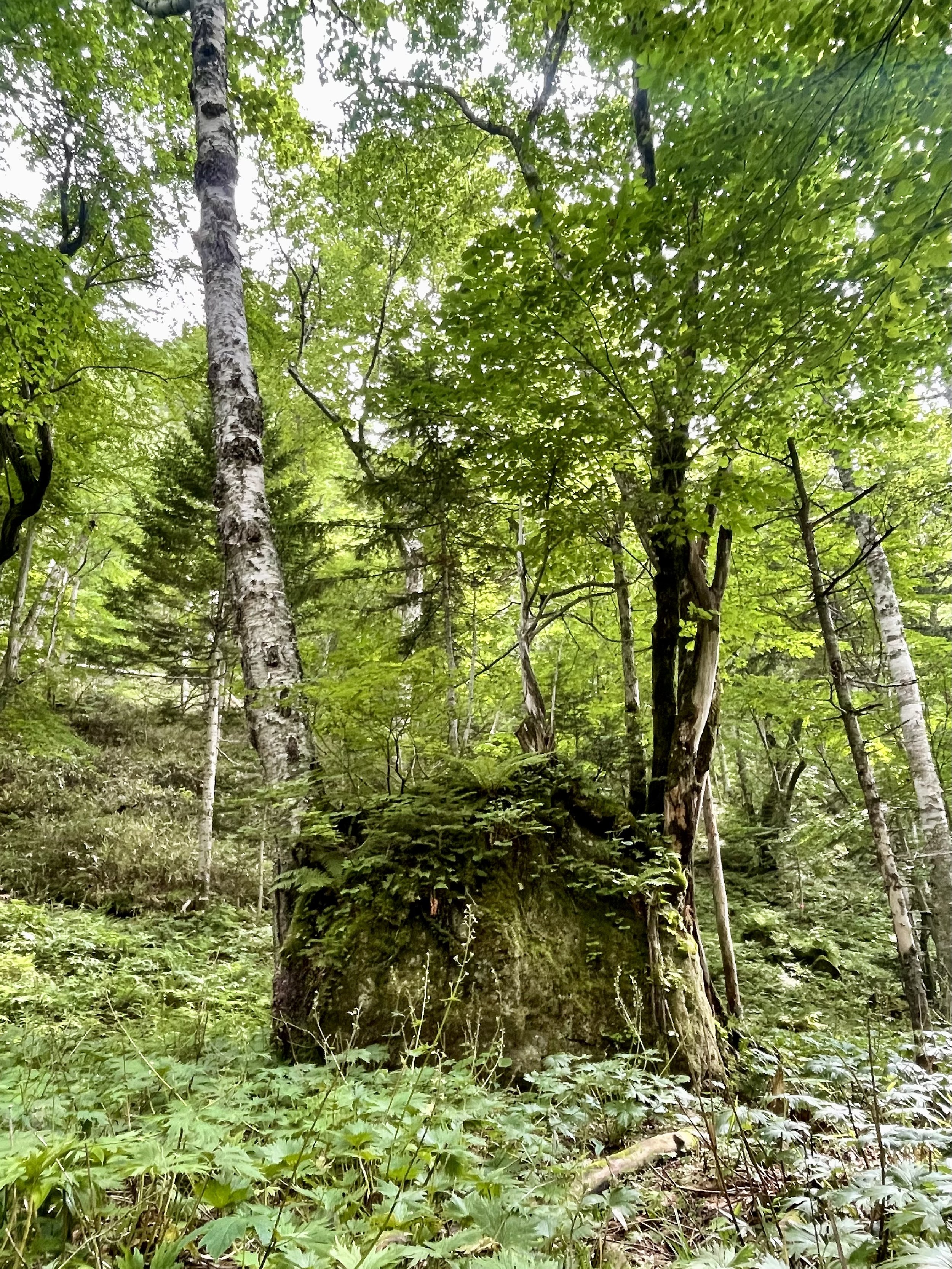
trees can sprout from rocks - surely a lesson there - Daisetzusan, National Park