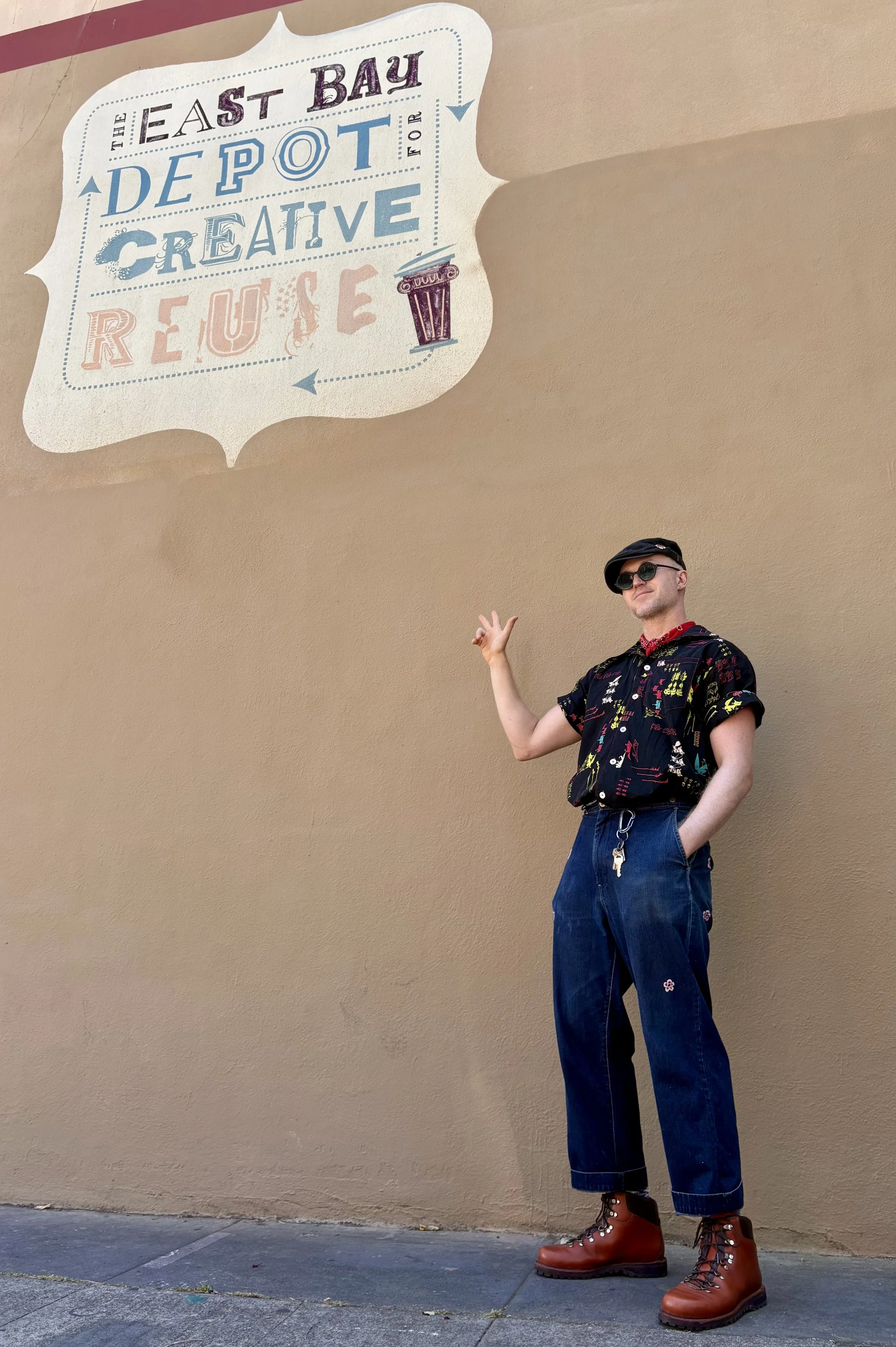
posing in front of the East Bay Depot for Creative Reuse - where I do most of my teaching
Lately I’ve been thinking a lot about my favorite children’s story, “The Porcelain Man”, by Richard Kennedy, in which a daydreaming maiden experiences all the joys and mishaps of folktale adventure as she combines and recombines the shards of a shattered porcelain vase, first into a man, then a horse, and at last as a…oh no, dear reader, you shan’t have the ending that easily. If you would like the full text you may read it here. It is only three pages long. I suggest you go there first before returning. (Or for those who prefer the coziness of being read to - as well as seeing Marcia Sewall’s excellent accompanying illustrations - I direct you to this video)
Done? Good. I hope you enjoyed it. And now let us continue.
The book, first published in 1976, was certainly around during my own childhood, and yet I didn’t encounter it until I was nearly thirty, through the incomparable radio program Selected Shorts, in which professional actors read short works of fiction on stage. I had assumed, given the classic ‘once upon a time’ fairytale structure – a girl in distress, a magical intervention, the rule of three, and, of course, a ‘happily ever after’ – that “The Porcelain Man” was a much older story, perhaps one gathered by Perrault, since it appeared altogether too sunny for the Grimms. (that ending especially) Also the transformative – and transportive – value of junk seemed very much aligned with the values of pre-modern peasantry. I could see it being French.
But the tale was entirely of Kennedy’s own invention. Even more shocking – to this reader – Kennedy was American. And we are not, generally, a people known for our flexibility and thrift.
What I loved about the story then, and what I still love about it now, is the reinvention of scrap. Some precious porcelain breaks, and it is never swept away and disposed of. Instead it comes together and breaks and comes together and breaks in a cycle of death and rebirth, every time different than before. And the fact that it is different and not better is an important distinction within the story.
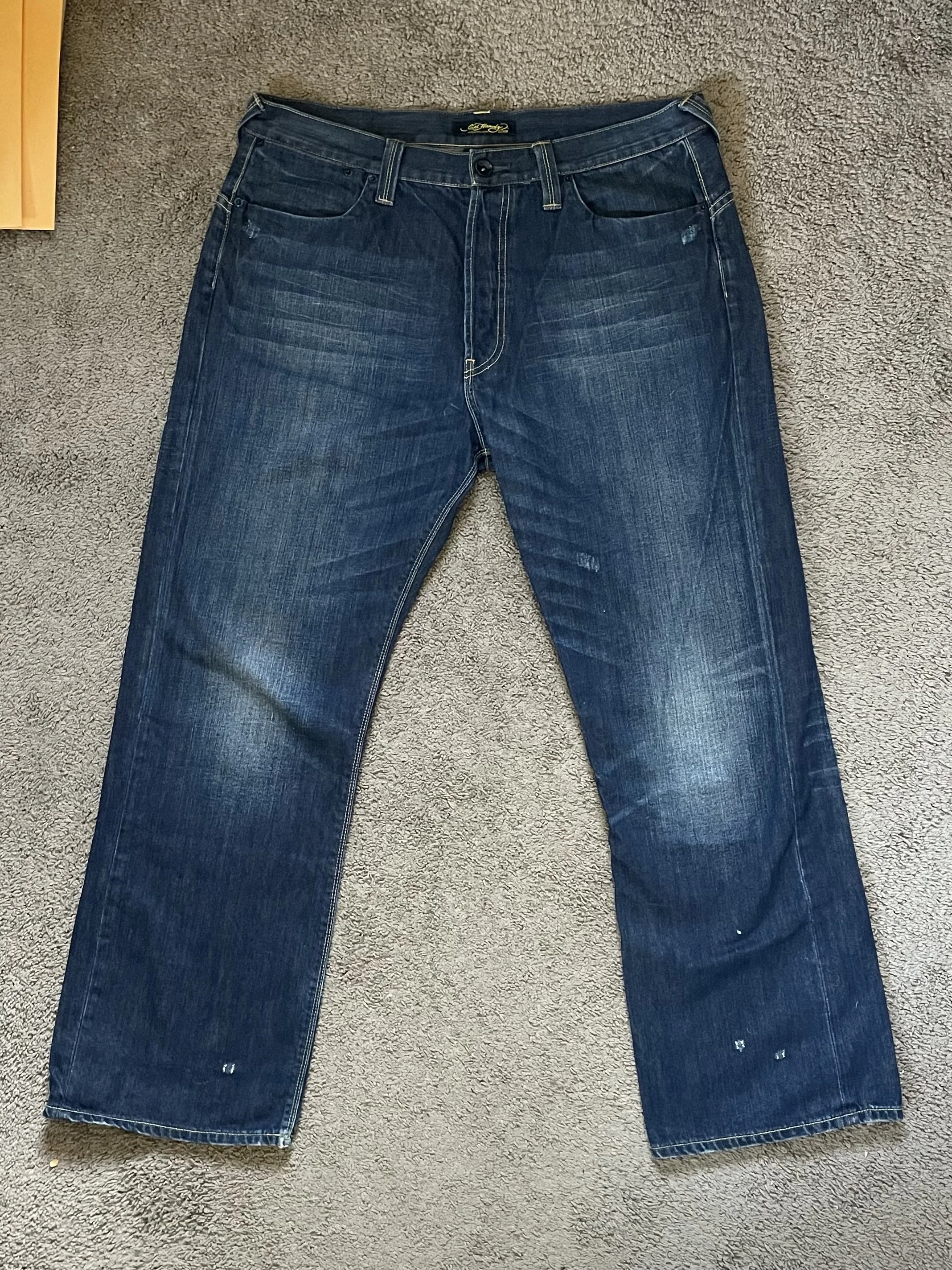
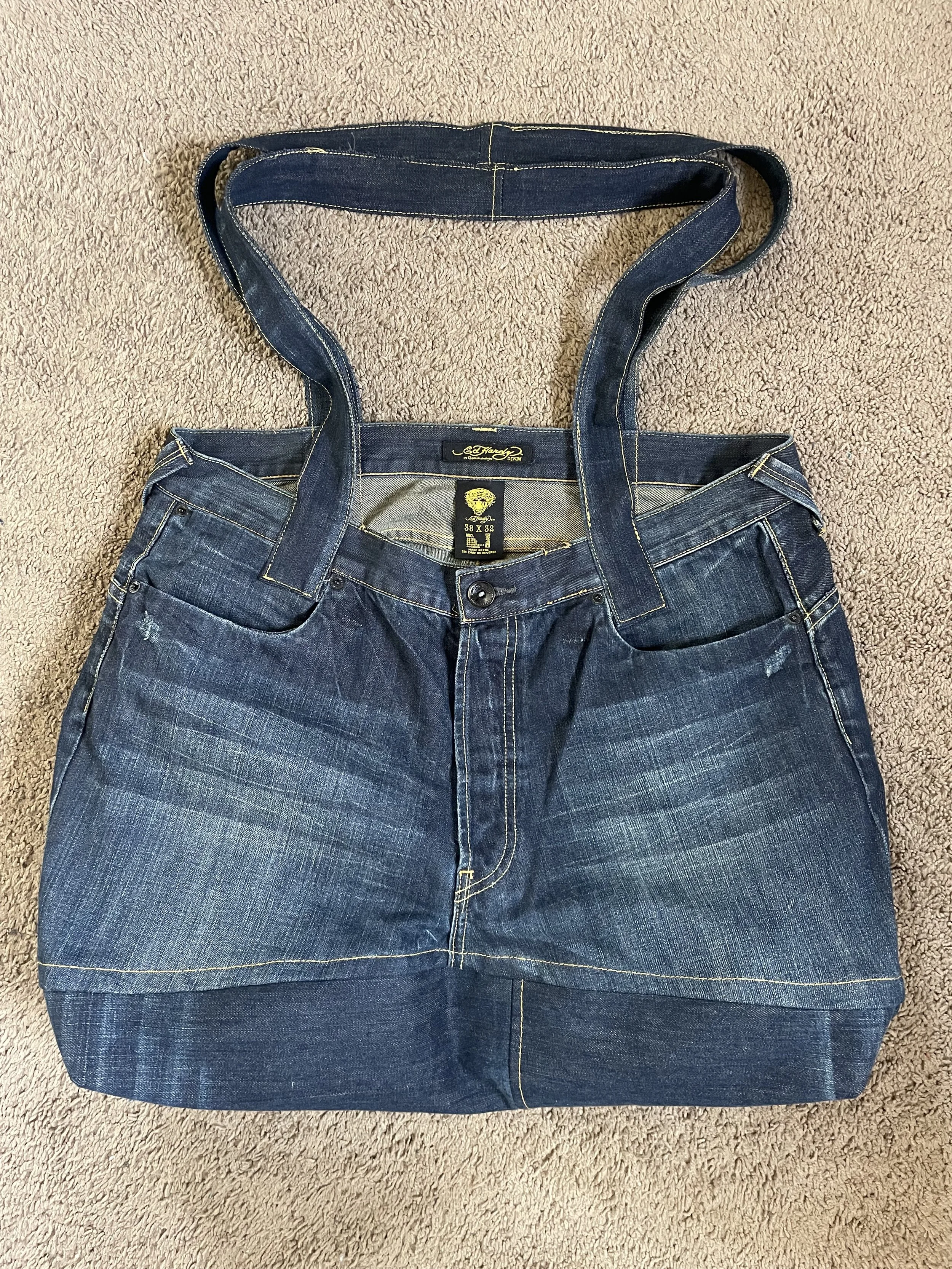
'That's no pants, that's a purse. Now you'll just have to do it all over again. And this time, concentrate!'
As we are dealing with porcelain, it is tempting to see the girl’s actions through the lens of kintsugi- 金継ぎ “gold joinery” - where shattered crockery is mended with a mix of lacquer and precious metal. Because the wounds are ornamented rather than hidden, one is meant to know ‘this cup is already broken’ (to reference a famed example). Certainly I could imagine a highly arresting illustrated version of “The Porcelain Man” where the titular character appears his limbs rejoined with lacquer, his skin webbed with veins of gold. But the girl is obviously not a practitioner of this particular art - or perhaps is just extremely bad at it - because while the beauty of kintsugi emerges in part by the accident of fracture, the reassembly is always but a single destination. Pieces are fixed exactly, with great intent. A vase is reborn as a vase. No matter how many times it may have been smashed and glued back together, it could never become a man. This is a separate lesson, and while the origin of broken shards is cognate to Kennedy’s story, the mindset of kintsugi sets it as fundamentally apart from the mindset of the girl. I will explain.
Now, it’s probably no surprise that someone who makes a significant portion of their income remaking remnant cloth would respond so strongly to the magic of mended scrap. But over the last few weeks, as I think quite a bit about the trajectory of my own life, I have been returning with increasing frequency to “The Porcelain Man”, occasionally re-reading it as my own bedtime story before turning in for the night. It was only in the past weekend that I think I’ve at last figured out why: it is because the girl is detached from outcome. She does not insist each new version is wrong and must be undone to match a predetermined and perfect vision. Instead she responds to every turn with inquiry, rather than stubbornness and demand. There is perseverance and toil, but no thought of a goal, such that she might even said to be aimless. When she arrives, the endpoint is almost accidental, not at all anywhere that she expected, but still somewhere she is glad.
This runs counter to most Western – or at least American – thought which urges that we must never begin any task without first having the end in mind. We ought already to know where and how exactly it is that we will be coming down. We have only to “manifest destiny” be it to the Pacific or the Moon. (Though our relationship is admittedly somewhat contradictory, such that while we might rarely describe someone as “aimless” in any kind of positive sense - such as to indicate that they are open, inquisitive, and devoid of judgment in all interaction - someone we find rather too pushy may be said to “have an agenda”.)
It is so difficult to break with that foundational code that even some of our most cherished dreamers aren’t all that imaginative. “If one advances confidently in the direction of his dreams, and endeavors to live the life which he has imagined, he will meet with a success unexpected in common hours,” from the last chapter of “Walden” by Henry David Thoreau, and a sentence richly populated with the bravado of certainty. (A confident advance in a singular direction! Endeavor to live! Success guaranteed within common hours! Purveyors of snake oil take note.)
Westerners - as a whole - prefer triumpth through defiance. Aut inveniam viam aut faciam - “find a way or make one” - for those who know their Seneca, although the phrase is more often attributed to the Carthaginian general Hannibal, or else to the mottos of preparatory schools and those tattoo parlors adjacent universities. (‘aut inveniam viam…’ is the “live, love, laugh'“ of permanent, latinate body art) For a more contemporary example, both of the major American political parties chose as symbolic figurehead creatures renowned for their stubbornness and strength - the jackass and the elephant - rather than, say, organisms better known for their resilience and resourcefulness, a miraculous ability to thrive in new found environments without first insisting on their alteration. Had such been the case we might have gotten parties represented by the pigeon and the feral pig. Or perhaps the crow and the common carp. Or the dandelion, or the cabbage.
Americans, I think, over-valorize perseverance at the expense of authenticity. We love stories of those brave and single-minded individuals who pushed on no matter what, no matter how many doors were shut in their face, how many people said no, how long it took to gain recognition, or whatever other obstacles were cast before them - death included - overcoming all. Certainly these stories can be – and are – inspirational, though also are not always applicable to one’s own life.
Ah! That sounds like I’m about to advise “give up on your dreams, kiddo” which is not at all the message I intend. But rather, to have the stillness to ask if the dream one thinks one wants is truly what one desires, or if you are only trying to mash yourself into a predestined outcome, to present to the world the vision of yourself at last in accord with what you have said, or – critically – with how you wish to be seen. Do I actually want to be an actuary, an astronaut, or an anesthesiologist? Or do I want to arrive at this pre-determined endpoint because it is the only definition of contentment and success which I have allowed myself to have?
If it is out of genuine desire, then bravo! Huzzah! Allah be praised and onward, Christian soldier! If it is not, then you may arrive feeling rather underwhelmed. Scammed even. Surrounded by figures of financial theory, or gazing back at the Earth from the hollow of a lunar crater, or otherwise insensibly anesthetized and feeling an absolute fraud. Because that contentment and success you were after, which you assured yourself would be here, isn’t, and you never allowed yourself to consider some other path. (The old ‘be careful what you wish for’, etcetera.) Having gone so far in, you’re now unable to get out, and you think back with regret of all those opportunities you outright refused in order to arrive, a square peg stuck fast in the round hole of life.
Perhaps you know the folktale of “Happiness Along the Way” in which a young man, unsatisfied at home, is certain that if he only ventures out he will at last discover contentment. Subsequently, he rejects work in a village in which his skills are much needed and admired, then having gone a bit farther turns away the love and warmth of a home that welcomes him, then further still rebuffs an old man who begs assistance to unearth a hoard of treasure amassed in youth. I may have the order wrong, but I’m sure the pattern is correct. At every unexpected opportunity the traveler rejects the invitation - be it to riches, to honest labor, or to love - and at the end of his wandering is devoured by a wolf, the only character who comes out of this story happy at all. (now this one does sound like it could be from the Grimms)
Although a bit of clever and comic caution, “Happiness Along the Way” - along with “The Porcelain Man” - illustrate by opposite the Daoist concept of wú wéi - 無為 - from the character 無 (wú), that is “without” and the verb wéi (為), that is “to do”, and which might best be expressed in English as non-action, or perhaps more accurately effortless action. The traveler of the latter tale sets the example by negative, because his contrariness requires a tremendous expenditure of effort, until at last he meets someone more open to the opportunities presented by their environment (i.e. the wolf). To experience wú wéi is to respond in tune to one’s surroundings and not resist, to act without strain, rigidity, or expectation, and so arrive wherever it is that you were going almost spontaneously, by magic it seems (i.e. the girl). What we in the West might reduce to ‘go with the flow’, though that particular expression frequently connotes passivity and non-choice. (‘a dead fish will always go with the flow,’ as a friend likes to quip) Wú wéi is rather choice within circumstance, or to use a foundational concept from the western philosophical school of improvisational theater, ‘yes, and…’
From my own life I can say with great confidence that things have gone exceptionally better for myself when I have had the stillness to receive an opportunity with inquiry rather than expectation, and then choose to flow with it, whenever it felt correct, or else let it pass so that I might go on flowing somewhere else. (one cannot flow against) I first got into mending, and then into teaching, and then later into garment and fashion design, because I was able to approach without agenda, and so likewise uncovered various diverting and rewarding pursuits along the way. For example, this blog. Consider the Quaker maxim “proceed as the way opens” to jump philosophies and reference another way - or wéi 為 - of being.
At each point when a chance arose, I – without knowing or caring for destination – responded yes, and... I did not accept such opportunities purely because they were there, nor reject them outright because they did not match the preset narrative I had about myself. Contrariwise, on those occasions when I have been determined to go on with confident advance in the direction of my dreams – personal, professional, romantic – beating on, boats against the current, headless of all obstacle and warning, rigidly jamming square pegs in round holes - aut! inveniam! viam! - I have always, without exception, been severely disappointed. I’ll spare details, but I can say in all truth that I am not cut out for office work, nor for the grind of daily journalism, and the Pacific Ocean is nowhere near so big a gap to bridge as trying to be with someone who does not want you back.
All of this is to say that I have come to a decision. And while I have previously announced to friends that “I will be moving to [city/country]” I would now prefer to correct the record, because I have realized the inflexibility of that statement allows for but a single outcome: geographic relocation. All else is failure. If I have already decided exactly where and how I will land, then I’m not doing any exploration at all. I’m not being open minded. I’m not engaging with life but merely its performance, no better than the traveler of “Happiness Along the Way”, and likely will come to a similar end. What is truly important is to have some space between the chapters, some stillness in which to introspect, and to then proceed where and as the way (or wéi 為) opens. Respond to, and not resist, the worlds without and those within. Piece together the porcelain without thought of the result.
I am canceling my lease, leaving my work, and leaving California. Though not in determined pursuit of a pre-arranged end, but to pause all obligation and to do some exploration. Genuine exploration, which cannot be done if an ending has already been decided. Voyage is meaningful because of surprise. If you crave certainty, stay at home. Of course I’ll be back – consider the tagline of this blog and of this business, ‘equal parts California & Kyoto’, San Francisco is a damn hard place to leave – but I don’t know when, or what will happen in the in between. And how it ends especially. Whether it all concludes in a set of dishes, or in being gobbled by a wolf.
Ah! You see now I’ve gone and spoiled “The Porcelain Man” after all. But if you’ve gotten this far, you likely already knew how that particular tale turns out. But you don’t yet know how this one will. And neither, for that matter, do I.
And that, I think, is a most exciting place to begin.
~C
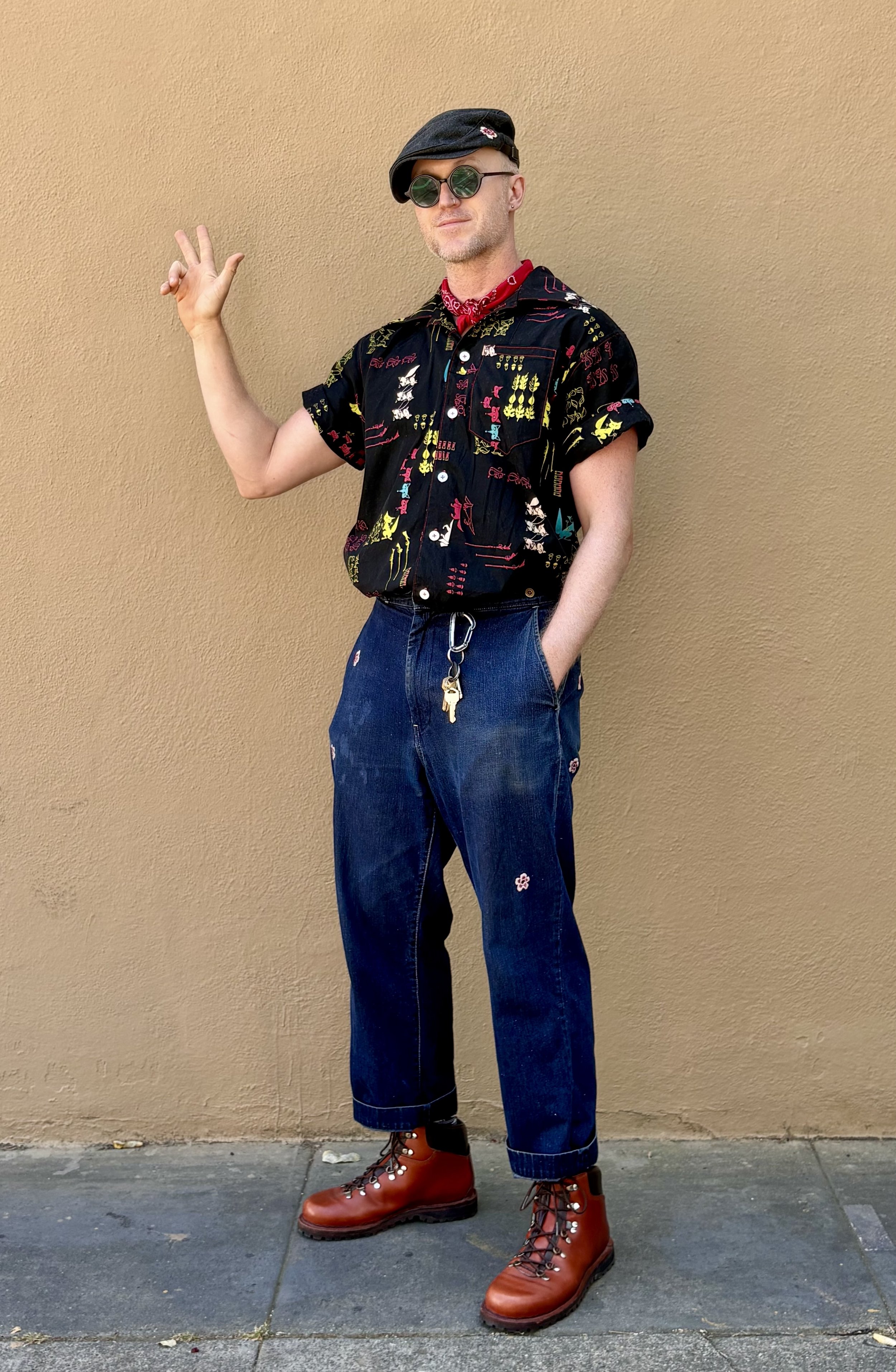
just a close up on the fit - shirt custom made by me from vintage fabric scrap sourced from the East Bay Depot for Creative Reuse - pants and hat purchased on a visit to Japan - cherry blossom embroidery added by myself - boots from Thomas Wandall, local shoemaker - sunglasses by Zenni Optical