Knitting in Japan - or - How the Stitch Spread Round the World
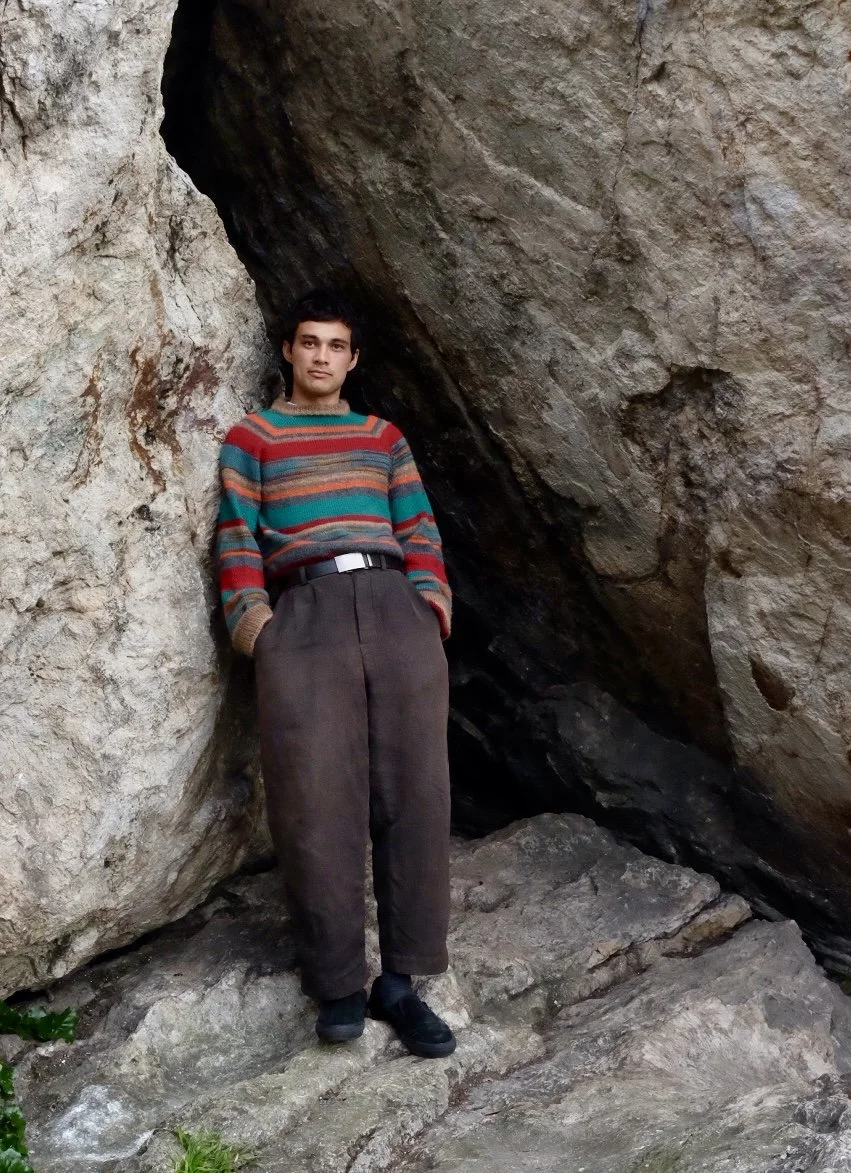
one of this year’s sweaters modeled by a friend - debating releasing this as a pattern or as a series of tutorial videos
It’s funny some of the people who leave marks upon our lives. Not merely the loving aunt or encouraging teacher, but the familiars. The bus driver on the daily commute. The shopkeeper with jaunty planters. Not close enough to be friends, but neither so far as to be complete strangers. Fellow birds upon migration we fly next to for a time. Of whom we know their names – their first at least – maybe their profession, even their home address, but their inner lives are secret.
My old roommate Meg was one of those. I lived with her for all of two, maybe three months - I think - during a brief but game attempt at Seattle. We didn’t keep in touch after I moved out, first to another apartment in Seattle’s Northgate neighborhood, and then eventually back to California. There seemed no real reason to remain in contact once we no longer shared a lease. And yet she has had perhaps as profound an effect on the course of my life thereafter as any of my childhood mentors. Certainly she has been more influential than anyone I ever dated. Because besides sharing a lease, Meg and I held one more thing in common between us. We were both of us inveterate fidgeters.
I’ve never had an easy time of sitting still. My mind, my foot, my fingers, at any given time at least one of those three has to be twitching. But what I had yet to figure out by the time I moved in with Meg, in November of the year that I turned 27, was how to quiet any of them. But Meg had the solution. She’d had it since she was fifteen. Knitting. And in abundance she had the physical proof thereof. She knit herself three sweaters every winter, as well as all her socks, hats, scarves, and gloves. All the woolens one could need to ward off the damp and darkness of Washington in winter, and then several more besides.
In agitation she outdid me, because whereas I would only tick or twitch a foot or finger while seated, Meg could not walk without having something to occupy her hands. Sometimes – rarely – it was just a stress ball she could constrict in her palm to squeeze out any mischief, but more often her hands were occupied in the deft manipulation of a set of double pointed needles skewering a half-finished sock. For Meg, knitting was not a leisurely pursuit by which to fill the idle hours. It was the pursuit, pure and without leisure. No waking hour was ever idle. I asked her to teach me.
And that’s how I learned the fundamentals. Casting on and off, knitting, purling, increasing and decreasing, cabling, caring for woolens. Battling moths. She was – I see now upon reflection – my knitting sensei, and I’m sure anyone who has since had to sit next to me on an extended flight has been grateful for her intervention, that I can safely pass the time from San Francisco to New York or Tokyo in quiet and contemplative construction of a glove, instead of drumming out Morse code upon the armrest.
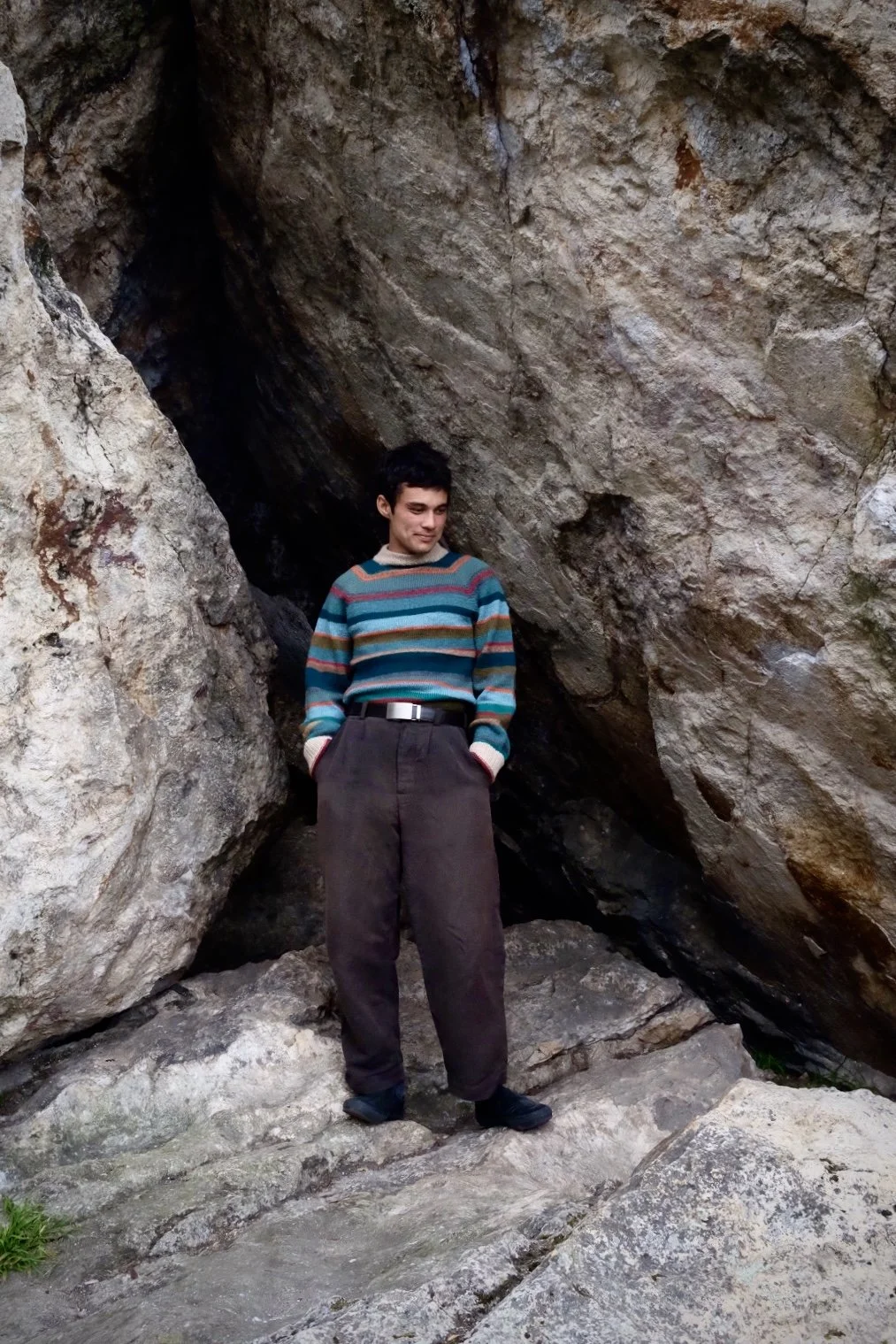
apologies for the poor image quality - I only realized later I had the camera settings wrong :P
In the years – or, oh my goodness me, decades – since I’ve gotten much more into sewing. But knitting was my first foray into garment making, and I return to it each year as the weather turns grey with gloom, then drift away again as the calendar slides towards summer. True, here in Berkeley it is often grey and gloomy regardless of the calendar, but I’ve been at knitting for so long I don’t actually need daylight to do the work anymore. Whereas, for my eyes, sewing requires the sun.
So now in what is – for me – the knitting off-season I thought to do some research. Since so much of my sewing and mending is, if not outright Japanese, unquestionably Japanese influenced, is there anything Japanese about the way that I knit? I doubted it, since while I have learned some new things since Meg’s tutorials, my techniques are still about 90% what she taught me, which seemed more German or Nordic in origin to judge by the designs and designers she favored.
But it still bore some looking into, especially as I do more designing of my own. I felt I ought to find out the history of knitting in Japan. So I went where everyone goes to start, and typed out ‘Japan knitting history’ into a little online box and then hit search. I would never have guessed where this would lead – to sailors, slatterns, and samurai – but first, we must go back further still.
If I had to guess where and when knitting began, I would have thought somewhere in the Middle East or Central Asia – someplace with long history of ready access wool – and probably stretching back millennia into the past, perhaps even to the cave. And while I was close to right about geography – the evidence suggests knitting first developed among nomadic tribes of either the Middle East or North Africa – and mostly correct about the reasons – ready access to wool producing livestock, but also because needles are smaller and more portable than looms – I was way off on the timeline. Because there is no evidence of knitted goods prior to the 11th century CE.
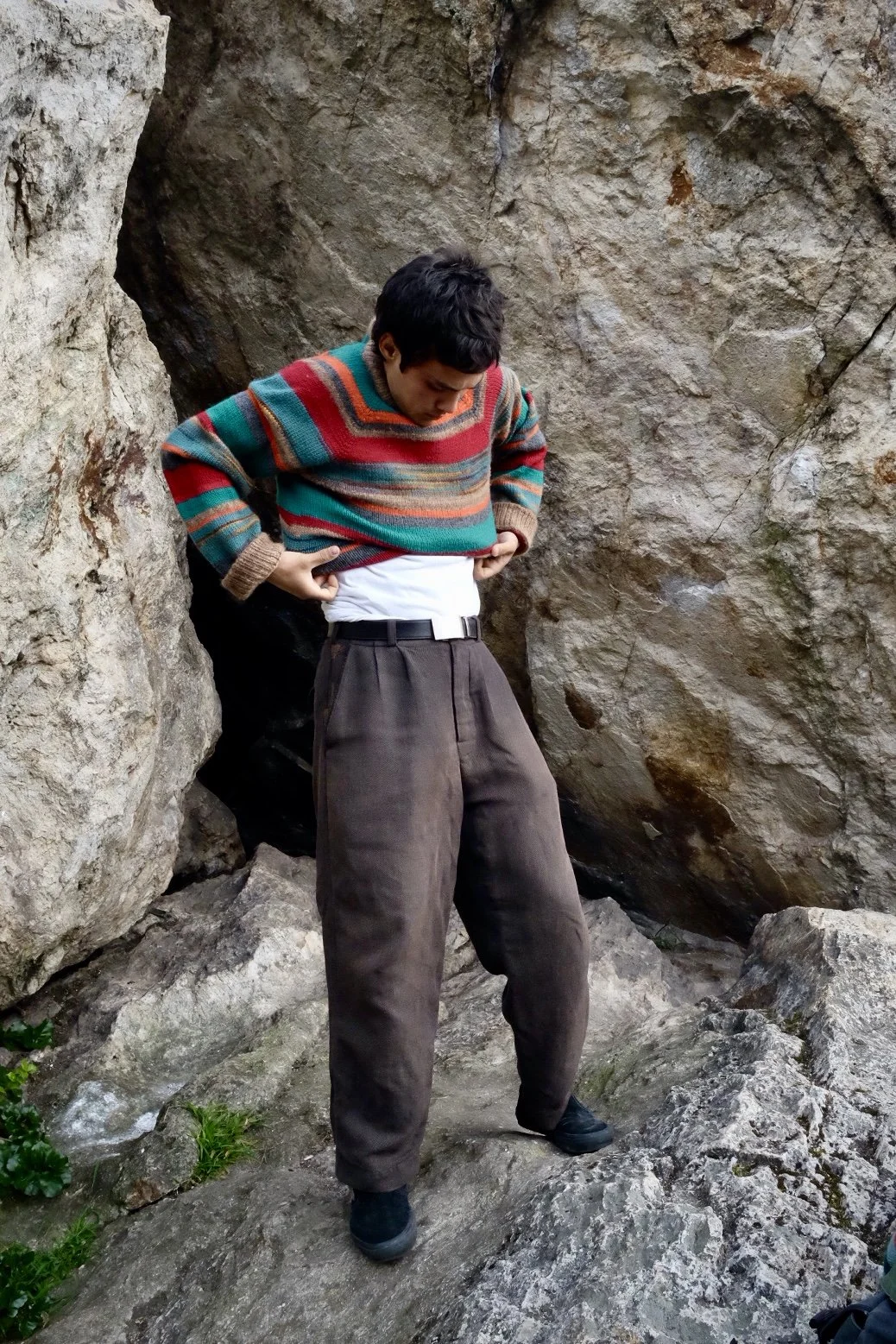
because I source wool secondhand, my sweaters are always striped - too difficult to get enough of one color for a whole garment, and besides it’s more fun :)
There are no Roman records of knitwear. No mummies entombed with knitted caps or socks. Even the Vikings of the famously frigid north would not have knitted because knitting didn’t come to Europe until the 12th century - via Islamic Iberia - and didn’t reach Scandinavia until the end of the 15th century, long after the age of pillage had ended. Terms like ‘Viking knits’ are pure marketing. The best any Viking could have done was nalbinding, a much slower process of garment making using one needle only, rather than two or more as with knitting. (Now nalbinding does go back millennia, and some stitchers do like to point to it and call it knitting on account of certain superficial similarities in the way the finished stitch looks, but that’s about as accurate as calling crochet and knitting one-and-the-same. If you’re reading this and you neither knit nor crochet that probably doesn’t sound like a big deal, but trust me those are fighting words)
Of course it is entirely possible that knitting is far older than the 11th century and we just have yet to find the physical evidence. But there are woven textiles from Turkey that are more than 8,000 years old. There are comparably old weavings from Peru made from plant fiber and alpaca. There are 6,000 year old looms from Egypt. There are mummies with nalbinding (nalbinded? nalbound?) socks. So if knitting were just as old and widespread as weaving or nalbinding or any other means of textile production, there should be similar amounts of evidence. And yet there isn’t. That pair of sticks doesn’t appear within the archaeological records until the heights of the Medieval Islamic empires of the Mediterranean basin, and doesn’t wend its way through Europe until well into the Renaissance.
Which means knitting couldn’t have come to Japan until the Europeans showed up. In this case the Portuguese. And we know that it was the Portuguese who introduced knitting because while the current word 編み物 (amimono) is now used to describe knitting by hand, an older Japanese word for knitting and for knitwear was メリヤス (meriyasu) written in katakana, which indicates a foreign origin, and comes from the Portuguese word for stocking, meias. And there is no record of knitting in Japan prior to the arrival of the Portuguese in 1543.

untucked, the contrasting hem becomes part of the visual appeal, dividing the body at the waist
Let us return for a moment to the present where knitting – while becoming less age and gender bound than it was perhaps a generation ago – is still very much thought of as the work of women and the elderly. But in the 16th century, during the Age of Exploration – or of conquest, depending on which side of the sword (or smallpox) you found yourself – people of all ages and both genders knit. There was no association of knitting being “women’s work” particularly if you were a sailor or a soldier, as both groups were expected to supply their own workwear and to know at least how to fix if not make their kit themselves.
Throughout Europe – and throughout European style warfare once it spread to the Americas – knitting was a great hit with soldiers in the dull hours between battle, socks especially as every grunt was forever in need of warding off trench foot. And even as late as the American Revolution, knitting was a critical means for insurgents to outfit themselves when supplies from the motherland were abruptly cut short. But it was no less popular among seafarers in the age of sail who were likewise often away for ages and in desperate need of dispelling the listlessness and agitation sustained in crossing the doldrums of the horse latitudes. I don’t know if knitting ever prevented mutiny, but I can vouch it certainly makes boredom easier to manage.
Reading this history I was struck to think myself as existing on a continuum, most recent in a line of twitching fingers that after starting somewhere in North Africa or perhaps the Middle East, had come to me, with breathtaking detours around the spinning globe. That I and the crew of King João’s caravels shared a mighty affection for the fiber arts before they came crashing into Japan, bearing pumpkins, sweet potatoes, peanuts, chilis, and other seeds of plunder snatched up from the New World, alongside fire arms and Catholicism – those last two making for an especially volatile combination – and a pair of needles dancing along a length of string. As with nearly every innovation, the global spread of knitting too is bound up in conquest and colonialism.
So…we know who brought knitting to Japan, and when and how it got there. But I was surprised to find out who knitting proved popular with once it arrived. Who truly claimed it as their own.
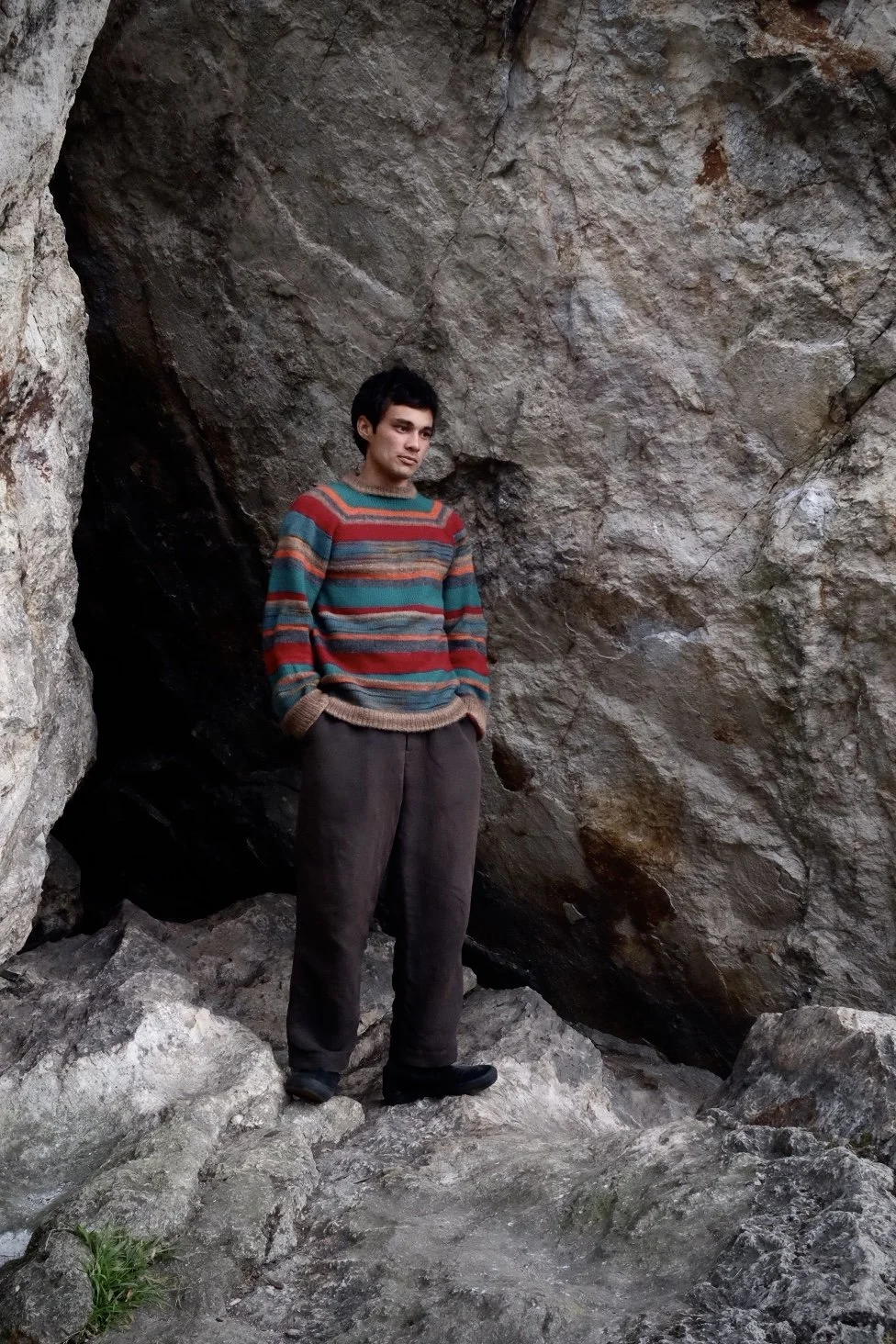
there is no heirarchy to the colors - the approach is to switch whenever it feels right
The Portuguese arrived towards the end of the Sengoku Period (戦国時代 – Sengoku jidai) also called the Warring States period. The centuries of violent civil wars when different factions battled one other for supremacy, culminating in the unification of Japan and declaration of the Shogunate in 1600, which would last until the middle of the 19th century, an era known as the Edo Period. This was a time of remarkable peace, stability, and artistic achievement, when much of what we in the West associate with Japan either began or at last became codified – kabuki, geisha, woodblock prints, the tea ceremony. It was also a time of great repression and indolence – for samurai especially.
Japan – like much of Europe at the same time – had a rigid class system. People lived out the entirety of their lives within the same class to which they were born: peasant, merchant, artisan, samurai, daimyo, shogun, emperor. Penalties were severe for those who tried to rise above their station, while dabbling too much with those below – “slumming it” – was both distasteful and dishonorable.
But the samurai of the Edo Period were centuries too late to the battle. The great wars were finished. No means to prove oneself against the enemy mettle. But they were still socially compelled to maintain their position as guardians of the local lords (daimyo) while simultaneously forbidden to go into business, the arts, or agriculture. At least not in any full time, or independent capacity. What’s a bored swordsman to do?
Just sit around and knit, it seems.
Because while samurai could not venture into fulltime business, they were permitted a side hustle so long as it did not interfere with primary duties, and knitting was perfect for the ease with which it could be transported while on the occasional patrol, or brought out for long bouts of not-too-much, followed by little-to-none, and topped off with nothing-at-all. Popular products included undershirts, gloves, weapons holsters and – as their western soldierly counterparts were just as keen to do – socks, though in the case of samurai they favored the Japanese tabi (足袋) a split toe sock worn with sandals. After the abolition of the feudal clan system and the Meiji Restoration of the mid 19th century, there are even records of newly liberated samurai banding together to open the first knitwear factories in Tokyo.
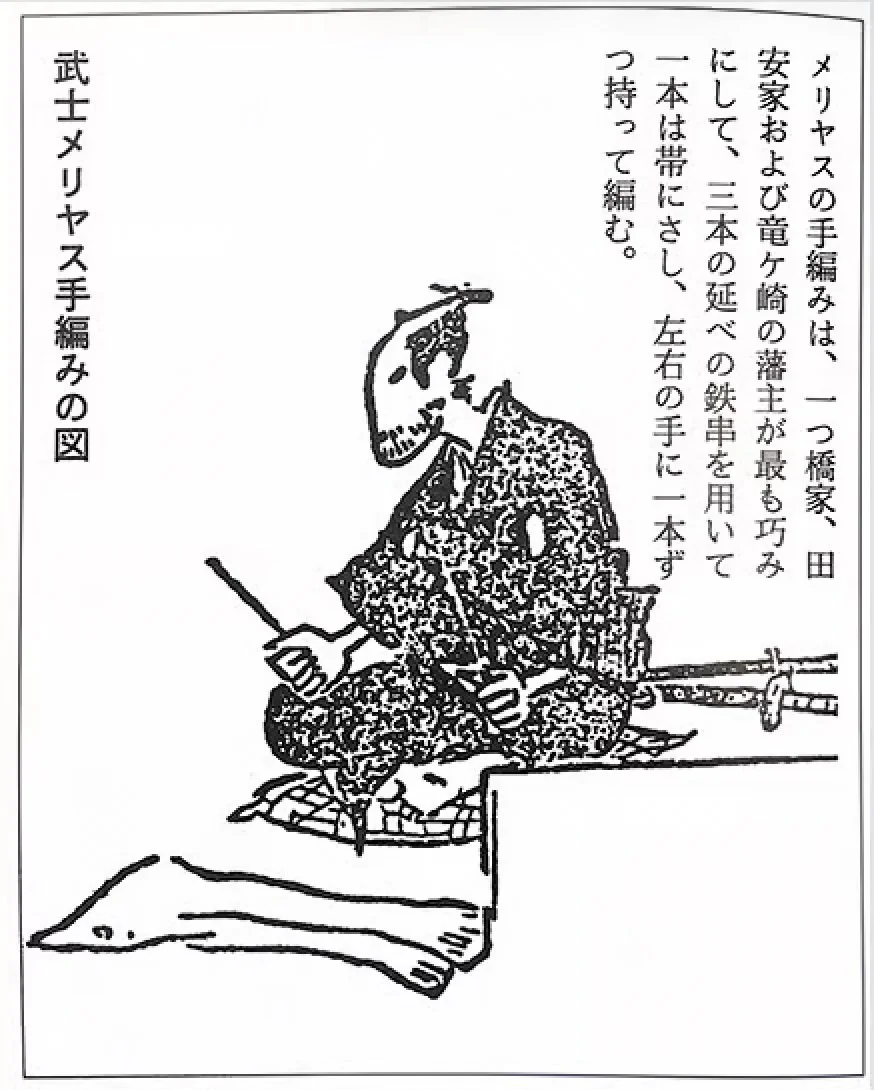
the knitting samurai - source: Japan House London
Again I pause in wonder. Who would have guessed that those who set down the daishō ( 大小), – the paired long and short sword of the samurai class – would pick up the needles instead? To think I too might count myself among the company of these ancient warrior poets, seated at some tea house among cherry trees in fading bloom, admiring a well stated bit of verse or the perfectly turned heel of a tabi as needles click against each other and petals drift in the breeze of a ripening spring.
But for all its charm, a link is missing in the narrative. We know who brought knitting to Japan (Portuguese sailors) and we know who adopted it with great enthusiasm (samurai). What I have yet to discover is how the knowledge transferred from the one group to the other. The Portuguese were restricted to the port of Nagasaki, in the far south of Japan. And while they most certainly would have had dealings with artisans and merchants – artistic wares being the primary European interest in Japan – the rigidity of the Japanese class system would have prohibited foreign traders from establishing contact with any of the other Japanese castes.
However there was one group of people that indolent samurai as well as foreign sailors excited by the novelty of exotic lands would both have interacted with, particularly in a port like Nagasaki: prostitutes.
Not geisha. Not courtesans. Not concubines. Just dockside strumpets hawking some good old-fashioned harlotry. Like sailors, they too would have had a fair amount of downtime, like samurai they were also prisoners of their own class, forbidden to rise, or even seek their own path forward, in need of some other occupation to fill the tedious hours between clientel.
This is, unfortunately, mere theory. There is – as yet – no proof of which I am aware for who spread the stitch from sailor to samurai. (If you, dear reader are aware of historical record to bridge the sailor-samurai knitting gap please do forward it along!) It is possible a Portuguese sailor taught a Nagasaki artisan, who in turn showed it to an idle-handed samurai. Or that a Catholic missionary instructed a convert, who then spread it to those beyond the faith. But I like this theory, as it involves the fewest steps and the largest conduit between disparate groups, and seems the more believable, a sailor sharing a treasured practical skill from home with an amorous associate of a few coins and hours, who then becomes a teacher herself to the next companion. To think here too I can find fellowship in the toiling, twiddling fingers of whores. And, like the Catholic theory, it still involves transmission via missionary.
There is now a rich tradition of knitting within Japan. As with so many other foreign introductions, the Japanese have taken the craft and elevated it, making it both more intricate and more elegant. The Japanese Knitting Stitch Bible is a famous example of the reference points of contemporary Japanese knitwear designers, and also one of the few available in English. But I don’t refer to it. Not out of principle, I just don’t have a copy, and I enjoy the simplicity of the stitches I know. So…no, to answer the question by which this began, there’s nothing particularly Japanese about my knitting. But there may be something about the way that I knit. And I enjoy thinking of us all – sailors, samurai, and slatterns – sitting and knitting together, sharing in the camaraderie of those who have known the stitch.
And Meg, if you’re reading this, you’re welcome to join.
~C
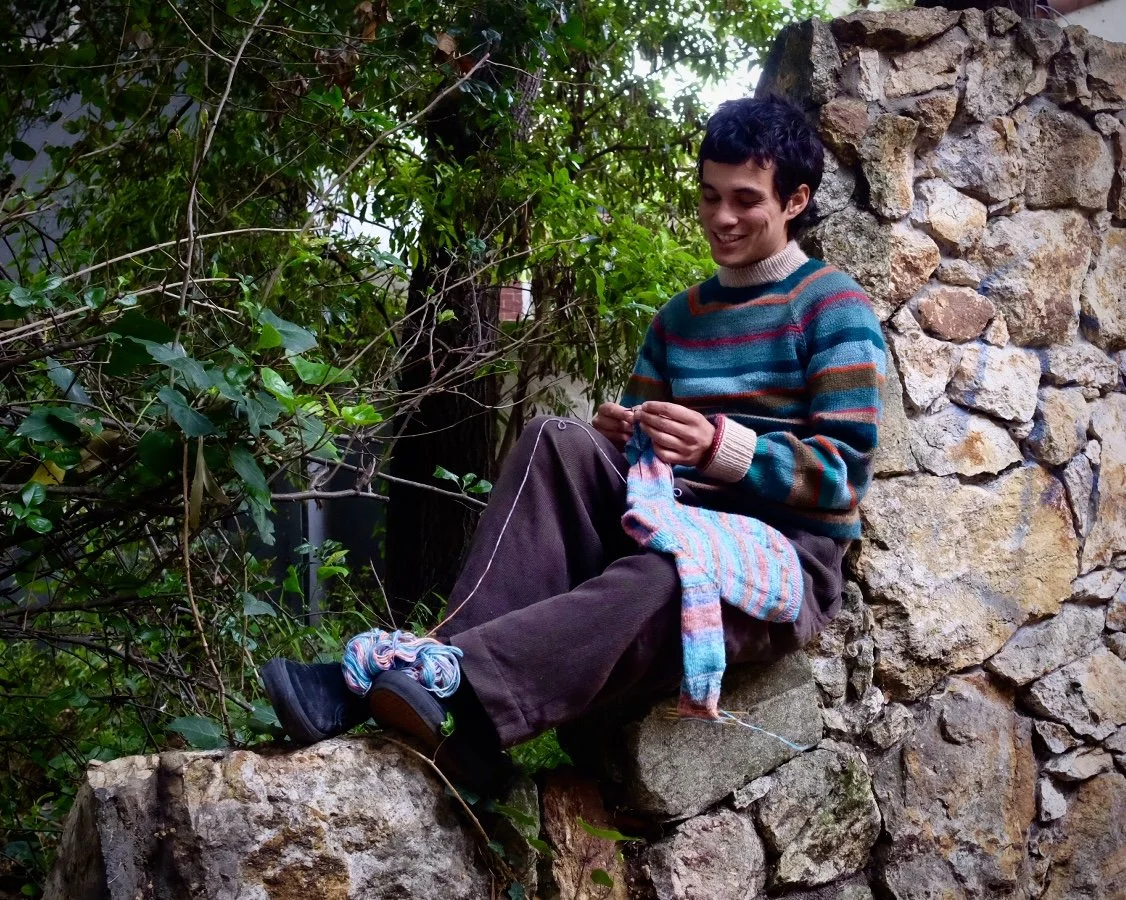
…my friend is far too decent for indulging my whimsy…
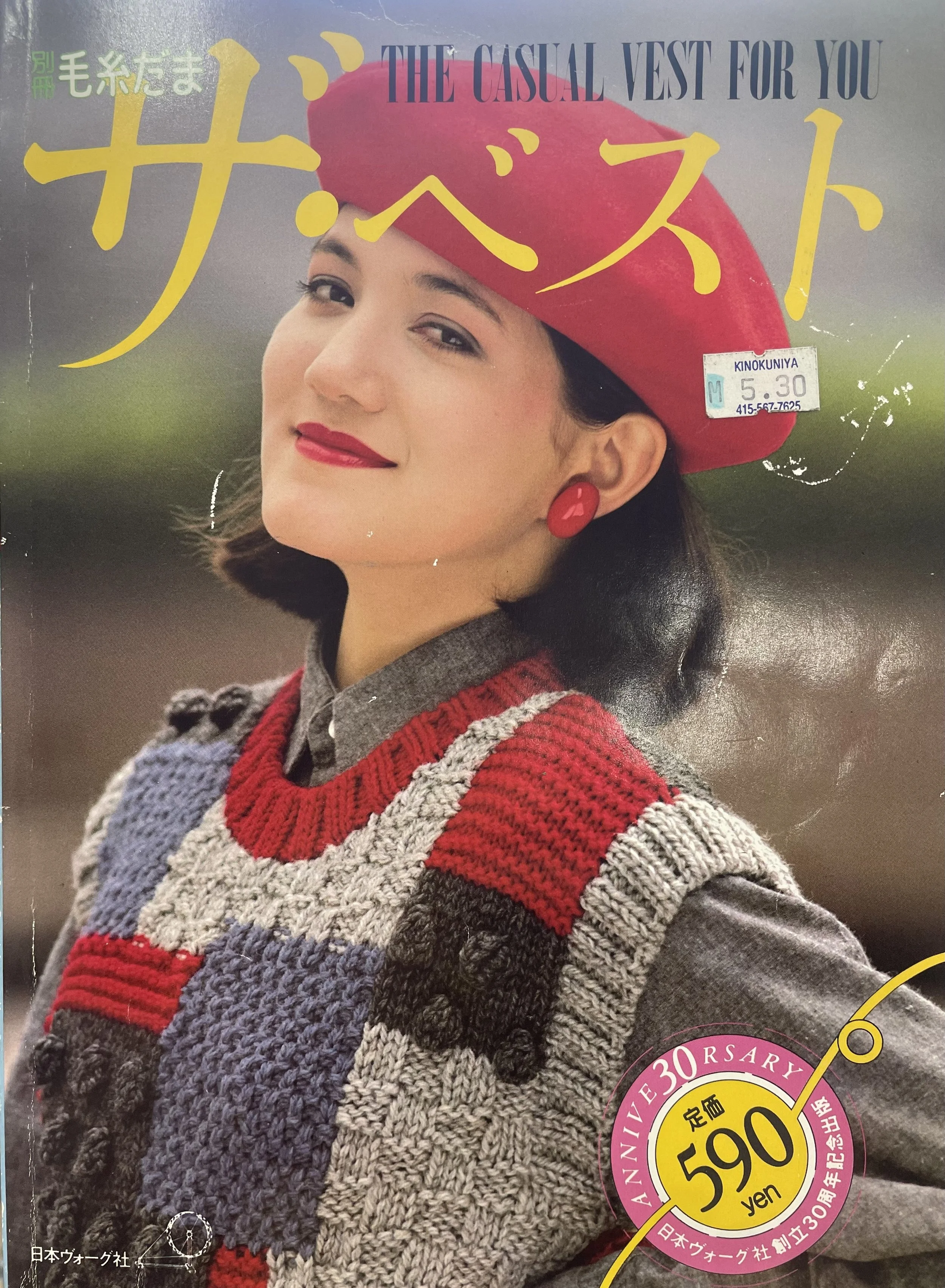
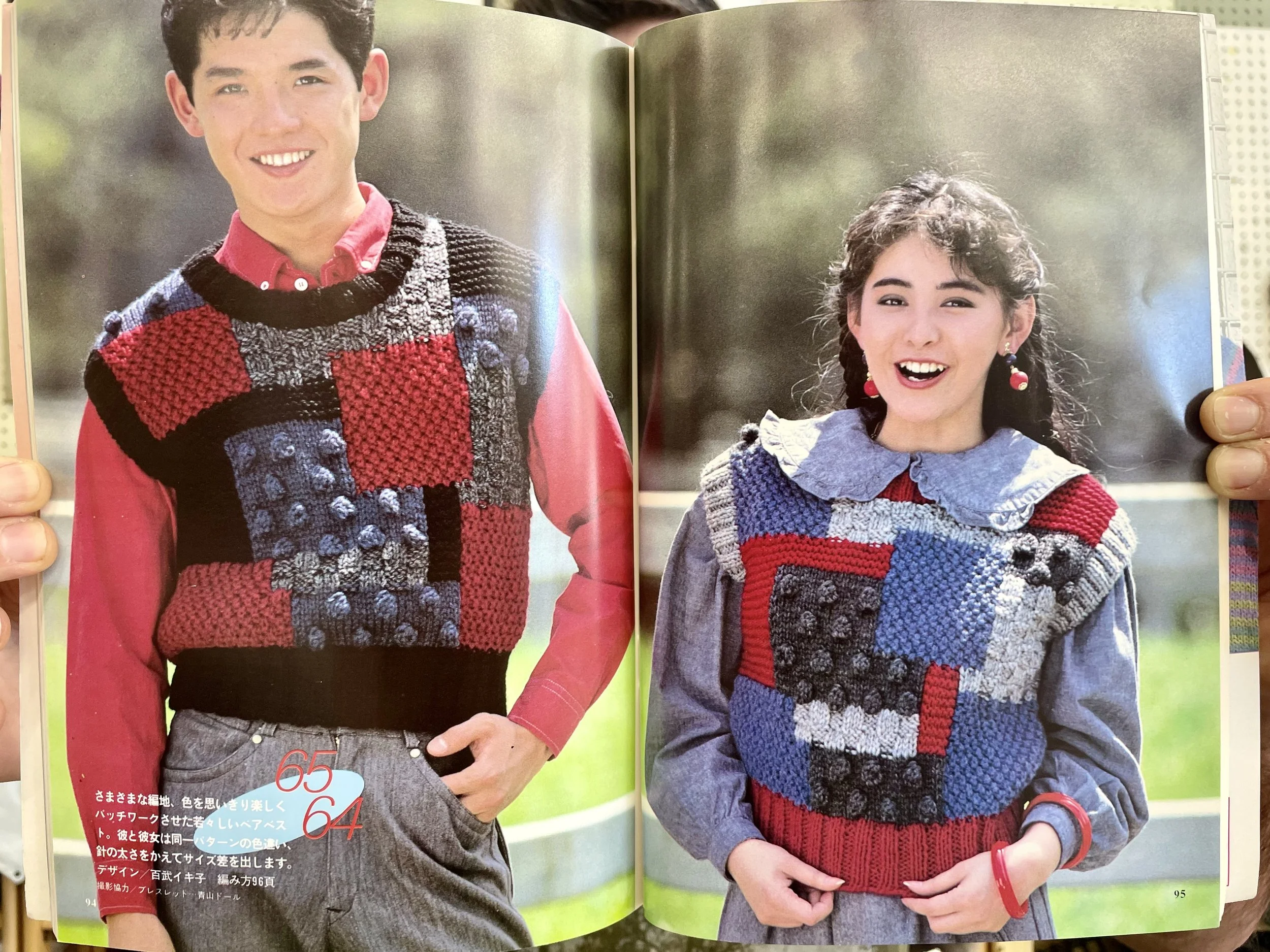
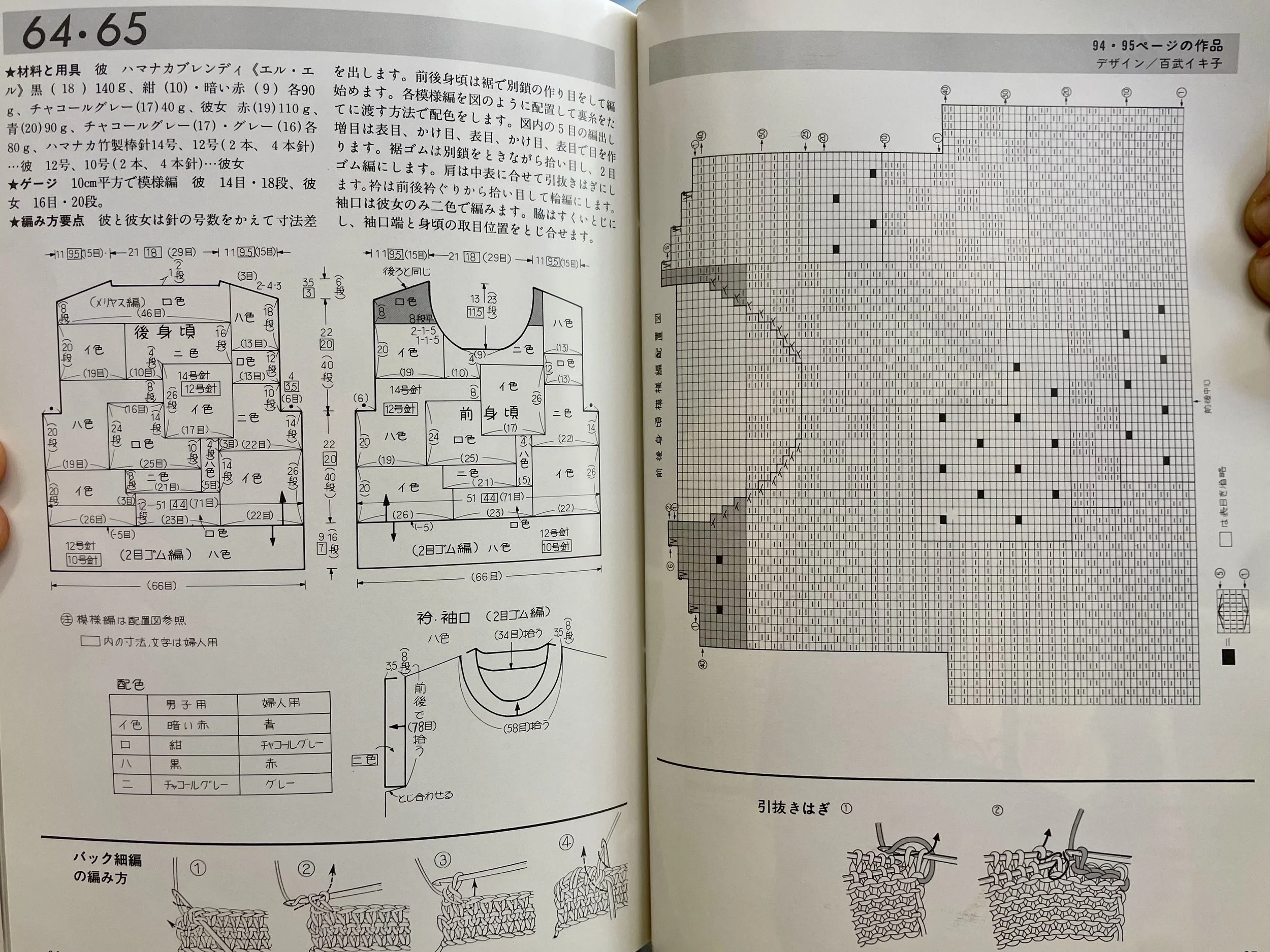
some more contemporary Japanese knitwear patterns found at the local thrift store just after publishing - you can see how much more intricate it is than my own knitting - even if my reading were better there is still no way I’m following all that…