Both Teacher & Student
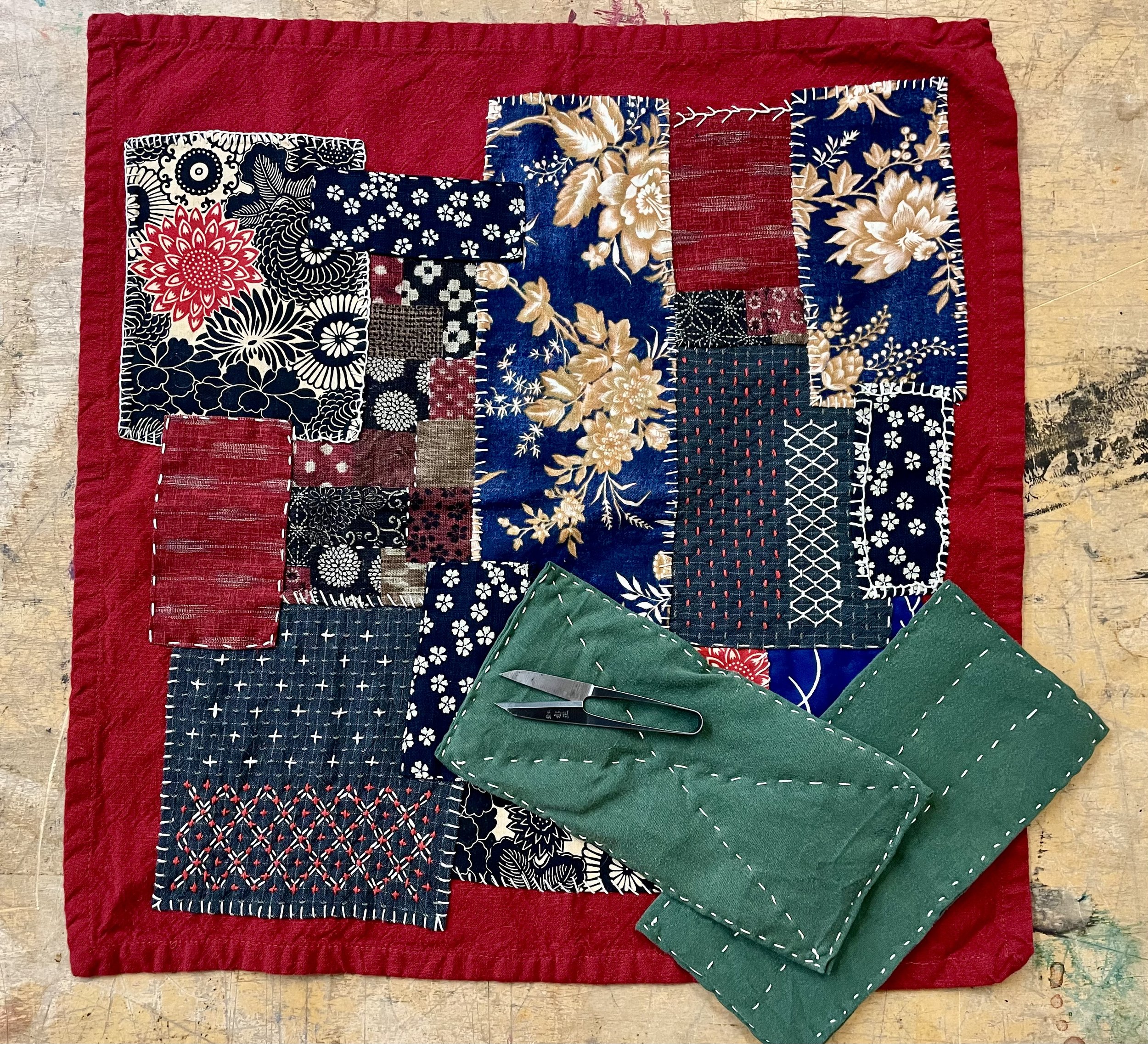
just a bit of boro, old patches stitched to a cloth napkin - and also some zokin (lower right) cleaning rags stitched from an old tee shirt
My favorite version of the myth of Sisyphus comes from Kyoto. Specifically from the writer Pico Iyer as recounted in his 1991 book “The Lady and the Monk” a collection of essays about his life as a newly arrived foreigner in Japan and then later as an academic at a university, where Iyer had taken a position teaching the western literary canon.
Iyer came to an unexpected insight about Japanese cultural values upon introducing his students to the myth of this particular Greek, king of Ephyra and grandfather of Odysseus, who for the crime having twice cheated death – in addition to some rather unsavory chicanery with his niece and gossip mongering among the immortals – is condemned for all eternity to push a rock up a hill only to have it roll back down. The mechanics were easy enough to grasp - man rolls rock, rock rolls away, man rolls rock again. Lather, rinse, repeat forever. These elements presented the students with no trouble. What they could not understand is how this constituted punishment. Because where the westerner saw tedium and futility, the Japanese saw fulfillment. Every time the stone rolls back down, old Sisyphus has his purpose roused anew. The stone must again be rolled.
Now suppose one of these times – the final time it would have to be – Sisyphus summits his hill and the stone remains fast. No more rolling. No more climbing. The task at last complete. Then what? Perhaps a single moment of exhausted, giddy glee, swiftly followed by nothing at all to fill the dreary days that stretch before him until the stars darken, the final fires go out, and the last coals of Tartary cool to ash and still time goes on. True punishment is indolence, having nowhere to be, and nothing to do, forever.
In comparison Camus’ admonition to ‘imagine Sisyphus happy’ would have been – to Iyer’s students – a rather easy grok. Though from my own experience I would not classify the Japanese as a terribly sunny lot, the French concept of raison d’être is not so far from that of ikigai (生き甲斐) which shares the same literal translation: “reason for being.” But whereas the French like to generously admix their raison d’être with savoir faire and joie de vivre, happiness is rather beside the point in its Japanese counterpart. It is far more important to begin with a role – any role – and then find fulfillment from within it than go irresponsibly chasing after fantasy.
Student and teacher exchanged roles as the class explained the myth to Iyer, and one can rather imagine each side grappling afresh with this challenge to perspective as with their own metaphorical boulder. To the students, Sisyphus was not a pitiable character but one to be admired. He does not surrender when the stone rolls away. We don’t know what would have happened had he just refused the task, because he never does. To both over-generalize and discount many talented exceptions on both sides of this particular cultural divide, where the westerner values the completed task, the Japanese values the doing. Craft is approached as a path - rather than product - in which there are no shortcuts and every step is both beginning and end.
I love this story for the mutual learning and its complete inversion of a well-known myth. It’s clear in his own telling that Iyer reflects on this lesson from his early days as a teacher with both reverence and humility. But I do also have to remind myself to treat Iyer with skepticism as he admitted even so late as 2019 – after more than thirty years living in Japan – that he still could not – by choice! - speak more than a few words of Japanese, so as “to preserve a sense of open space in life, something to offset the sense of the familiar.” You would think someone who has lived so long within a society that prioritizes social concord would have learned by then the imposition and inconvenience of deliberate ignorance. If he still cannot translate something as academically unchallenging as a children’s book, how well could he adequately translate a culture at the university level? But…I also don’t want to discount the translation of one’s own experience. (As, afterall, that is precisely what I am doing right now.) And even if none of the above is accurately “Japanese”, there is always a value in questioning one’s cherished assumptions, about burnished myths, or about oneself.
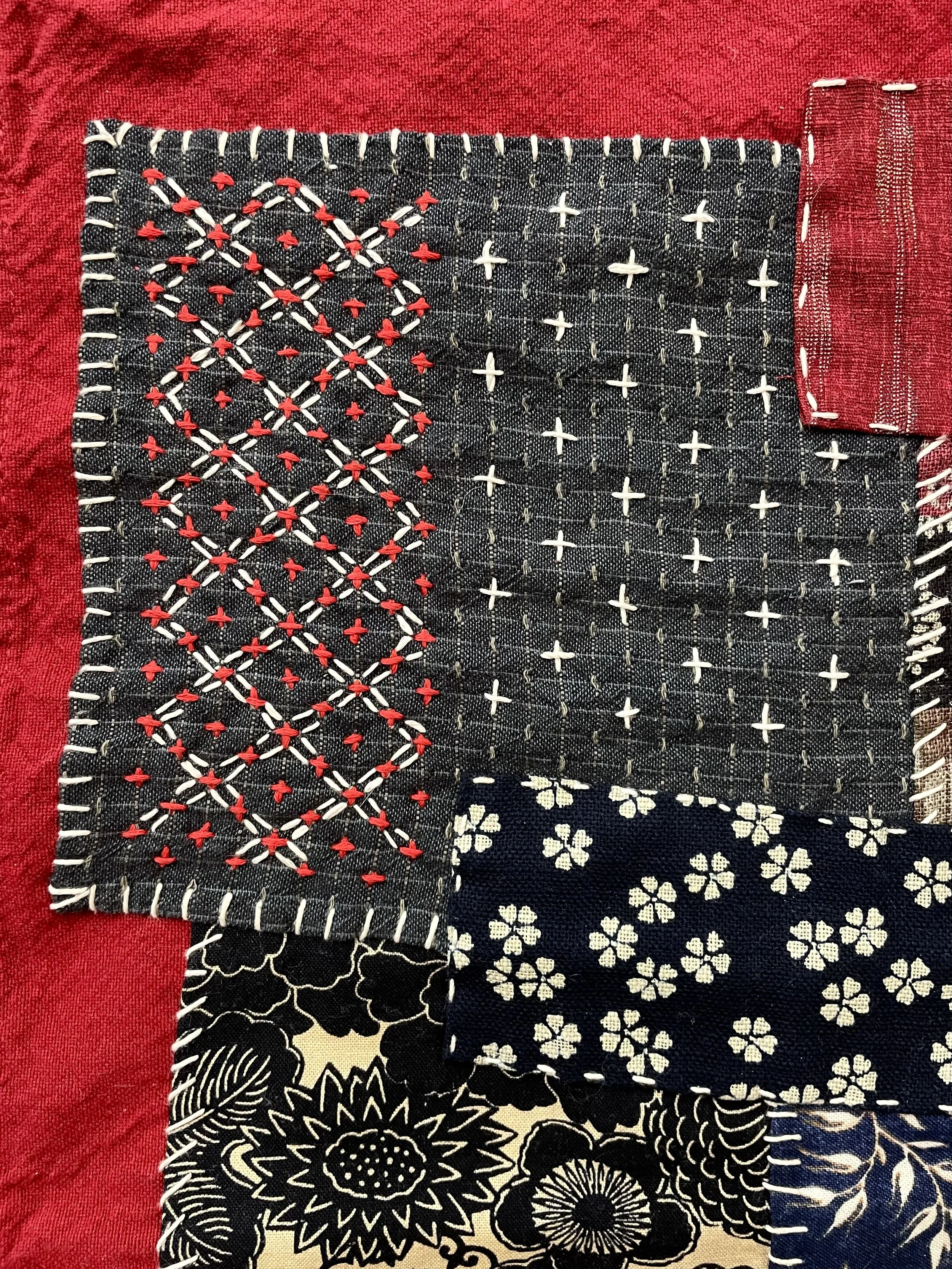
practicing sashiko stitches on boro
I return to Iyer’s Sisyphus in Kyoto again and again not only because of how it subverts a familiar, received understanding, but also of how neatly it dovetails with the concept of kaizen - 改善- a philosophy of continuous improvement via the discipline of repetition, attention, and inquiry - though I don’t believe Iyer ever explicitly used the word. No matter how many times one has done a task, it can always be done a bit better. With greater focus, greater flourish, greater understanding. And with all eternity to practice, Sisyphus will be the best goddamn rock pusher that ever there was or could be.
I have wondered if kaizen has been more in vogue of late among westerners – and particularly among the American business journals – for two reasons. The first, the frequency with which I am sent articles subtitled something along the lines of “the one life changing Japanese secret to improve at everything” packaged as though it were a diet prescription. (I mean, I don’t think they’re wrong, I do think kaizen is useful to pretty much every discipline, I just don’t like being hawked pharmaceuticals) The second because kaizen already meshes with the long held western notion – and again, American especially – of a potentially perfectible self. “The Autobiography of Benjamin Franklin” would be a classic example, with the statesman’s meticulous records of spendings, savings, and boyhood calisthenics. Malcolm X’s account of handwriting the dictionary from prison would be another articulation. We already had the idea, though perhaps not its distillation.
But I notice that whenever I have encountered a western account of kaizen it is almost always approached from a competitive viewpoint, typically for business, occasionally for professional athletics, rarely - though memorably - from philosophy - I suspect both Franklin and X stumbled upon their own versions of kaizen because of how it could mold a more formidable mind - and almost never from craft, which is where I first heard it described.
There is a rich and thoroughly living artisan tradition in Japan, and one is expected, even as an apprentice, to be both teacher and student to oneself. I have heard it recounted, though unfortunately cannot locate the source, that a Japanese master will sort an apprentice’s works into the passable and the just plain bad, but will not explain what qualities divide the one from the other. It is on the apprentice to deduce the secret, to be mindful of the material and the method and do better every time. Because it is not the final object - a teapot, say, or a kitchen knife, or a bolt of cloth - but the craft that is being served. To use a commonly cited example from zen, it is not the washed dish but the act of washing the dish. Not, how can I get a cleaner dish? Or clean more dishes? And faster? But how is it that I clean? The distinction is subtle but important. The inquiry is on the process. To consider only the result is to almost inevitably resent the process by which one arrives. (As a side note, I would not be surprised of a rather high attrition rate among Japanese apprentices as mastery sounds quite demanding)
I admit I am reluctant to use even so good a word as mindfulness in these musings because of its cooption by commerce, as so many philosophies are when in migration from east to west. I can easily imagine such jaunty titles as “How to meditate greater shareholder value” or “Bushido for the bull market.” Even a promisingly titled article like “How a Small Shop in Kyoto Connects Mindfulness with Meditation” focuses on product design as a means to out-manoeuvre competitors and concludes with advice on client emails, as though these were the greatest possible insights one could gain from observing a master at his craft. (It bears mentioning though that the east-west flow of craftsman discipline-cum-corporate advantage works in reverse as well - as the more traditional Japanese word for a deep & active focus on the present - 没入 - botsunyū - is today supplanted by マインドフルネス - maindo-furu-nesu - in every day Japan, largely due to the influence of western style self-help)
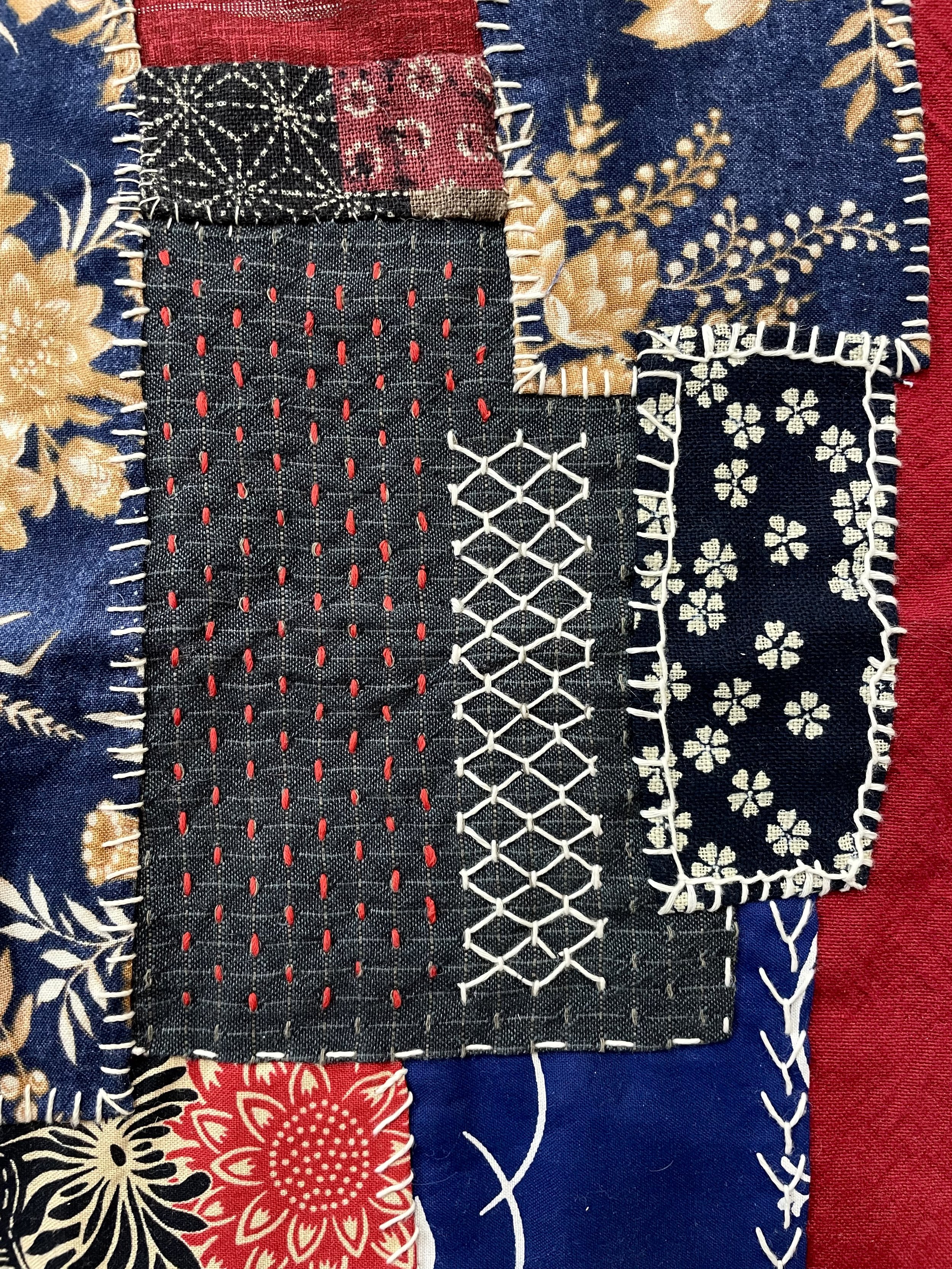
But kaizen was again on my mind because of a rather grand project on which I have been procrastinating – the creation of a boro quilt. Boro - ボロ- literally ‘worn out’ or ‘rags’ is a form of both textile repair and of textile creation. At base it is patchwork. A patched piece of cloth is boro, but so too is cloth made of nothing but patches. There is no one approach anymore than there is a single definitive recipe for Southern barbecue, or Indian curry, or of Spanish paella. It is more of a philosophy of stitching, of determining what is worthy of the honor of repair, and then…well, honoring it. Besides, I had several unopened packs of scrap fabrics from my first visit to Japan - already some years ago - and which were in danger of becoming someone’s inheritance some forty years hence if I didn’t finally shake a leg and free them from their plastic.
First though, I needed to remind myself of the basics and pieced together a sampler, layering some odd bits of fabric fished out of the stash of scrap and pieced whichever way felt most satisfying, then going at them with some stitches I already knew – and some that I didn’t – and trying to improve a little every time. Being mindful of the needle - oh that word - and of the thread and of my own body as I drew at each stitch. Not the stitch but the act of stitching. To find fulfillment within the method and then upon finishing, how to bring this approach to the greater project. The rock goes up, the rock goes down, and Sisyphus gets to push the stone again, each time a little better than the last…
~C