Hustle & Dawdle
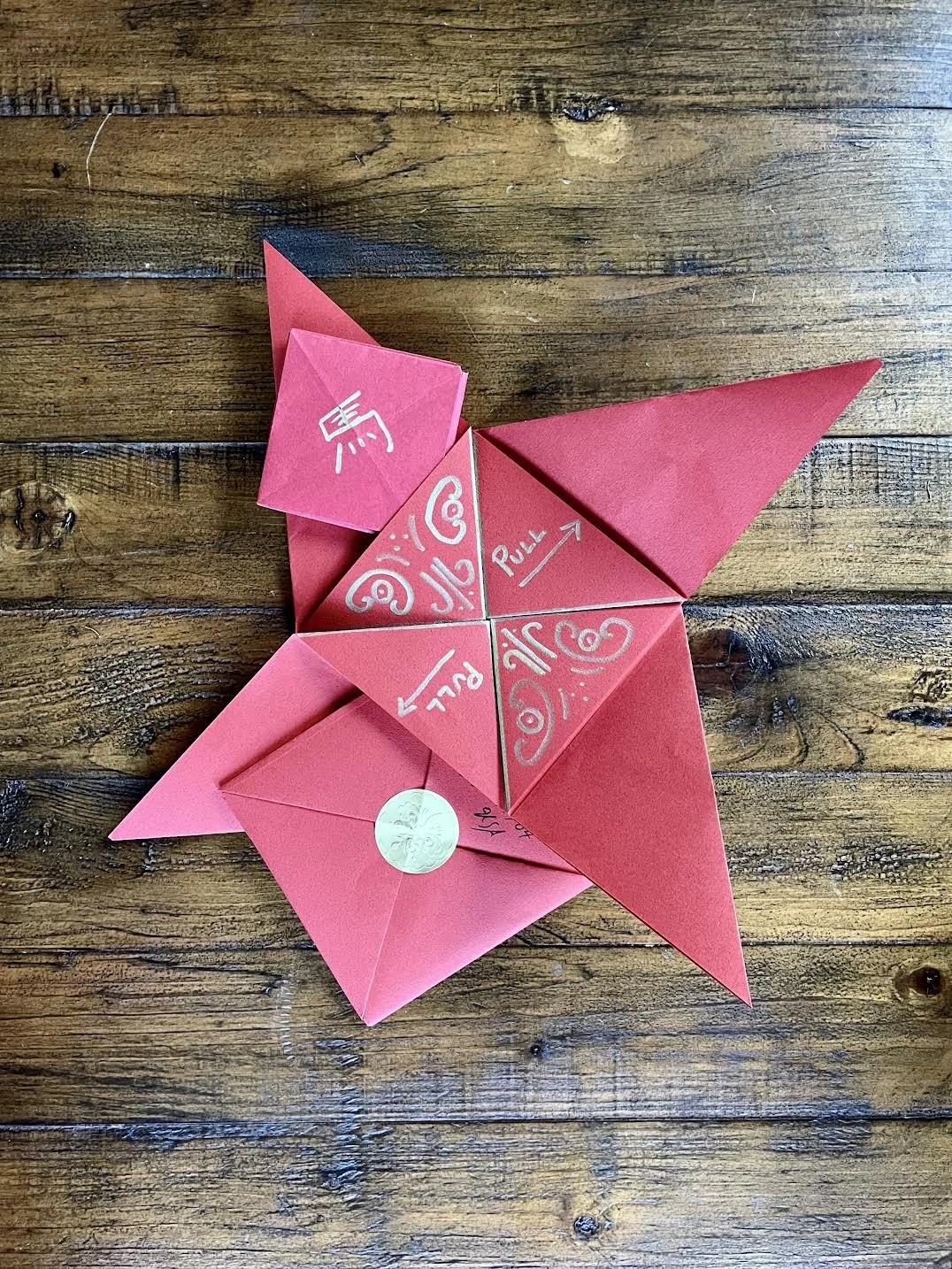
a Victorian style puzzle purse, modified for lucky envelopes for Lunar New Year
A friend recently asked what makes for a Romantic city. I think she meant amorous, so lower case, couples pairing off hand in hand as they stroll along a boulevard. But I chose to engage with the word as a capital R, so a city that inspires strong emotion and idealism.
I hate gabbing about the weather but I love this kind of small talk.
My very first thought was for a city to inspire strong positive feelings it must encourage dawdling. It should be easy to wander at a walk while absorbing the environment and equally easy to stop at one’s own pleasure to appreciate what catches the eye. Exploration should feel organic. There should be interest that draws the person forward of their own accord, rather than an invisible – or occasionally obvious – force that compels them onward because it will punish standing still.
There should be points of interest at every block – intriguing architecture, engaging shops, greenery, places for spontaneous relaxation. A good indicator of this is two able bodied people having an active conversation while sitting on something not obviously a bench. A great indicator is a small group of elderly people seated together to play a game.
An absence of either does not mean an inherently undawdleable city – maybe the weather was uncooperative that day – but it could mean a lack of suitable habitat. Cities that are constructed with the aim to hustle people as fast as possible between pre-determined destinations aren’t Romantic because they deny spontaneity. They feel like entering a conveyor belt, or the ramps that loop an airport, with everything oriented towards arrival and departure and little to nothing on the journey itself. I’ve visited a few of these kinds of cities. I find them alienating and alarming, though I won’t name names, since I know some of my least favorite are also someone else’s most beloved.
There should be plenty of non-prescriptive green space for people to do their own unstructured entertainment: reading, gossiping, or just sitting and thinking. (I realize that not every city can have plenty of public greenspace on account of climate, but I would bet older desert cities have figured some ingenious work arounds) So there should be street trees, parks, plazas. They don’t have to be large. A bench under a big tree is good enough. But a person should be able to stop to enjoy them however they want to in that moment. And so a planted median between opposing traffic lanes does not count as greenspace, no matter how lovely the wildflowers. Ditto a soccer field is also excluded by virtue of being highly-prescriptive and single use. Try having a picnic on one and you’ll incur the wrath of every Bundesliga wannabe.
Next, things should feel both handmade and locally specific. Do the signs at the shops and restaurants look hand painted? Is the writing in the local language? (Go to a grocery store or produce market and see if the prices are scribbled on cardboard) Does the architecture have a certain flourish not found elsewhere? Though I should also say that handmade does not have to mean one hundred percent natural. Neon signs for local businesses are wonderfully Romantic, especially when they’re for long family names or institutions that go back generations.
You should have the feeling, once you start to pay attention, that someone had pride in the creation and was really thinking of experience when they put all this together. They were not just trying to fulfill the minimum. You’ll know you’re in an ‘at the minimum’ kind of neighborhood when the apartments are so generic they could be anywhere in the world, and all the advertising is jet printed plastic and vinyl banners, no matter what the mix of businesses.
Lastly, there should be a certain collision of times observable at street level. There can be new features – the presence of a single Starbucks is hardly a death knell – but there should also be holdovers from previous eras which suggests a somewhat relaxed and diverse gathering of age and economics, and one which is hopefully reflected in the makeup of the residents. A stalwart, century old bank next to a climbing gym, for example. Across the street from a former private school, now an embassy, itself next to a mechanic.
Cities are forever re-inventing themselves, and there should be some sense of re-purpose with time. A city or neighborhood that is entirely new feels like a nation in contempt of the past. While one that is nothing but heritage features feels like a re-enactment or a gated community, stifled and devoid of creativity. I tend to feel unbalanced and out of place in either, though I am a bit more forgiving of the first, as every old thing was once new, but feel almost nauseous in the second, despite my love of the antique. The first is too free-wheeling, and frankly capitalist for me. Not only a case of anything goes, but everything went. While the second feels too aristocratically conservative as to bar all participation. I can’t touch anything until I’ve purchased a membership.
Romance requires nostalgia, but love requires freshness. Alertness, or at least attention, but also relaxation. There is, one hopes, a path for you own participation in this grand show beyond merely as observer. Have you ever kissed someone who was still on their guard? It may have been memorable, but I doubt for the reason by which kisses are meant to be remembered.
Anyway, I’m an urban dweller but not an urban planner. I haven’t done the research to formulate this list of requirements. I arrived at them by contrary, thinking of all those places where I have felt the most ill at ease and most desperate to get out of. So one could arrive at my own personal most unromantic city – otherwise said the most repellent – by inverting all of the above. Rather than a locally specific, handmade sort of place where one can freely dawdle, beautiful both when in motion and at rest, imagine a place that is highly nonspecific, frenetic, mass produced, and not terribly easy on the eye no matter what the pace or angle. A city reduced to the barest function. In, out, here, there, left, right, up, down. Block architecture. Mass retailers. Vinyl banners. Intestines unconcerned with the nourishment of the body’s fellow organs, but only with the intake of forage and the production of shit.
Counterpoint: So?
Why so preoccupied with greenery? Should it matter if cities are more utilitarian than utopian? Isn’t that preferable to desperation and squalor?
First off, it’s a false dichotomy to present it as a choice between freeways or slums. (besides which America has proven time and again that it is more than capable of both) But also for a nation as wealthy as the United States, if anyone could afford to make their cities not merely habitable but aesthetically humanist, we could do it. So I think yes, I think greenery, considerate architecture, and handmade goods matter. Especially because I don’t think craft is just about cities.
Maybe I’m being too grandiose here, but I think the unquestioned valorization of American-style capitalism (as cheap and fast as possible, maximum extraction for minimum investment) has led to a severe and wholesale cultural impoverishment.
In a country as notoriously braggadocious as the U.S. it’s ironic that the current spirit is so aggressively minimalist. I don’t mean minimalist in the positive sense of fewer, better possessions or in favoring efficiency over excess, but I mean it in the barest of effort, the barest of expenditure, and so the barest of pleasure. There has been a real watering down of the American aesthetic over the past century, and probably even longer, with an ever-spiraling reduction towards zero. Not just in city planning. It’s likewise observable in clothing, in food, in education, in governance, and in inter-personal relationships. Nearly all of it is less durable, more brittle, of poorer overall quality relative to the past. In a word, disposable. And plenty of Americans are waking up to a feeling a loss.
I know I’m not the first to say any of this. Railing against mammon, sloth, and the general decline of Man has been a standing tradition of the American pulpit as far back as the founding, and probably even further. But I don’t think the average American is terribly intentional in any of their habits. Mostly because they just haven’t thought about it. We’re not dumb, just uncritical. We’re passively capitalist, accepting it as given fact. Just ‘the way of the world’ that having cut so many corners – or more accurately, having those corners cut for us - the resulting circle has spun away.
We’ve accepted this economic worldview with such absolutism that whenever a more craft-oriented economy has successfully established itself in our country – local production, artisanal goods, small scale – it has only ever thrived as a plaything of the rich. (The Hamptons. Martha’s Vineyard. Marin County, California to name a few examples) I do think that artisans should be financially rewarded for their study and skills, but I also don’t want well-made clothing and housewares, nutritious foods and human-sized neighborhoods to be purely be the province of millionaires.
But anyway, to return to the starting point of romantic versus unromantic cities, which brought us through aesthetics, and then to economics, let us now come to this question: How if at all can this be corrected? And does it need to be? Let’s set aside the question of ‘can unromantic cities be made romantic?’ We’ll leave that one for the urban planners, and you’ve already read my thoughts on this besides. (I suspect the secret is in the economics) Let’s instead engage with this question: how can we better recognize and appreciate craft?
In this regard I believe there is a practical exercise accessible to most anyone and it is this: letter writing. I mean actual paper and pen. One page minimum. Because it will force the writer to create a physical, personally specific object in the course of which – hopefully – they will also think about the process of creation. Not just writing the individual letters, but why do they write each letter in just that way? Do they favor cursive? Or print? What kind of pen? Are their l’s and h’s the same height? Do they like to draw pictures in the margins? How does the paper feel beneath the pen? Would a different type of paper change the experience? And while for a certain brand of writer I could imagine the response, ‘screw it! My hand is cramping and I detest the scent of ball point pens. I’ll just text them.’ How do they imagine the receiver will feel to know they took this time to think of them? What do they want that person to feel? Do they imagine a few thumbed keys on a phone screen will convey the same amount of sentiment or stimulation as paper?
Let’s not be precious to the point of absurdity. Obviously, if it’s urgent, use a telephone. I’m not going to write out ‘call a doctor’ in calligraphic ink and affix it to the ankle of a carrier pigeon. (Dichotomy is another American tendency: it is this or it is that, you’re all in or you’re all out, go big or go home) But I suggest a letter precisely because it is so at odds with present American values. It is not fast. It is not efficient. It will generate neither sales nor customers. (Think of all that paper that still ends up in your mailbox every week and just how little of it has absolutely nothing to do with soliciting cash) It isn’t even what the postal service is accustomed to sending any more. A letter is the smallest and slyest of rebellions. A rage against the machine.
This past December I decided to make hand embroidered holiday cards for friends and family. Each card took about thirty to thirty-five minutes to make. When, after the first few, I realized it would take more than seven hours total to finish the stack, I decided to reduce the flourishes and make a card as quickly as I could with the lowest acceptable number of features. It could be done in fifteen minutes, I discovered, and I felt absolutely sickened. Because to finish as fast as possible I had dispensed with artistry, intention, and creativity – all the elements which brought fulfillment to the process – and made of myself a card factory. I had chosen to give someone my minimum instead of my best, and the making and presenting of a gift as just another chore to be done. I wasn’t even thinking of the recipient while I did it, only of getting to the end.
Comparing the hasty card next to one of the more intentional ones, it wasn’t even close. The faster card was of absurdly poorer quality. But I would still count it time well spent as I learned something in fifteen minutes what might have otherwise taken years:
Artisan. Not factory worker (or office drone) The hand, not the hammer (or the mouse)
So I’ve decided to extend the holiday season and mail friends and family lucky red envelopes for Chinese New Years. Because I want a life that feels more handmade. Slower. More intentional. One that proceeds at much the same pace as those capital-R Romantic cities that I think about, and where I hope to one day live (and hopefully without having to resort to an airplane to do it).
I don’t have much hustle, and I don’t think I want it. Give me dawdle any day.
~C
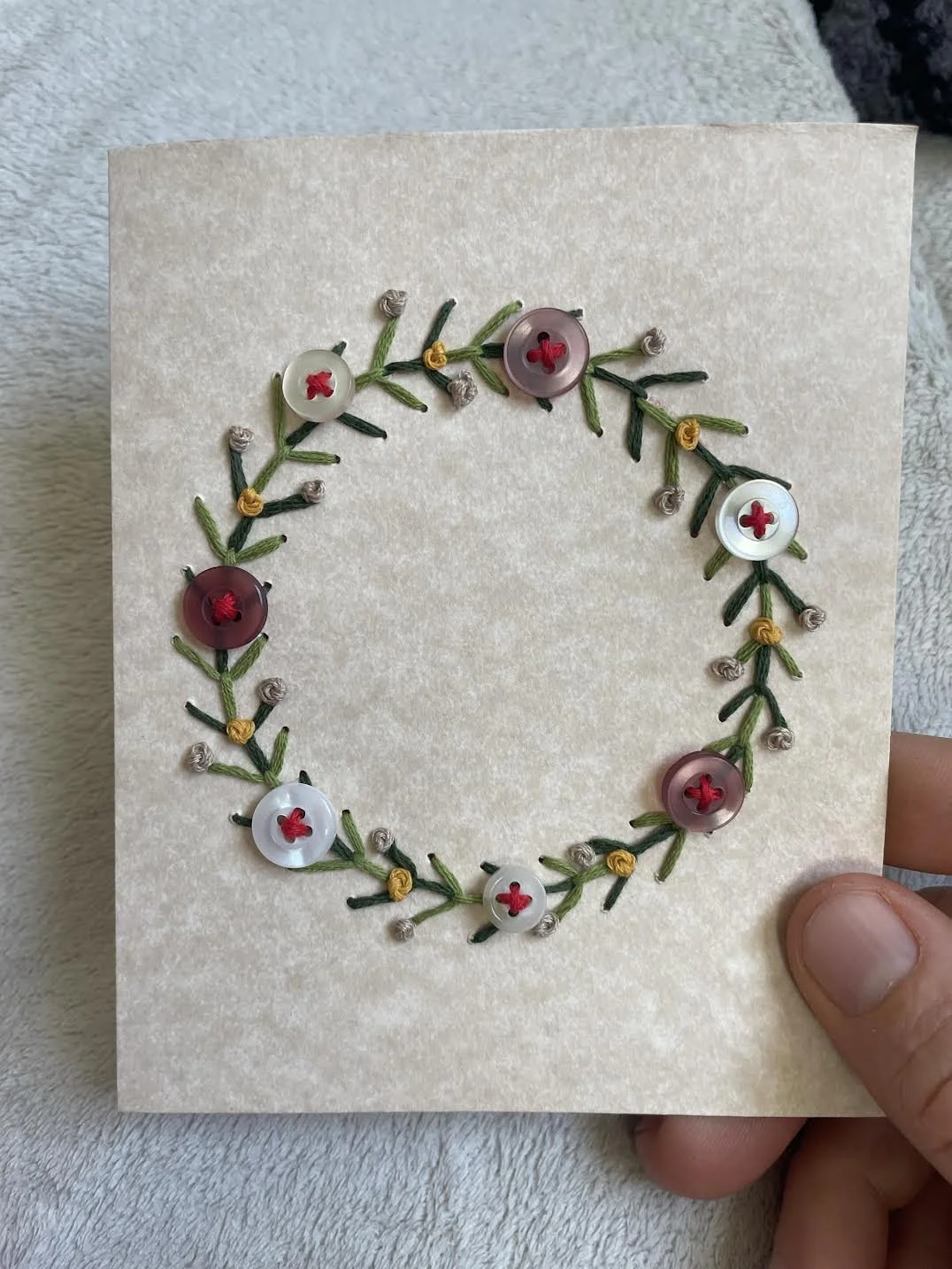
one of the better embroidered cards from this past holiday season