Bonfires & Illuminations
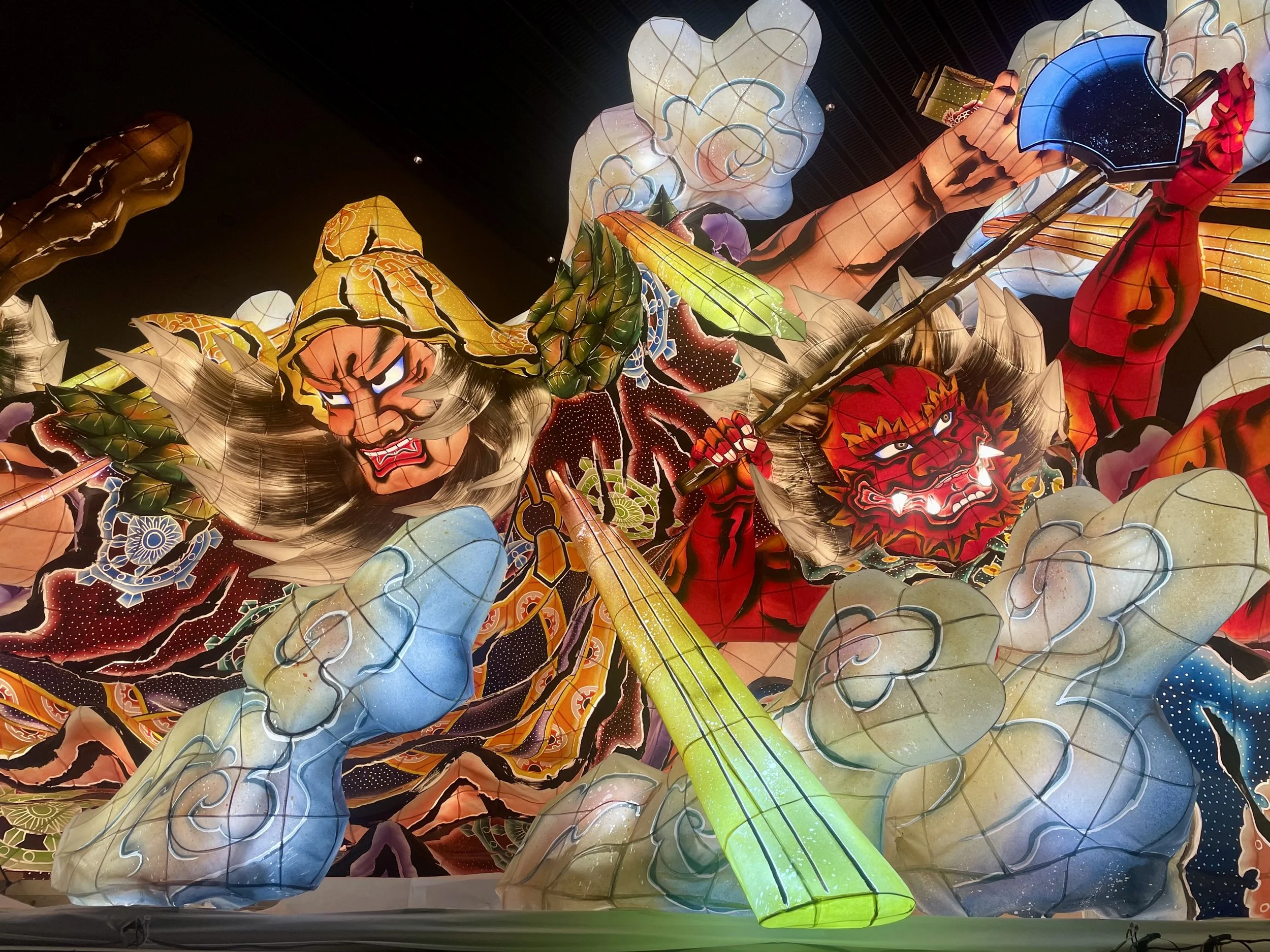
a preserved nebuta at the Wa-Rasse Museum
However comfortable you may be it’s always a good idea to leave home. Wherever you choose to go will either challenge your perspective, or affirm your good judgment. I had especially looked forward to being out of the US on this past Independence Day, to be in a country where July fourth was truly a non-event, and passed the day recovering from jetlag in a capsule hotel in Sapporo.
Reading coverage a few days later did instill a bit of a guilty thrill – the fiasco in Washington, of course, but also that of San Francisco, which as a city happens to be exactly as old as the nation, and so had just as much reason to celebrate a 250th. Setting aside D.C. for a moment, and to focus my disappointment, what struck me most is that there are literally centuries of records available to San Franciscans – as well as the firsthand knowledge of its present residents – that July, in San Francisco, is not warm. It is windswept, vaporous, cloud-bound. The fog comes in from the Pacific by 5 PM, and by 6 o’clock every street, starting especially from those on the west, becomes a corridor of murk. The nights are almost never clear.
Our summer comes later, in September and October. Our July is what elsewhere passes for November. It is not a month for gathering in the evening to stare upwards at the sky. It is a time for scarves, sweaters by a fire, a bowl of soup and tranche of bread, a labrador snoring somewhere nearby. And yet each year the city follows an East Coast bias that the fourth is a time of swim trunks and ice cream stands. As though the calendar can be thwarted by mere wishful thinking. I have never felt so much sympathy for our Australian brethren, who must feel similarly stranded each Christmas, as I do each July in San Francisco Bay.
And for this year’s celebrations – as was triumphantly announced sometime in March – a grand, free displays of fireworks would leap from the span of the Golden Gate Bridge. Which is to say, at the very lip of the Pacific, where the fog rolls thickest and quickest as it streams into the basin of the bay. You would think Mayor Daniel Lurie – having been born and raised in San Francisco himself – would have known that while such a display might have been truly stirring in a comparably sized city of bridges anywhere to the east – say, Pittsburgh or Detroit – it was doomed as soon as it was suggested. Few things are as predictable as San Francisco’s summer gloom. Attendants reported muffled banging and dulled flashes of the underside of clouds.
Of course, I wouldn’t have gone anyway, even had I stayed in California. I haven’t celebrated the fourth since entering the age of reason. The past few years I’ve preferred to stay at home, and either read excerpts from the writings of Frederick Douglass or listen to the soundtrack to Cabaret, which is to say, reflect upon the meaning of liberty and of nationhood, and the brittleness of both. Typically I bake a pie. I’m not a pure humbug. I’m not against festivity, I hold no grudge for “pomp and parade, shows, games, sports, guns, bells, bonfires and illuminations,” as John Adams so prophesied from Philadelphia in a letter to his wife, dated July of 1776. I just don’t do well with pablum. (That said, I do remain optimistic about Juneteenth, a holiday that more truly celebrates the flaws and freedoms of the nation, more accurately reflects the promise of the founders, the duties of their descendants)
And yet, in escaping one round of celebration I found myself in the midst of another, which returns me to my earlier point – the value of setting out from home.
The first week of August is often a time for summer festivals in Japan - matsuri - and I attended one of the more famous: the Aomori Nebuta. For seven days, great lanterns in the shapes of gods and heroes, of demons and dragons parade through the streets to the clash of cymbal and drum. Paper stretched on metal frames, lit from within by many hundred halogen lights, these gargantuan lanterns – nebuta – are mythic dioramas of the struggles of creation and defeat, and thousands and thousands of people join in the chant of the dance and the thrum of the drum. What can one say to such pomp and parade but “bonfires and illuminations” as the caravan swings by.
On the third night I received a tip that Aomori is not the only city to celebrate their matsuri with pageantry by lantern light. If I went to Goshogawara, I could see nebuta seven stories tall. And if I went to Hirosaki, I could see fan shaped nebuta, that spin and reveal new painted scenes. Always drums, always cymbals, though each town has their own distinct rhythm and chant. Wa-rassera-wa-rassera! (Aomori) Yattemere! Yattemere! (Goshogawara) Ya-ya-do! (Hirosaki) Though not quite nonsense sounds, the words have undergone semantic bleaching - like hallelujah, or oy gevult, or all you need is love – people might know when to say them, but not exactly what they mean.
And in much the same way the original cause of celebration is likewise lost. While going back centuries , I found some documentation suggesting that, like European Passion Plays, the matsuri was an outgrowth of the Shinto rite. But then, if that were so, why isn’t it celebrated everywhere Shinto is practiced? I found some other sources suggesting it was to commemorate victory in battle. But said battle did not happen in Aomori. I was quite heartened to discover that in both of the museums I went to – one in Aomori and the other in Goshogawara – even the curators were at a loss to definitively explain the origin of the lanterns or of the festival, the best they were able to offer is that it was probably just a way for restless villagers to blow off steam, with influences from Shinto and revels from mainland China. Celebration for celebration’s sake and a demonstration of hometown pride, certain characteristics in common throughout the region - drums, displays, fried food on a stick - but one’s own distinguished and recognizable stamp.
And I could not help but think as I saw them pass - lanterns so large they span one’s whole vision, so tall they become as clouds – San Francisco take note! You know how to do parades: Pride, Chinese New Year. You know that summer is a season of fog, ill-suited for sky-bound rocketry. You have a gorgeous park that terminates at an expansive beach - Golden Gate Park, Great Highway Dunes – great swaths of lawn and then sand for crowds to gather and marvel and for vendors to hawk. True, seven nights might be a bit much for you. But perhaps a weekend. Two good, consecutive evenings of summer to appreciate the light up artistry of your own creative class and celebrate for the sake of celebration, with displays unconcerned with the vagaries of weather. Let us not fixate on size. The floats could be large as shipping containers, but so too they could be as small as Volkswagens – or as beetles, of which I saw more than a few, along with glowing fish and apples and other celebrants in electric costumery – or even just many hundred – or even thousand – of your own people bearing lanterns on a walk, street-bound, moving westward towards the sea…
...bonfires and illuminations.
~C