Refuge & Reinvention
In the beginning the gods stood alone upon the heavenly bridge and gazed down upon the water. Curious what secret forces might hide below, the pair took a jeweled spear, broke the surface, and stirred the chaos. At first, there was nothing, but then once lifted from the waves, brine dripped down the pointed spear and formed a string of islands. In this way did Izanami and Izanagi, the primordial deities, create the first eight islands of Japan.
To those who grew up in North America, and more specifically south of Quebec and north of Georgia, there is an uncanny familiarity to Japan – and Hokkaido especially – that one wonders if the deities repurposed the same spear to dredge up the Ohio and Saint Lawrence River Valleys, and stipple the east with mountains. Although Japan was formed by volcanic action, and the Appalachians by tectonic collision – whatever the claims of Izanami and Izanagi – the land has similar contours, and one sees everywhere the same flora. Some of that is on account of later exchange – Japanese knot weed, North American goldenrod, the collateral damage of a commercially integrated globe – but here are asters, clovers, even, improbably, the purple umbels of Joe Pye Weed, and on the mountain slopes the electric white of beech and birch strike up like lightning from low carpets of bamboo.
Every foreign admirer claims to see their own country reflected back to them within Japan. There is a long tradition of seeing Japan as one’s own nation through the looking-glass, largely on account of certain superficialities. Just like home, only not at all. Brits never tire of comparing an island kingdom off a continent to an island kingdom off a continent. (“They even drive on the left!”) Germans see Bavaria in the mountains. (“Es gibt hier bier und baumkuchen auch!”) I’ve met Canadians and Chileans who recognize their own lands in the coast. (cedars, fish markets) And a Mexican who said the colder months especially could make him homesick, not because of the frost and snow made him realize just what he’d left behind, but because here too the street vendors sell roast sweet potatoes instead of chestnuts in the winter, and the familiarity roused within him the dull ache of longing for the city where he’d been a boy. I don’t agree with any of them when it is so obviously New England.
North Americans have an unusually strong claim to twinship. The coastal ecosystems of East Asia and of eastern North America resemble one another more than either does to other ecosystems of the remainder of their respective continents, or to any elsewhere in the world. This phenomenon was observed as early as the 18th century – Linneaus thought it curious that magnolia were to be found in Asia and North America but not anywhere between – and given greater documentation in the 19th century under the Asa Gray Disjunction, named for the botanist of the same name, who, naturally, developed the theory in Paris, at the Jardin des Plantes – the famous Parisian botanical garden – where Gray found himself unable to distinguish between several botanical specimens collected from China and North Carolina.
Species from one tend to do so well in the other they scarce know themselves transplanted. The tulip trees of Odori Park, in Sapporo. The katsura of Central Park, New York. These are some well-behaved examples. But there are plenty that prove disastrous – the Asian spotted lanternfly, emerald ash borer, burning bush, kudzu, and chestnut blight in North America, while North American goldenrod, black eyed susan, the red eared slider terrapin, the raccoon, and common sunfish are invasive in Japan. On every island, in every prefecture, at the twilight fringe of day, bullfrogs croak and drum in the canals - introduced 1918 - bellowing, oblivious, insatiable…as most misplaced Americans.
It is somewhat unaccountable why the two regions should be so ecologically similar when Eastern North America was at one time – and geologically provably – joined to the west of Europe and to North Africa whereas Japan was independently formed by vulcanism. Did this set of species start in one and migrate to the other? Or had there once upon a time between a mythic, sylvan bridge – now extinct – that stretched itself both east and west until amoeba-like it split in two - mountains, prairies, oceans gradually filling the gap?
Coming from one and going to the other, there is a sense of déjà vu. As though one had flown thirteen hours only to land exactly where one started. Though I have lived almost twenty years in California, I grew up in the Northeast, thinking the day lilies that sprouted everywhere by the roadside were a wildflower, when this was their native range, and their own ancestral home is now thick with evening primrose, goldenrod, and black-eyed susans, the true wildflowers of mine. Here is the same summer humidity at roughly the same latitude, the same deep valleys of cold and leaping creeks that join to shallow rivers, well-populated with fly-fishermen, sun dappled in the shade of oaks.
Insects build and break their empires in a season, and from every hedgerow and hayfield come ten thousand ticking, twitching cries of summer’s watch springs unwinding by the hour as the hands sweep down the year. Cicadas, uncountable in number, thrilling like whole forests of electric razors, sparking at every branch. At night the wings of luna moths and the softened flash of fireflies drift about the lanterns. And I felt I was not in Japan at all but northern New England, more specifically Vermont. Both regions share much of the same relation to their respective sweltering, southerly cities – Tokyo, and New York – and as in each, in the fall, tourists come north by the busload to admire the changing leaves, and in winter to ski. On a whim and on an empty country road, without a car in sight, I swapped from the left side of the road to the right and there I was, transported somewhere just above Bennington, pedaling north towards Montreal. Mountains before me, mountains behind, and mountains more to either side.
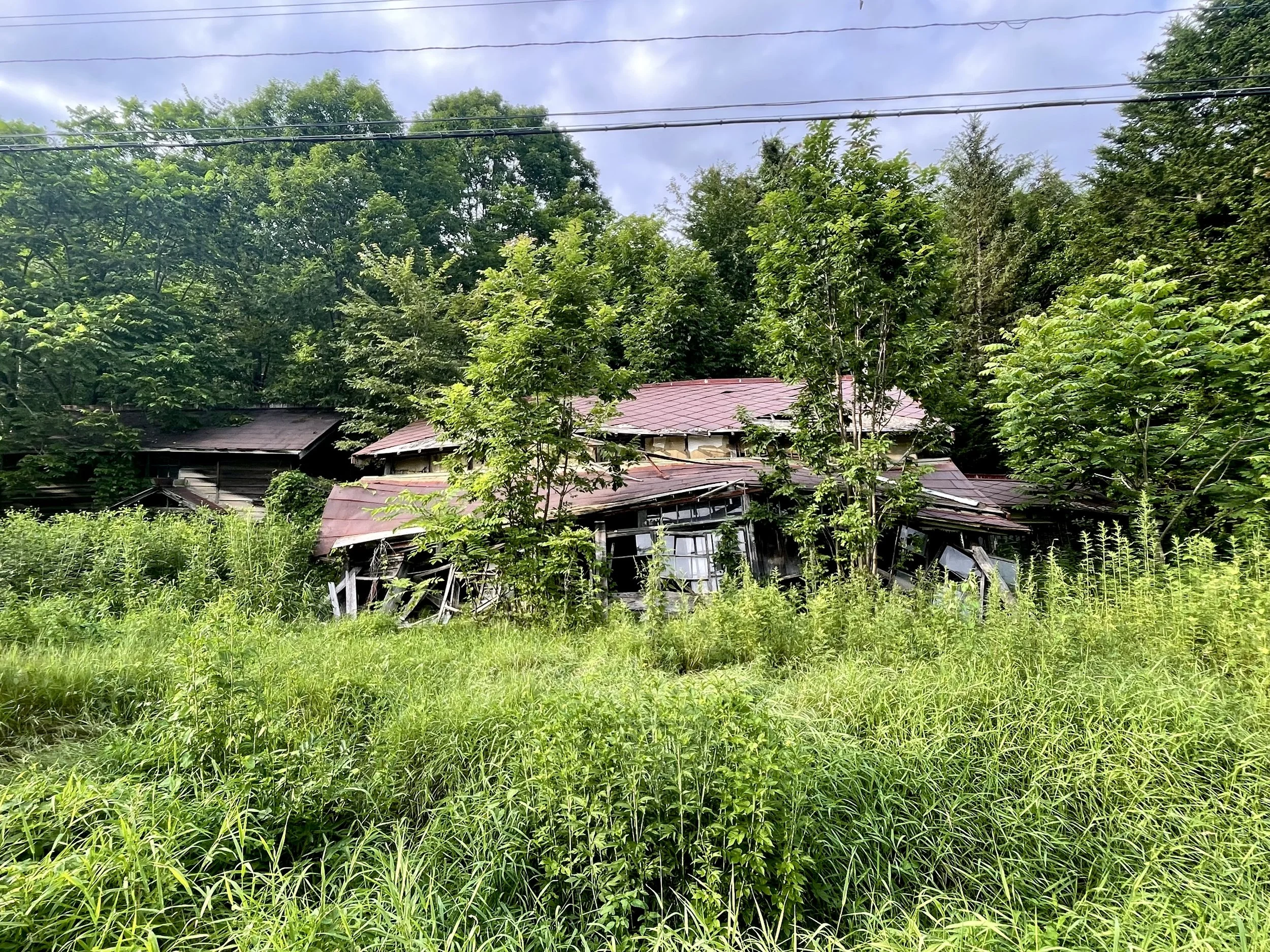
a collapsed country house
There are so many points in common that it is almost tedious to list them all, and one is better off mentioning what is absent – maple flavoring, smart white churches, the Von Trapp singers – and what is more geographically distinct – tatami mats, volcanoes, brown bears with the size and heft of a double wide vending machine, fully stocked with drink.
Everyone outside of a vehicle and traveling anywhere free from pavement wears a little brass bell at the hip, that I at first mistook this atmospheric, backcountry jingling for some goatherds who had taken a precautionary cue from Switzerland and belled their flocks. But it is almost always a hiker, or fisherman, who wishes to announce their coming to any errant bears than alarm them with their presence, though I did once see a bell tethered to the seat of a Kawasaki motorbike, though I doubted its ring-a-ding-ding could be heard whenever the rider revved the engine. (I used to have one of these bells myself – the gift of an ex-boyfriend who had vacationed here before me – but as I did not have much need for it post breakup, I had gifted it to a friend who had taken a position outside of Banff, Alberta, Canada, where I understand bears are somewhat more common than they are in San Francisco Bay.)
One day, following one of those black, and boulder strewn rivers in the cleft between two mountains, five separate drivers stopped to warn me of bear activity. The last tailing me all the way to the pass and then handing me ¥5,000 and bidding me book a hotel for the night. Too dangerous to camp, she said. In 2025, bears killed 13 people in Japan. Astonishingly high compared to the 3 deaths that same year in the United States and Canada combined. Though of the three kilometer tunnel with no shoulder, she said nothing. To drivers, cars are never a danger. (total number of traffic fatalities in Japan in 2025: 2,547 or roughly 182 times as many deaths as those caused by bears)
The predators I most feared were the small, biting insects that bloom in Hokkaido high summer. The air occasionally so dense with flies it becomes a sort of chewable gruel, though just as likely to chew one back. I passed through swarms of winged and flying mouths, each one out to glut itself on the flush of summer fluid. Sap or nectar. Sweat or blood. Coming up the steep slopes of a pass, or rim of a caldera, flies the size of navy beans harassed the climb, piercing layers of clothing to lap at sweat-slick skin then drill down into the flesh. Nothing contented itself by nibbling leaves or crawling through the moldering earth.
Before camping one night, dozens of small black flies gathered on my calves. I thought to swat them, but as I did not feel a single bite, they seemed more mild annoyance than threat, and I let them alone while carrying the more urgent task of setting up my tent in the fading light. Two days later my legs broke out in blisters, and I learned the particular quirk of the Japanese black fly – or buyu – that their bite is only painless at first, and the intense irritation comes at several day’s delay. Another evening, in twilight and again while pitching camp, I received a visit from the Asian Giant Hornet – colloquially known to Americans and Canadians as the murder hornet, for the splash it made on both sides of the Washington/B.C. border in the summers of 2020 and 2021. The insect resembled nothing so much as an extremely angry Brazil nut doused in kerosene, daring you to strike a match. Mercifully, I had nothing of interest to it, and it had come alone and soon left without return. I closed my tent, lay very still, and did not emerge again till morning.
Of the Hokkaido brown bear, I had no fear, and never saw a single one despite covering almost all of the island and traveling sans bell. (Though I did not get so far as Shiretoko, which I understand has the highest concentration) Perhaps it’s coming from North America where bears are more abundant, and while I have limited direct experience with any of our native species, I have some familiarity with basic precaution. (Make noise, don’t smell or act like food, largely the same principles that assist one in any environment). And on this particular trip I was at least fifty percent metal and rubber. Hardly appetizing to creatures that prefer a browse of berries and salmon.
Of the double wide vending machine though, to which the Hokkaido brown bear is roughly equal in size, I saw many. Riding an empty road, you arrive at an intersection, and there is a battered house, a closed garage, and a vending machine. You put in ¥150 yen, the coins tumble down the slot, and out comes a bottle of green tea or ginger ale or Coca-Cola, moist with a perspiration of dew, the liquid dazzlingly cold.
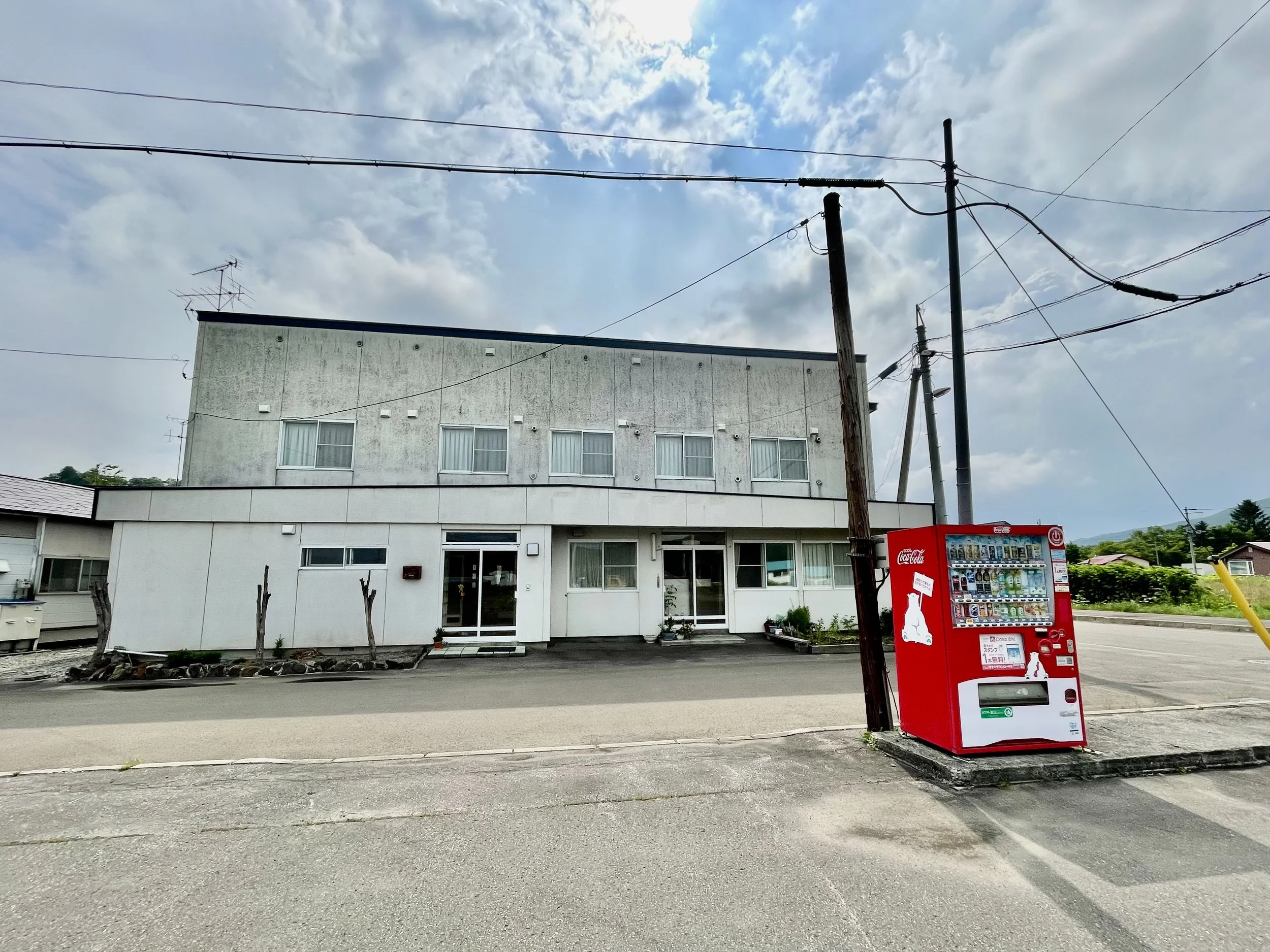
you are never very far from a vending machine
What many foreign visitors don’t grasp at first about Japan’s celebrated vending machines – or any vending machine anywhere – is that they are intended as replacement for human labor. In the splendor of the cities, it is easy to still imagine Japan as an electric, youthful place. But get away from the brilliance and billboards, out into the boonies – or at least anywhere that isn’t Tokyo – and the stories of Japan as a diminished and diminishing country begin to seem more true. Half abandoned towns, closed businesses, elementary schools shuttered, houses with the roofs fallen in, shards of broken crockery cast about the kitchen.
I went inside of one and there was the same rank smell of desolation and decay as I had experienced before in the wake of an indefinite vacancy – dust, dry rot, the foulness of vermin nesting in the linens. Bones of small animals scattered on the floor. The dereliction held a sad familiarity, and maybe so too for those visitors from the U.K., Germany, Canada, and so on was a touchpoint of their own respective homes. For while I’ve not been everywhere, I’ve heard the same story repeat itself many times, just in a different accent – a world that both moves on for some while leaving others behind.
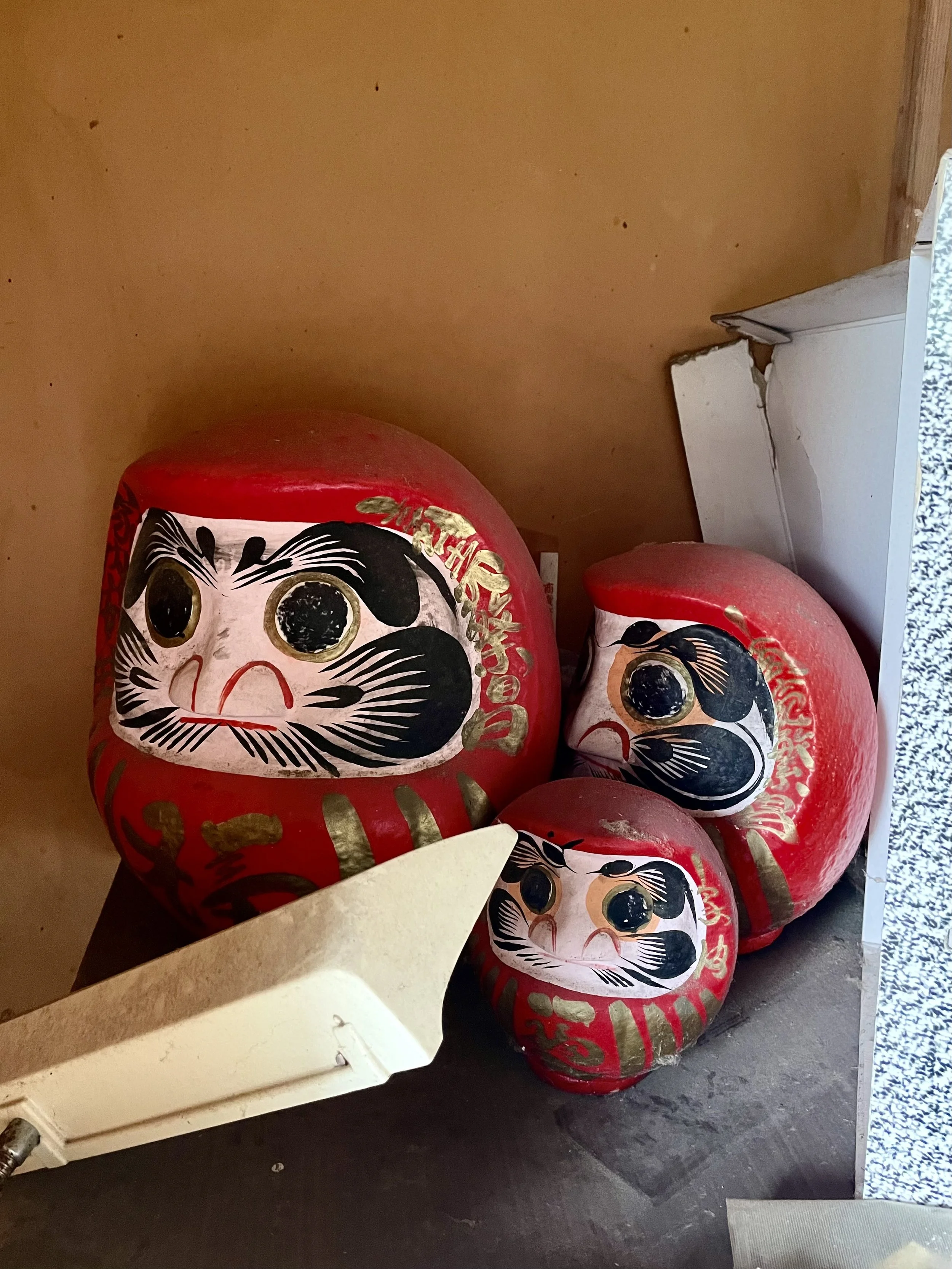
I opened one of the closets, and there, clustered like a family of owls, were three daruma dolls, papier mache icons of the Buddhist sage Bodhidharma, eyes agape, sole occupants of the ruin. Bodhidharma, so the story goes, was so incensed at himself for having fallen asleep while meditating that in rageful penance he sliced off his own eyelids. In another tale, he meditated for so long and so faithfully that his arms and legs atrophied, withered, and fell away, leaving only torso and head. The wide-eyed, limbless daruma doll embodies the humor of both legends, and as they are not easily toppled on account of this roly-poly shape, they are also represent the Japanese proverb ‘fall down seven times, get up eight’ and are often given as talismans of luck.
When received the eyes are incomplete, and it is the custom to fill them one at a time – the first eye when making a wish, the second when the wish is fulfilled. As all three dolls had pupils, their maker must have gotten their wish, whatever it may have been. Maybe it was just to leave. To get up eight times, and then be gone. I looked upon them each in turn, then closed the door upon their vigil.
For most of its history, Hokkaido lay outside the realm of effective governance, and as a consequence has held much the same role within the Japanese imagination as the western frontier has for Americans - an undomesticated place removed from civilized decadence, a land free of consequence, for good or ill. Out beyond the last lantern, the last comforts, and then further onward still. A place of refuge and reinvention. Go north, young man.
In the creation myth, when Izanami and Izanagi churned up the first eight islands of Japan, they are all of them to the south. Kyushu, Shikoku, and Honshu are all mentioned. Even little Ishi-no-Shima is named – a rock half the size of Martha’s Vineyard, only slightly larger than Nantucket. But Hokkaido – larger than Scotland, smaller than Portugal, the second largest island in the archipelago of present-day Japan – doesn’t come up at all. It was simply Ezochi, land of the Ezo, another name for Ainu - an indigenous people more similar genetically, culturally, and linguistically to the reindeer herders of Siberia and the seal hunters of the Aleutian islands - and a catchall term for anywhere to the north that wasn’t China, or Russia, or water. A place beyond the jeweled spear’s reach. A wilderness that occupied the imagination long before it was even occupied itself. Whatever it was, it wasn’t Japan. But also, somehow it was. Or ought to be.
In the ninth century, with the main island of Honshu at last unified, the dissident, disaffected and defeated fled north. The court had grown too foreign in manners – adopting almost wholescale the bureaucracy and Buddhism of Tang China – and what was needed was either to rebuild the Japan that had been lost, or at least escape this new one on the rise. Then again in the 19th century, with the country once more at war with itself, and for similar reasons – vigorous adoption of foreign ways, though this time the United States and Europe were the source of these exotic evils – renegades and rebels once more moved northward to register their discontent. Among their objections were the introduction of a cash-based tax code, publicly funded education for all children (even girls!), and – most odious of all – of a samurai class so reduced in status as to be without privilege entirely. Two million people had their annual pensions commuted to a severance package and a mass layoff. Meanwhile, resident Westerners were subject to the laws of their respective nations and not to those of Japan. And as Paris, London, Washington, et al had little interest in curbing their unruly citizens abroad, a whole class of immigrants could - essentially - live above the law. To any living samurai it would have felt they had been supplanted as the world turned upside down. For some the betrayal was too much.
In 1868, Enamoto Takeaki, a samurai aristocrat and admiral of the Tokugawa navy, refused to submit to the restored Meiji empery, sailed his fleet north to Hakodate, seized the port city and occupied its recently completed fortifications. On Christmas Day of that year, he and his loyalists declared the Ezo Republic, an experiment which was to last six months. The Boshin War was on.
In a small but telling instance of how badly these defenders of tradition would fare, when the newly established Meiji navy caught up with the rebels on the 25th of March, 1969, the renegades attempted to board and seize the Meiji flagship. All had naval experience, and so some expectation of how to infiltrate and occupy an enemy vessel. Except this vessel was the Kotetsu, the first ironclad of any Asian fleet, equipped with gatling guns, capable of firing six rounds per second of ammunition, while the attackers had come armed with smooth bore muzzle loaders, which an experienced marksman could fire with accuracy at most four times a minute. Even a word like skirmish implies some kind of comparative advantage. There is no kind word for this sort of defeat. By May, what remained of Enamoto’s navy was destroyed. By June his remaining forces surrendered.
(In a curious intersection with 19th century rebellion elsewhere on the globe, the Kotetsu had not originally been commissioned by the Japanese navy, but the Confederate States of America, under the name CSS Stonewall, having been built at a French shipyard and delivered to the Atlantic seaboard on May 6th, 1865, almost a full month after the surrender at Appomattox, and consequently having never seen service. In 1867, a visiting Japanese diplomat spied the not-once-used ship at anchor in the Chesapeake, and made a cash offer of $400,000, which Washington accepted, sailing out of the close of one civil war and into the opening salvos of another.)
Remarkably Enamoto survived, and after a few years imprisonment, received both pardon and promotion within the Meiji government. He might just as well have been executed or died in prison, but the new administration considered its hold on a newly reconstituted country too fragile to go making martyrs, and Enamoto’s talents far too great to sacrifice. (With inferior resources and fewer than half the men, he had still held off the imperial fleet for six months on their own home turf and home surf.) But it was to be the end of Hokkaido as a haven for rebellion.
The characters which comprise Hokkaido - 北海道- mean individually北 kita (north) 海umi (sea) and 道machi (road) – implying some kind of escape, or passage. But the final character is also the first character in the kanji for tool – dougu 道具 – an indication of Hokkaido’s conversion to come. The island had been nominally under Japanese protection since the year 1600 at the outset of the shogunate, but never formally been occupied or effectively taxed. The interior was still largely undeveloped and left to the Ainu. With an occasionally expansionist Russia to the north – with whom Japan shared an uneasy joint occupation of the island of Sakhalin – and with two million discontented, unemployed young men within their own borders - always a recipe for unrest – in the 1870s the Meiji government set about aggressively domesticating Hokkaido with the express aim of turning an uncultivated wilderness into a heart of industry and agriculture, with grants of cash and land made available to any samurai willing to relocate. It wasn’t enough to claim Hokkaido, or even just to occupy . It must be thoroughly integrated. It must be made Japan.
If westerners are aware of this at all, it may only be because of one of the most famous beneficiaries – Sapporo beer – was started by a German trained Japanese who accepted one of those cash grants, and launched a brewery that is today worth some $5.16 billion USD, with subsidiary breweries in Guelph, Ontario and La Crosse, Wisconsin. Think of that next time you see a can of Sapporo lager at the grocery store.
The most famous losers are the same as in every story of conquest and occupation - the Ainu – whose story echoes those of indigenous peoples throughout the world: confiscation of ancestral lands, prohibition against the practice of their own language and religion, and wave upon wave of epidemic to which they had no natural immunity. Small pox, cholera, influenza, syphilis. Today, Ainu comprise less than one half of one percent of the total population of Hokkaido. What started as a token Japanese presence at the southern tip of their island home around the year 850, turned to settlement, then dominance, then control, then extermination and replacement, though it took a thousand years. (I had hoped to learn more of this history but found few sources in English, and while I did stop at an Ainu cultural center, the information was only available in Japanese, and my present reading skills are only just about adequate to the task of navigating a menu, not grasping the politics that led to genocide)
It is the recency which in part makes Hokkaido seem so familiar. Elsewhere, the country stretches back millennia. But here it isn’t even two hundred years, and shares all the expansionist optimism as well as convulsive desperation of both those prior centuries. The talismans of the Japanese rite – Shinto, rice cultivation – are confined largely to the narrow southerly peninsula that stretches a finger out towards Honshu, where occupation has been the longest. But there are no castles, and few temples. Get anywhere north of Sapporo, and the island becomes hayfields, potatoes, dairy cows, and forest without end. Towns spaced seventy kilometers distant from each other. Forbidding mountains capped with spruce, a few trendy ski towns, feedstores, tractor mechanics, junk yards – and along the coast are canneries that wallow in the stink of processed crab. Vacant homes, closed businesses, seaside resorts fast crumbling into driftwood. In one small town I stopped outside a shuttered Honda dealership and took a photograph. Something about the symmetry appealed to me. It was only afterwards, looking at the image that I realized how closely the building resembled a skull that had gone to rust.
Much is made of the aging of Japan. Every few years the story of Nagoro circles back, the small town where dolls have replaced the absent people. Or the well established statistic that for more than a decade, adult diapers have outpaced the sale of baby diapers. While it is noticeably much more grey than almost any other nation, I do not think Japan is a dead or even dying country. Only one that has yet to figure out how it wants to be reborn, its present state one of unmanaged contraction.
But isn’t a contraction the final tremor before a birth?
~C
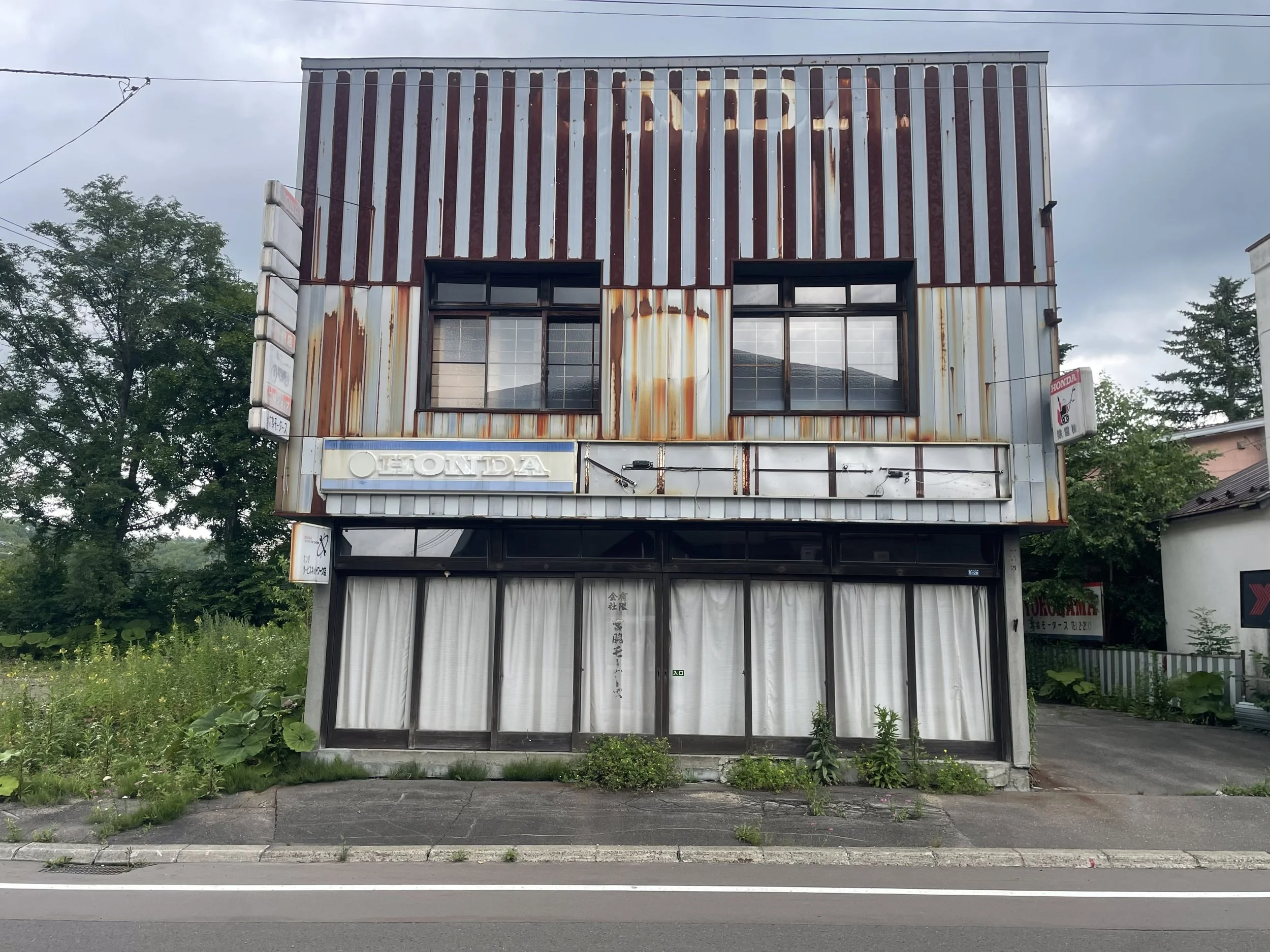
so many towns had the same sad familiarity - once thriving business districts now shuttered - vacant storefronts - empty homes - inhabitants gone for elsewhere