Japan v. intransitive
raindrops, reflections, Spaniards chattering in the background - a classic experience of Kyoto - Kinkakuji
I was at a bar in Gion, the old entertainment district of Kyoto, sitting at the counter watching a man make pizza with a grace that left me more breathless than any geisha show ever could. His hands moved with the quick, light touch of a classical pianist or an old school DJ as he cut a block of dough, floured the counter, forearms dusted to the elbows, and placing his palm into the center of the dough, tugged the formless wad into a wheel. Then with a wooden spoon he spun a tight, thin helix of sauce, and arranged slices of imported cheese, mushrooms, and meats, thin and delicate as mouse’s ears, and cracked an egg into the center of the disc, the yolk the final shade of sunset – a vivid and violent orange – before it sinks into the crimson of the sea, and drizzled the lot with a splash of olive oil poured from a tea kettle’s spout.
Then with the graceful heft of any professional accomplished in the deft manipulation of great, unbalanced weight, he spun his body with a swiftness I could never reproduce and pitched the assemblage into the oven, beside the flashing embers of a woodfire. He scooped a shovelful of moistened shavings from a pail beside the oven and cast them on the embers, where they emitted thick, and evil looking vapors that dissipated quickly into clouds of steam and savory aromas. With a long-handled paddle, he spun the pizza twice, the crust bubbling and just beginning to blacken, and the marvel was withdrawn, the egg yolk at the center a trembling and barely contained eruption. He drew a spoon from his arsenal of cutlery and smashed the yolk into a starburst, then drew the yellow into the whirling, nebulous arms of a liquid galaxy, that settled swiftly into the cooling melt of cheese and sauce. I was starstruck. Spontaneously, I broke into applause.
“Maestro!” I exclaimed.
He blushed, bowed, and thanked me for the praise.
I had been in search of something novel to my experience of Kyoto. Some unifying principle that could clarify the spirit of the city in a way I still had yet to grasp. I’d been here often enough on previous visits, contentedly losing myself in the collision of classical and contemporary. Kyoto largely escaped the bombings that levelled almost all other large cities during the Second World War. (Tokyo and Osaka were charred almost absolutely.) And while it is true that this near miraculous escape was primarily due to the intervention of Henry L. Stimson, Secretary of War, who personally appealed to President Truman to strike Kyoto from the list of potential A-bomb targets just days before Little Boy was dropped on Hiroshima instead, the rationale of this unexpected deliverance being on account of fond memories of a honeymoon visit are – alas – an invention. (Stimson and his wife took their honeymoon in Connecticut.)
As for Stimson being deeply, personally moved by the history of Kyoto’s emperors, the beauty of its temples, the craft of its artisans, all of this is possible and none of it is provable. His personal journal entries of his several visits to Kyoto read like a man who wanted to ensure reimbursement from his employer. Almost nothing but records of hotel bookings and train tickets purchased at personal expense. Stimson’s reasons for successfully preventing the destruction of Kyoto remain unknown, but he may have been useful post-war propaganda – to offer a defeated nation the solace of at least one powerful admirer among the occupation.
And here I was, a fellow admirer nearly a century later, among the latest cohort of occupiers (which is to say, tourists) trying to make sense if not of what so moved Stimson, then at least to figure out what it is that so attracts myself that I keep coming back. Watching a pizza arise from dough before me, beneath the hands of a qualified master, the reasons were at last becoming clear.
I had seen people make pizza before. I’d made pizza myself. But what I had never previously seen – had never imagined – was a professional who elevated through touch the raw material of sauce and dough with such control and ease. In his hands, the ingredients became transcendent. From first to last bite, the sweet, acidity of the sauce, the slight burn of habanero lurking just under the brine of imported mozzarella, the tug and the chew of the crust. I was raised Catholic. And taught that bread and wine could become the flesh of Christ. And yet this transported me to realms beyond those promised in the catechism. I was euphoric. This wasn’t, I felt, the best pizza I had ever tasted. It was, that I felt, I had never tasted pizza before. This awe that I experienced was the result of bearing witness to someone who understood their craft outside the lens of making pizza, or product, or money, but as 道 or dō that is way. The endless wheel, where every step along the path is both its own beginning and its end.
The character 道can be read two ways. When alone, it is typically understood as road – michi - that is, a literal path between two points. But it can also, when used in combination, be read by an older, Chinese derived pronunciation of dō, that is way. Sometimes this reading still serves the purpose of a literal path, as in the famed Nakasendo 中山道 (“central mountain road”) the highway connecting Kyoto and Edo (as Tokyo was then known) during the time of the shogunate. But when combined with a profession, object, or craft, while still read as dō, 道 could somewhat more fancifully be understood as discipline. A familiar example to many westerners would be the bushido - 武士道 – the samurai code, or as it is also translated, “the way of the warrior” where we see the character of 道 in the final position. Another example would be 茶道 – chadō or sadō – which while most often translated as “tea ceremony” is more accurately read “the way of tea.” (茶cha being the kanji for tea) Or 書道 shōdō, that is calligraphy, or more literally, “the way of writing.”
Linguistically, Japanese has almost nothing in common with Chinese, but much of the aesthetics and understanding of art and religion within Japan stems from ancient China, in much the same way as the Greco-Roman world informs western aesthetics, whether or not one hails from anywhere within the borders of the ancient empires. And to articulate the complicated overlap between art, philosophy, and religion within Chinese and Japanese culture, consider Daoism, whose central concept of the Tao (that is “the way”) or the Dao as it is called in Japanese, is represented by an identical kanji in both languages. (No, I shan’t tell you which. If you’ve read this far, you have all the tools you need to find your own way to it. Really, I just can’t be any more heavy handed than that with the hints.)
It is too reductive to call the man I saw a pizza maker, and a far too precious to say he was a pizza artist. He was rather, a practioner of ピザ道 pizzadō - “the way of pizza” - a fellow traveler along the path of Zeno’s paradox, where perfection can be approached but never achieved. Still, he will come far closer than any of us mortals ever shall.
This was the spirit I hoped to encounter throughout my visit in Kyoto, no matter where it happened to be found – pizza making, coffee roasting, brewing and pulling the perfect pint of beer. I wanted 道 dō in places besides where it is expected, such as geisha shows and tea ceremonies. I wanted living, thriving examples. Not historic re-enactment.
For much of its history, and especially during the Sakoku Era (“the closure” – roughly 1634 to 1854) Kyoto has been the center of art and of artisans for all of Japan, in a role quite similar to Paris within western fashion. Which is to say, it is Kyoto which has set and standardized the trends. (Less so since the astonishing rise of Tokyo, which has unquestionably supplanted Kyoto in all ways, excepting perhaps the preservation of the classic arts – shibori, kintsugi, 茶道, 書道. Within Japan, the Kyoto/Tokyo rivalry is the familiar dynamic of David versus Godzilla) And indeed, I have been told by more than one Japanese that the way westerners feel about Paris – and particularly the way we feel about Parisians – is the way they feel about Kyoto – and Kyotans. (however inaccurate) Boulevards of well-swaddled snobbery on strut, just swap the Tuileries for tea gardens.
But as with Parisians – whom I have found to be no more snobbish, and often less so, than American transplants – I have not found Kyotans to be particularly stand-offish, though this may be foreigner privilege. (As a visible gaijin I am exempt from the majority of the judgment and pity heaped upon provincials from elsewhere in Japan) They may be a bit reserved, and rather buttoned up, but get them to an onsen or izakaya, and they’re every bit as raucous as co-eds during pledge week.
Though in common with their Gallic counterparts, the Kyotans dress incomparably better than the rest of us, or any of their compatriots. Better than you, me, Hollywood celebrities, professional stylists, heads of state. Look, you’d have to go to a Vogue runway shoot before encountering a comparably-sized concentration of well-accoutered individuals as you will see on any given weekday at the Teramachi market. I am embarrassed each time I go outside the flophouse – an absolute steal at $9 a night, and in Gion no less! – as though having stumbled from the yellowing, flimsy pages of Dirt Bag Rag and straight into the glossy centerfold of Harper’s Bazaar. Next time I’m back – and there will be a next time – I will unquestionably pay better attention to my wardrobe.
I had planned to come to Kyoto anyway, but still been somewhat stranded, albeit by choice, while waiting for a replacement part for my bicycle. The crank had cracked somewhere north of Kanazawa, and in that city I had been assured by every mechanic that it would take at least a week to order and refit a new one. Each had likewise advised I have it remedied as soon as possible, though allowed that the bicycle was rideable, if barely, in the meantime. So, if I had to wait a week, I would rather limp into Kyoto, where there was more to see and do, and if ever I got bored, Osaka was not so far off, just forty minutes south along the Keihan line. (Though I will say that with its preserved historic quarter and ancient temples, Kanazawa was a lovely discovery for me, having likewise escaped the devastation of WWII and – for now at any rate – the curse of mass tourism, in that it was still possible when I visited to extend both arms and spin in circles without risking collision with a Spaniard.)
Kyoto is a city where the sacred bumps up against the commonplace, each coloring the other. While crossing the Kamo I looked down into the waters and happened to notice a form rippling as the swish of a silken banner just below the surface of the waves. Carp are often found in the Kamo, but the vast majority are a turgid and mud-sucking umber, their scales rimmed only slightly with the brilliance of a tarnished penny - if they have any color variation at all - and the descendants of escapees soon revert to the native, mucky brown. This was clearly a domestic slipped loose from the pond, the pelt an ashen white, splashed with the burnt orange lacquering of a le Creuset cast iron, swimming contrary to the current in the shadow of the bridge.
Of course, whatever their coloration, all carp feed off the same slime, I thought, as another came to join it from further upstream. This one jet black, but with a brilliant, coppery underbelly which it flashed in a rather frolicksome manner, at play it seemed, delighted in the joys and freedoms of the Kamo. And why shouldn’t it? To live just below a bridge where geisha in kimono still navigate between engagements, a smartphone clutched in one hand, a parasol in the other. Only once the newcomer came beside the first did I realize it wasn’t a carp at all but a man’s dress shoe – size eleven I would guess – tumbling toe over heel en route down current to Osaka and then onwards out to sea. The true carp moved aside for the oncoming shoe in a slow and poised avoidance, then resumed its former place, a daub of brilliance floating over shaded muck. The whole act was so reminiscent of the resident geisha dodging a hasty tourist that it was impossible to guess who had learned the trick from whom.
In several of its quarters Kyoto does not so much resemble a city so much as a series of jewelled puzzle boxes. What I had first taken for streets of perpetually closed businesses, or else private residences, were thriving districts. They were not “shutter streets” – as I had seen elsewhere in my travels – rows of steel curtains drawn a final time before a storefront and raised again no more. For one thing, the facades here were all of wood. For another, the potted gardens kept outside were always trim and tidy. The street swept clean each day. Never so much as a stray and fallen leaf cluttering up the path. And yet their tenders were never seen, hidden slyly on the other side of sliding paper screens. One has to look for the secret signs – a lantern, a banner, a series of charming stones – to know if they are open, that they are businesses at all. But even then it is not enough to know all this, one also must be in possession of the code for them to unlock and reveal their treasures. I couldn’t tell you what it is. I’m not being coy, I simply don’t know.
I didn’t even realize they were businesses at all until, on my way back to the flophouse one evening, I happened to pass one with the door open, the aproned staff mid-bow in adieu of an elegant lady in black slip and pearls and a gentleman clutching an Hermes bag. The pair snapped open an umbrella and receded into the dampening night. I looked back at the establishment from which they had come, but the door to their world was already shut, the staff vanished, before any further secrets could escape. The following day I went back to look more closely at the facade, see if I could detect some discernible logic or else guess the sorcery that allowed the casual passerby entry to this further realm, but found it not. One either knows these things, or doesn’t. And I doesn’t. And don’t think I am ever apt to learn.
I have tried on occasion to better grasp the classical Japanese mindset, the sensibility represented in Noh theater, the Tale of Genji, the tea ceremony, to have some better handle on these ancient and elaborate rituals of word and act. But it is beyond me. “It takes an extraordinary amount of artifice to create the ideal simplicity of the tea ceremony,” Mineko Iwasaki wrote in her memoir, Geisha, a Life. “Nothing is left to chance.” As an outsider, though member of the audience, I too felt the same weight of responsibility, burdened to return the “series of minutely choreographed and endlessly practiced movements,” but without the comfort or accomplishment of ever having done so. Where many other foreign visitors describe the absolute serenity of an elevated enjoyment of something so commonplace as a bowl of tea, I felt claustrophobic and contained. All I could think of was the dirt beneath my fingernails, the grease stains at my collar, the previous meal fermenting in its passage through my gut. One wrong motion I shall ruin the rite for all involved. I am not worthy of these mysteries. Just gimme a pigfoot and a bottle of beer.
I can respect what the ceremony is meant to be. “At its best it is a formal social gathering of connoisseurs, free for a time from the cares of the world to give themselves to appreciation of what is modestly beautiful,” wrote the Australian academic RHP Mason in his book A History of Japan. “The prescribed setting is removed from the everyday world, but reminiscent of it in essentials.” In these words I at last can locate my shortcomings, as complete as my inability to photosynthesize or bioluminesce. I am not some connoisseur capable of removing myself from the everyday world.
Which is why I suppose I don’t now and likely never shall know the secret code that enabled the lady in pearls and the man with the Hermes bag to emerge from a secret doorway and slip through the stillness of Gion as that colored carp asserted its own place in confident swish in the waters of the Kamogawa. I am some tumbling, blackened shoe, tripping away down current to drown myself at sea.
the gardens of Oubai-in, a sub temple of Daitoku-ji
I wonder if it is for the preservation of local sanity that certain other quarters of Kyoto have been offered up in sacrifice – Nishiki Market, Kiyomizu-dera, Fushimi Inari – where it is near impossible to walk any faster than a shuffle from the sheer abundance of foreigners walking three and four abreast within the road, impeding traffic for the sake of selfies before a pagoda.
I had thought to return to Kinkakuji, the Golden Temple, which is among the most densely crowded of these treasures, and which I had visited previously. The first time I ever saw it, I literally gasped as it rose into view, a gilded eruption, doubled and inverted by reflection in a pond. Spontaneously, the lines from Yukio Mishima’s novel The Temple of the Golden Pavillion came unbidden to my heart: “It is on a beautiful spring afternoon like this that people suddenly become cruel, while one’s vaguely watching the sun as it peeps through the leaves of the trees above a well-mown lawn. Every possible nightmare in the world, every possible nightmare in history, has come into being like this.”
It was winter then, but warm enough the plum blossoms were just beginning to emerge throughout the city that I could believe it Mishima’s spring. And I remembered too the word’s of Rilke: that beauty is a terror which we are only just able to bear. A feeling crept upon me the likes of which were nearest to the biblical awe of those who witness angels. Not the apple-cheek cherub of Halmark greeting cards – fat-faced, plump, and butter fed – but beings of fire and flaming sword. At last the novel, which had baffled me upon first reading, made profound sense. Nothing made elsewhere by the hand of man could ever equal, let alone surpass, this marvel.
It was raining on this second time around. Scant risk of fire. And as I was now prepared, I was not quite so struck as I had been the first time, though no less moved by beauty. I approached the nearest I could come to the guardian fence.
“Did he have to stand right there?” I heard a male, and rather American sounding voice say behind me.
“Who?” a female companion replied.
“The guy with the black umbrella.”
By which he meant myself.
It was a rather occupied visit, it now being summer, though late was the season and fast sliding away, and the photo vantage point that I had wanted was likewise occupied. So I did have to stand there as I waited for a Spanish family to take turns posing in front of the Golden Temple. First the son. Then the daughter. Then the mother. Then the grandmother. Then each again in pairs. (son+daughter, son+mother, son+grandmother, etcetera…) Then in threes, and finally all together. With each repetition the bright lines of Kinkakuji clustered in a few pixels scarcely larger than a beetle in the upper lefthand of the frame, while a Mount Rushmore assemblage - ijo, ija, madre, abuella - dominated more than half the screen of each. It did not seem at all important to see the Golden Temple, but to be seen as having seen it.
I had noticed the same a few days before in Arashiyama – the bamboo forest to the south of the Golden Temple. Where though one could have a serene walk through the whispering trunks of the shaking trunks and have such deep and unanswerable questions of wonder as ‘just how many pandas would it take to chew this whole place flat?’ or ‘if bamboo is a grass, then are we hiking though a forest? or are we walking through a lawn?’ but instead most visitors seem content to mug for cameras, position phones, set timers, dash behind corners, and then walk back as though captured candidly in meditative stroll. They don’t take very many photos of Arashiyama at all. The mostly take photos of themselves in front of it.
I thought again of Mishima. His 1956 novel was a fictionalized version of the true, 1949 burning of the temple by the novice Hayashi Shoken. Mishima’s protagonist is moved to arson as a means of protest against the tyranny of beauty, as well as a fulfillment of Zen admonition, “and if you meet the buddha on the road, kill him.” That is, a rejection of idolatry. However Shoken’s motives were, it seems, petty adolescent wickedness and an over-inflated sense of self. A desire for fame by attachment to the destruction of the more justly famous. The same as has moved young men throughout history to the assassination of archdukes and presidents on parade in Dallas. (“Every possible nightmare in the world, every possible nightmare in history, has come into being like this.”)
Shoken framed his crime as a romantic murder-suicide, but only half of which was fulfilled. His own attempt to take his own life via multiple self-inflicted stabbings and by swallowing fistfuls of pills failed before police could intervene. He survived, was tried, convicted, and sentenced to seven years of prison. His mother, shamed her son had first committed such offense against the nation and then failed to atone himself through suicide, threw herself from a moving train.
Shoken did not fulfill the full prison term, dying of tuberculosis in 1956, the same year as Mishima’s novel was released, one year after the Golden Temple was rebuilt from ash, and crowned with a golden phoenix. (The original, miraculously intact) To a country still recovering from the atomic bombings, and the devastation visited upon Tokyo and Osaka, the peacetime violation of the Golden Temple – and by one of their own! – was an unforgiveable offense against the nation, and its rebuilding among the more important symbols of rebirth.
Did the Spanish family think of any of this? The American couple? Did any of the tourists? Or, if not of this, most recent bit of history, then to any point during the five centuries prior? To when the Golden Temple had been restored in the centuries of the Edo Era? Or to its transformation as a Zen retreat in the 15th century and the many sages who had sought refuge and meditation therein? Or its foundation as the private estate of the shogun Ashikaga Yoshimitsu in the year 1397? Or had it only been pretty backdrop to the petty, personal dramas of those clustered in front of the camera lens, as Mishima had foreseen in his critique of a modern and modernizing Japan: a brow-beaten nation remaking itself from ruin as a footstool of the West. Its sacred temples secularized. Its traditions rendered visitor experience. Its culture rentable by the hour. Nation-cum-themepark: Japanland.
(Incidentally, like the fictional protagonist of his novel, Mishima too had seen himself as a valiant, if delusional, defender of tradition. And, like Shoken, in 1970 committed his own version of a murder-suicide. He succeeded where Shoken failed – the suicide – but not the murder, because Mishima had aimed too high, and could not murder Japan.)
To reference another sexually ambiguous literary gadfly of mid 20th century East Asia, I thought of the inveterate observer Somerset Maugham and his 1922 fictionalized travelogue On a Chinese Screen, where in his two paragraph vignette The Altar of Heaven, an American tourist ,while beholding the near millennium old religious structure of the title, thinks not of the passage of emperors, or admirable architecture, or the tonnage of incense turned to smoke within its sacred doors, but instead aches to graffito his own name and hometown into the altar stones. “And here at the very spot where the vice-regent of heaven and earth knelt down, Willard B. Untermeyer wrote his name in a fine bold hand and the town and state he came from, Hastings, Nebraska.”
The family finished, I recorded a short video approximately fifteen seconds long, raindrops splashing into the reflecting pond, Spaniards chattering in the background, and then moved aside so the American sounding couple so irritated by my umbrella could occupy the space and then take pictures of themselves. The woman looking towards the lens, then away from it. Then the man looking towards, then away. Then both together. And then they were gone, having achieved all necessary mementi required to prove that they too had once been here.
The whole experience left a bitter taste in my mouth, and I found myself in haste to escape all view of the temple, speedwalking around the other visitors, beating my way to the exit. I’d seen it before anyway. Any further visitation could be performed within my mind.
I realized that in my critique of the Spanish family, and the American-sounding couple, and of all my fellow visitors, that I am being the fuddiest of duddies: poo-pooing someone else on holiday for doing it differently than myself. But there is no more treasured pass time of the tourist than the judgment of other tourists. To look upon the other and silently assess, that no, that isn’t the way one ought to japan. You aren’t japanning correctly at all. Do you even know how to japan? And - naturally - I japan far better than you.
The mechanic had messaged that the part we had both been waiting on had finally arrived, so I climbed atop my bicycle and retreated back into town so I could drop it off, second guessing myself all along the way. Kyoto is a city of approximately 1.4 million residents and 17 million foreign visitors. But then, compared to Barcelona, a comparably sized, comparably touristed city, it had found other, kinder solutions than subjecting visitors to obscenities and water pistols. Certain sections were available to the admiration of the incoming millions – the Golden Temple, Arashiyama – others were not – Gion. The boundary was held by an invisible, yet deeply guarded wall of ritual, of talisman, and cypher.
The longer I spent in Kyoto, the better I got at recognizing them, though still could not interpret their meaning, in much the same way I can see kanji, but cannot recompose the narrative. The open doorways, the obvious signage, the square meters of street-facing window favored by western nations to indicate the operation of an enterprise are a much more recent introduction, and you can find these easily. But in the traditional neighborhoods the streets are lined with walls and shuttered doors, and guests – they are never to be called so vulgar a word as ‘customers’ – are guided to a garden or other inner sanctum in the back, and commerce at last commenced. But only if they know the means to entry.
Gion is the geisha quarter – and to judge by the taxies that ply the streets on rainy nights, a still highly active one – but this is not the only place where the runes of business are to be seen. A cracked door edged with light, opening on a stairway leading downwards to den of high hat and guitar, lanterns distributed on the steps. A name the size of a postcard beside a black and windowless door. Yet on the other side is the sound of merriment, and clinking glassware of the Kyotoans safe within their hold.
And so all my experiences of Kyoto felt terribly obvious, as I followed more familiar codes. (open doors, visible customers, signage reading either ‘English menu available’ or ‘hablamos Español’) Yet the stew of tourism I had thrown myself into was exactly why I had structured the rest of the trip around smaller, less visited venues. To have a more personal experience. The cliffside temples of Yamadera. The brilliant Nebuta of Goshogawara. The castle park and sentō in the tiny village of Ono, the hilltop overlooking acres of well-tended rice. Should I have heeded those earlier mechanics and stayed a week in Kanazawa? I seem to recall there was excellent pizza there as well.
En route to the mechanic, I passed another temple complex - Daitoku-ji – so extensive it consumed an entire city block, though the temple is older than much of the surrounding street grid, and this in Kyoto is not a particular rarity. There are several such temples, but this one intrigued me by its overall appearance of vacancy, and temples were easily deciphered as whether or not they admitted the casual passerby. (Open doors equal open for prayers. Closed doors equal closed.) I paid the entry fee of the smaller, sub-temple of Oubai-in and went inside. Throughout the whole of the tour I encountered only three other visitors, a young girl who I passed early on near to the first garden courtyard, and a couple with whom I roughly kept pace. I was the only non-Japanese.
The temple had originally been constructed as a hermitage for the illustrious Oda Nobunaga, by his subordinate Toyotomi Hideyoshi, then military governor of Kyoto, in 1562. After Nobunaga’s death at Honnoji – a baffling yet breathtaking drama of attempted assassination by a treacherous subordinate, escalating into seppuku, at last concluded two weeks later at the battle of Yamazaki and the triumph of Hideyoshi as the successor and unifier of Japan – the estate was changed to a temple. Here in mossy and untrammeled gardens, the pine trees tended, the gravel neatly raked in patterns, a late summer lotus blooming from a row of pots, I could at last feel the quiet stillness that had made Kyoto the heart of a still fractured and fractious Japan that even such tempestuous hotheads as Nobunaga, and strategists as Hideyoshi, could preserve it as a respite and refuge from the wearying task of battle and bloodshed. So well had Hideyoshi executed the orders of arhitectural serenity that famed tea master Sen no Rikyu (1522-1591) selected the Oubai-in as the center from which he would meditate and at last perfect the chadō, the tea ceremony - 茶道 - that is, the way of tea.
The girl had been left somewhere behind me, the couple had moved ahead, and I had each courtyard to myself as garden gave under garden, and I could feel my earlier distaste and sour mood dispense. And then I arrived at the “Think Different” garden in tribute to Steve Jobs, who had made a visit to Oubai-in some twenty years before. The panel was the most abundant information available in English anywhere in the temple, all other examples reading “no entry”, “please do not touch”, or “scan for explanatory video.” The first two I followed, the last I did not, as I had wanted an experience as little mediated as possible by the intervention of a handheld, smartphone technology. And here was a wall sized advertisement dedicated to their architect and chief marketer.
The words were largely biographical, a supposedly verbal extemporization of the CEO’s interest in Zen, though the response seemed far too composed and simplistic and fell in line with my own observations of eastern philosophies when in the hands of western capitalists: it makes great copy. While the panel did not go so far as to claim the garden itself had led directly to the creation of the iPhone – besides which, the back of each device clearly states ‘designed in California, assembled in China’ - Japan, let alone Oubai-in rates, no mention of acknowledgement – surely Apple products evidenced the clear principles of Zen.
The crude and sycophantic attempts by caretakers to attach the enduring grandeur of Oubai-in as footnote to corporate product sickened me, as though the Golden Temple wanted to be photographed with visiting families, and the Altar of Heaven yearned to carve its image in the illustrious Willard B. Untermeyer of Hastings, Nebraska. Typically it is outsiders who abuse the principles of Zen. But here it seemed the call was coming from inside the house. Never before had I wanted so badly to kill the Buddha. It became very difficult to enjoy anything again for awhile after that. (Thank you for your visit to Japanland. Perhaps someday you too can get a national, centuries-old, cultural treasure renamed in tribute.)
Hastily I cycled through the remainder of the gardens. It was time to go. I still had plenty to do in the rest of the day anyway: drop the bike off with the mechanic, return to the flophouse to do my laundry, then be sure to kill the Buddha somewhere along the way. The couple had left long before, but the girl was still where I had left her early on, sitting in the very first courtyard, a sketch pad in hand. While I had been congratulating myself for my contempt of cloying, and heavy-handed product placement by a garden (“I am so very good at japanning, you see, I can even on occasion do it better than the locals”) she was practicing calligraphy – 書道 shodō “the way of writing” – admiring raindrops as they fell on leaves and dripped into waiting, mossy pools, dipping the inkbrush into the pot, dragging shadows across the page. I set down the weight of judgment, and of superiority, and left the girl behind me in the temple, then went back out into the world, hoping the mechanic could quickly fix my bicycle, knowing I’d already been in Kyoto too long.
~C
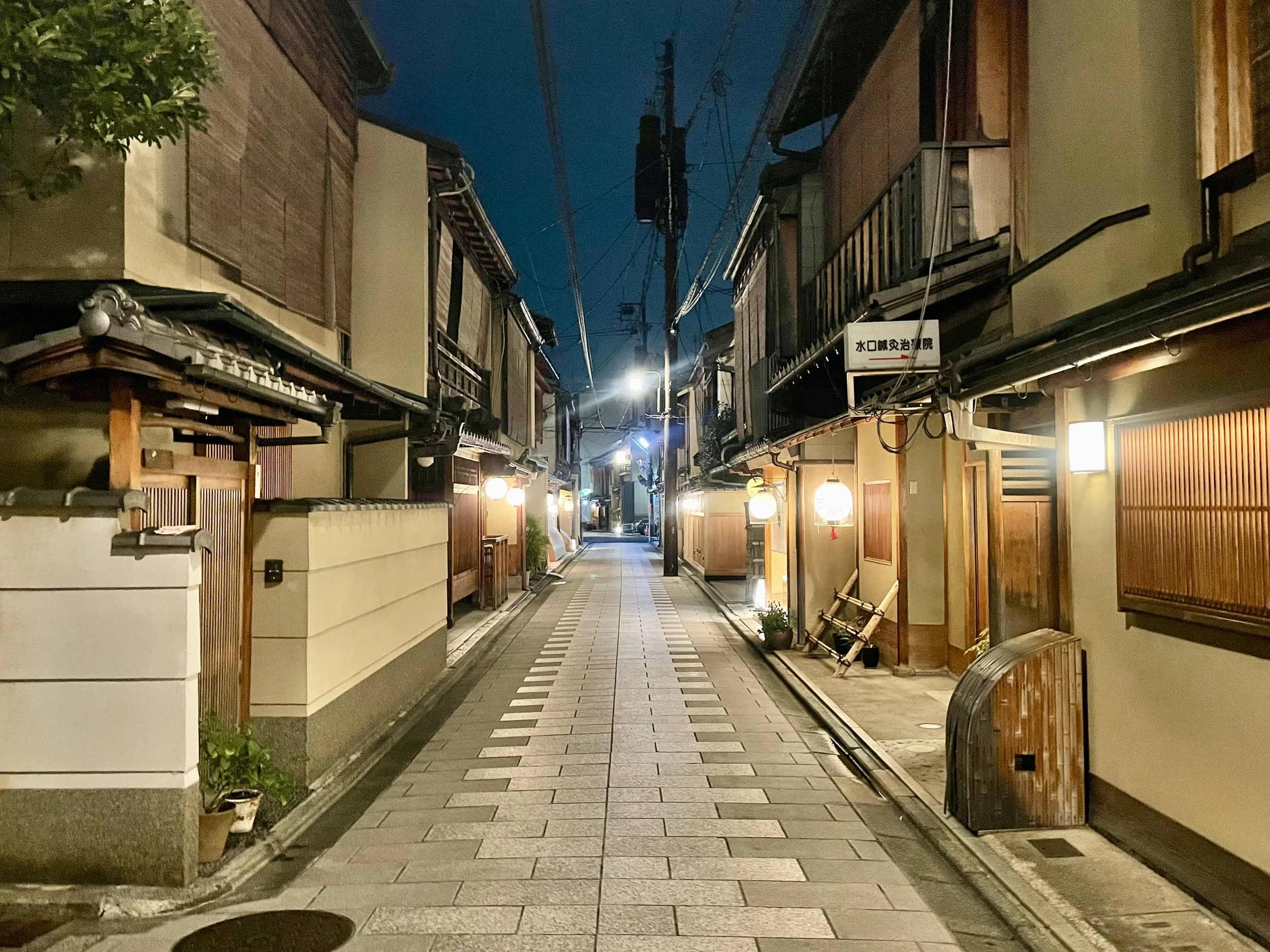
Gion, after dark and open for business