Japan, as seen from the bottom of a barrel…
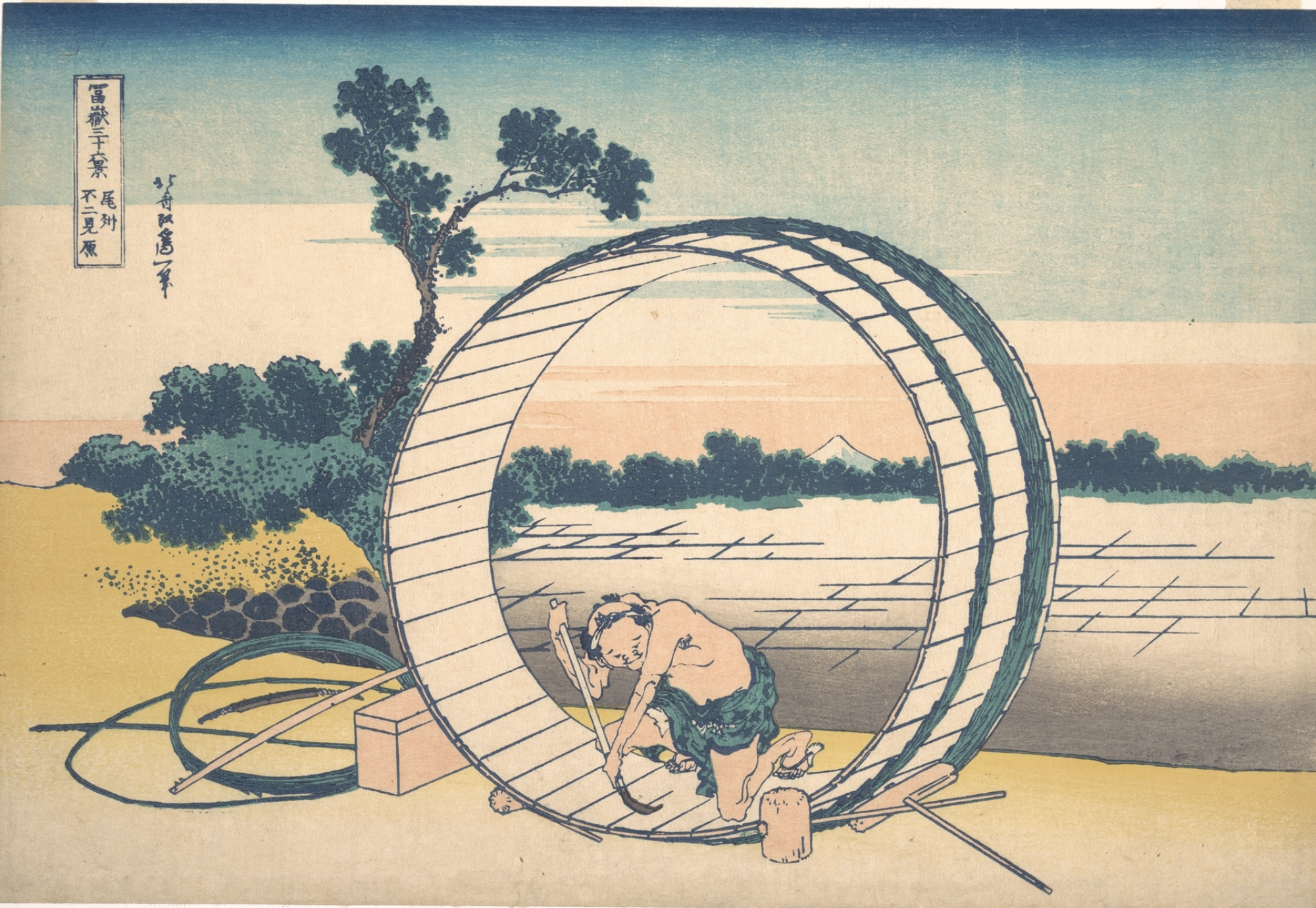
Fujimigahara in Owari Province, by Katsushika Hokusai
See the man. Encompassed by the roundness of the barrel in which he toils, with a gouge he scrapes the staves. He is shirtless, aged, as though the work has taken decades, but he does not at all appear weary. His expression is that of satisfied good humor, and the comic simplicity of the illustration suggests a children’s storybook, as though once he has set the day aside he might be joining Ratty and Mole for a bit of boating among the water weeds. He is both in and of the landscape, the foreground of a perfect circle centered as a rising sun, while deep within the back, beyond the fields of rice and forest, is the white cone of Fuji, so small it might only be a pile of snow or salt, soon melted by the rain.
In this single woodblock – Fujimigahara in Owari Province, by Katsushika Hokusai, part of his 36 Views of Mount Fuji – the artist is playing with several concepts simultaneously. The barrel is both bottomless and incomplete, and yet holds all that is most sacred to Japan’s own sense of self: dedicated artisans, fields of tended rice, the enduring, guardian presence of Fuji-san. But it is not, in composition, Japanese.
Hokusai is among the most famous of Japanese artists celebrated outside Japan. His work The Great Wave Off Kanagawa, part of the same series of prints, is probably the single most famous piece of Asian art – let alone Japanese art – ever produced. One of those pieces that has been echoed and iterated so many times in pop culture, parody, merchandise and advertising that one feels they’ve already seen it even if they never have. Like the Mona Lisa, the Birth of Venus, or Alberto Korda’s photograph of Che Guevara, the Great Wave appeals to people who have little to no engagement with art. It even has its own emoji 🌊 . Earlier this year the contemporary Japanese pop artist Hiro Sugiyama created a version using 750,000 dahlia blooms on the streets of Brussels.
There are so many reasons why Hokusai is Japan’s cultural ambassador of choice, but we’ll start with the easiest: his work sells.
Hokusai enjoyed a great amount of professional success during his lifetime - 1760-1849 - and is one of those exceptional artists who never ceased experimentation. (Even The Great Wave as we know it is the fourth iteration. The evolution is phenomenal.) The 36 Views of Mount Fuji were produced towards the end of his life. But he was not a producer of “fine art”, as it is understood either now or then. When Hokusai was alive, fine art was painting. Suitable topics were portraits of Daimyo (feudal lords), or the Shogunate, or the Imperial Family, or else scenes of history, religion, or mythology, and their flattering connections to the present ruling class. Which is to say art commissioned by rich people for rich people, covering much the same topics as had already been mined for centuries.
Woodblocks were low-class. They could be printed and reproduced quickly and almost ad infinitum, and above all, were cheap. Hand bills for upcoming theatrical performances, portraits of actors (Edo era equivalent of headshots), religious festival, public notices. All these were done in woodblock print. Practically any day laborer could still afford a woodblock print, in the same way most people can still afford a magazine because they want to tear off the cover or centerfold and pin it to a wall. They were advertising, and Hokusai expended most of his creativity hawking product or events, with a smaller – though financially quite significant – side hustle dedicated to Shunga, that is pornography. (On that topic of centerfolds, while it feels bizarre to label a more than 200 year old piece of now classic art as ‘Not Safe for Work’ – I mean, geez, just how prudish are we moderns???– the daring can click this link and see why The Dream of the Fisherman’s Wife is considered the foundational text of tentacle porn)
Hokusai’s woodblocks work so well in advertising because Hokusai himself worked in advertising. And not just for products or events – although he did plenty of those – he was also a shameless self-promoter. In 1817 in Nagoya, he painted an 11 meter by 18 meter mural of a daruma doll using a broom and bucket of ink and billed it as a piece of performance art – which it absolutely was – and promoted it by distributing hundreds of handbills advertising both the event and his collection of manga, available for purchase, “yours for the low low price of…” Hokusai was the product, and he became the event.
Hokusai was – and remains – so beloved across cultures because while his techniques are Japanese, his inspirations were external. He never left Japan, and probably never came into direct contact with any foreigners since his lifetime coincided with Sakoku, (the closure) when the nation was nominally closed off to all outside influence. But somehow he got his hands on a collection of Dutch landscape paintings and copied the open horizons, multilayering, and vanishing focal points and incorporated them into his own work.
Prior to this, Japanese art was flat – closer to European medieval paintings where all characters appear to occupy the same plane, regardless of distance. (consider Night Attack on the Sanjo Palace) But if you look at the landscape paintings of Pieter Bruegel the Elder (c. 1530-1569) , especially Landscape with the Fall of Icarus, or Hunters in the Snow you see what attracted and exerted influence on Hokusai. Not just how characters diminish with distance, but the human figures as characters both separate and inseparable from the landscape. Each engages with their own deeply personal experience. In the first, the mythical, quasi god-like figure of Icarus is reduced literally to a footnote beside the quotidian drama of a farmer ploughing a field, himself completely unconcerned with the downfall of the proud. Like the toiling cooper and the minute Fuji, both contained by a bottomless barrel, the whole work communicates ‘and still the world goes on.’ Or in the second work of Brueghel, Hunters in the Snow, it’s not just the differences of literal distance that are depicted, but figurative ones as well. A disappointed and dejected party returns to their icebound village, even as the merriment of a skating party unfolds within the background. Just as beyond the rage of a cresting wave, the distant cone of Fuji stands serene, unmoved.
“I did not know that one could be so terrifying with blue and green,” Vincent Van Gogh wrote his brother Theo, after seeing The Great Wave off Kanagawa at the Paris International Exhibition of 1867. “The waves are claws, the boat is caught in them, you can feel it.” The 1867 Paris Exhibition, which included a full run of 36 Views of Mount Fuji, is one of those legendary novas of art history where you can pinpoint exactly the collapse of an former solar system and the emergence of new stars. An awestruck Cezanne went home and began his series on Mont Saint Victoire. Monet retired to Giverny and started painting lily ponds and bridges. And as for Van Gogh, one sees that wave in echo in his own feverish dreams of a starry sky.
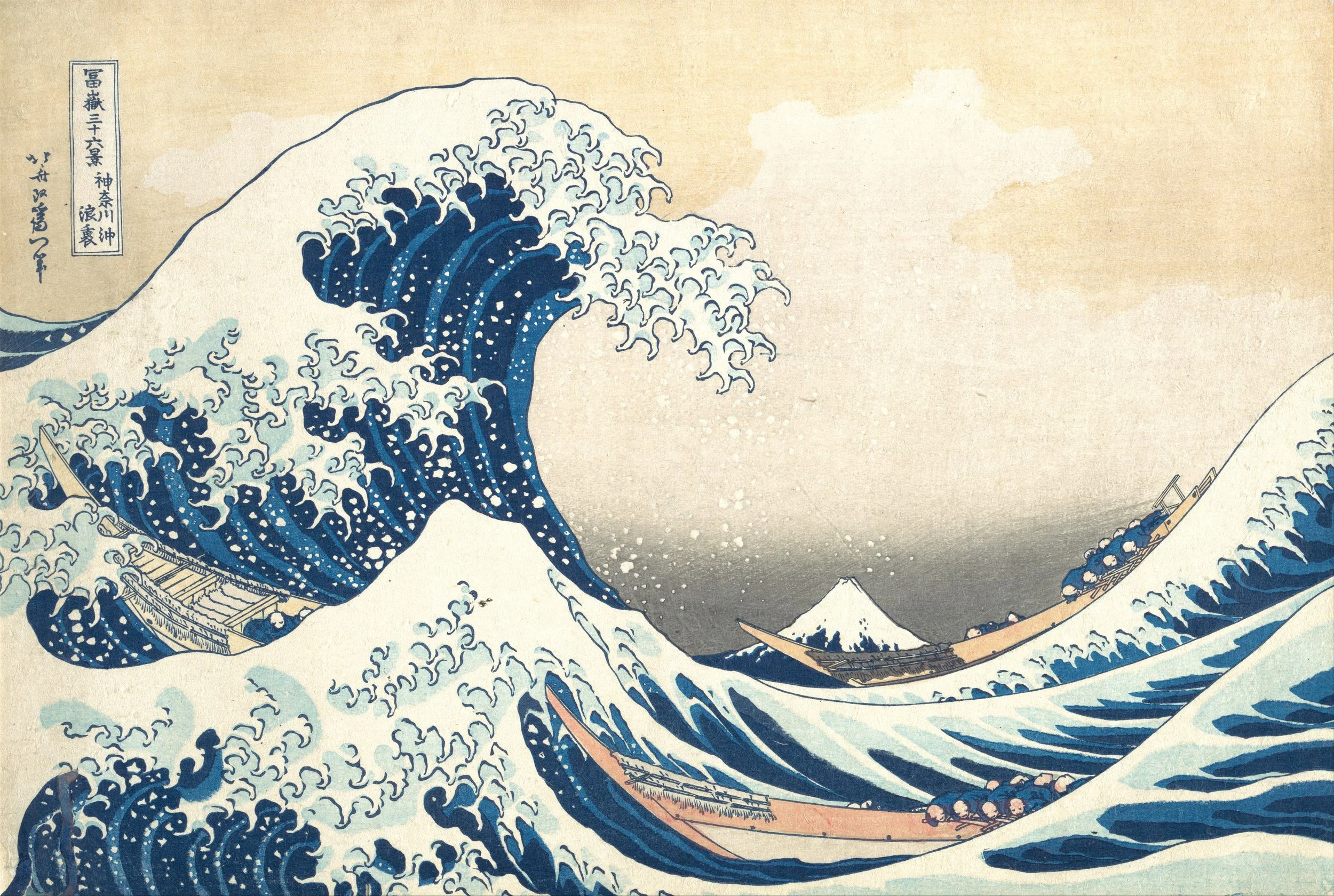
The Great Wave off Kanagawa
Hokusai’s innovation was the adaptation of Western perspectives to Japanese subjects and in so doing he was – perhaps unwittingly – giving Japan a new sense of self, while at the same time presenting Japan to the world. He made Japan legible. And ever since there has been an astonishing recursive feedback between work produced within Japan and work produced outside of it, and fierce debate within the nation itself of just what gets to count as Japanese.
So much of what the Japanese prize as distinctly their own is foreign import repackaged for domestic consumption, then re-exported abroad. Zen, kanji, tea culture, bonsai, calligraphy, tempura, ramen, anime, denim. All of them have their origin overseas. Because even at its most shuttered, Japan has never been completely closed. There has always been immigration of ideas if not of people.
I’m reflecting all this as Japan enters a new era of gatekeeping and fresh anxiety. There is perhaps no more fascinating embodiment of the current xenophobia than Kimi Onoda, minister of the somewhat cumbersomely titled ‘Society of Well-Ordered and Harmonious Coexistence with Foreign Nationals.’ (Basically director of immigration, but notice how carefully the office avoids the term. Japan has always been more open to foreign ideas than foreigners themselves.)
Onoda, a mixed-race individual born in Chicago of a Japanese mother and Irish-American father – though she did formally renounce her American citizenship upon entering politics – has stated that maintaining “Japanese culture is the line we absolutely will not cross.” And distilled her own policies to a simplified dictum: “If you come to Japan, follow the rules, or leave.” These opinions were expressed – somewhat bafflingly – during a conference regarding certain accommodations for Japan’s small, but growing Muslim minority, such as burial options beyond cremation and halal lunch options in public schools. But unfortunately, like all xenophobes, Onoda fails to understand that the existence of a minority does not constitute a threat to the majority. No one is taking away her access to sumo and udon - or yours for that matter should you visit - they are just proposing additional options be made available for the newest generation of Japanese. Besides which, Muslims constitute less than one half of one percent of the population of Japan. By far the greatest share of immigrants come from China, which is to say, from the mother culture of zen, tea, rice, silk, ramen, bonsai, kanji…I could go on, but do I need to?
Throughout its history Japan has always gone through periods of openness and then exclusion. The current anxiety over immigration is really an anxiety of growing old and irrelevant. But preventing newcomers will do nothing to assuage either. It is possible to adhere so strictly to an idea of the past as to deny yourself the possibility of a future. And unfortunately this particular outlook is not uniquely Japanese.
Nominal patriots hide behind reasonable sounding but ultimately meaningless positions like cultural defense. What does it mean to maintain the culture? When was Japan most Japanese? The average resident is far more likely to attend a baseball game than a sumo match, to sing off key Van Halen covers at karaoke than hire a geisha for entertainment, to wear blue jeans than kimono, and I sincerely doubt that very many Japanese teenagers experience their own sexual awakening via The Dream of the Fisherman’s Wife, or any other classics of an analog genre.
I’m sure Onoda is not suggesting a literal retreat to a precise point when she says Japanese culture is the line that must not be crossed, or that all rules must be followed, but it’s not exactly clear what the culture is, much less the line, or every single rule. All cultures draw inspiration from art, religion, politics, and geography and from sources outside their own. They are constantly in flux. What is French culture? Is it reducible to a single code? When was France most French? Paris summer 2024? The protests of 1968? Was it La Belle Epoque? 1812? 1789? The reign of Louis XIV? Even within Onoda’s lifetime the culture has changed radically since her birth in 1982. As a child born abroad to a foreign father, she did not inherently qualify for Japanese citizenship by the laws of the time but only gained it retroactively as a teenager once said laws were changed. In other words, she entered Japan – and lived much of her life – as an immigrant.
Like hiphop and jazz before it, the most interesting and exciting art and artists have always drawn from traditions outside their own, whether or not the culture as a whole was ready to receive it. And Japan has produced its best and most exciting work when it – or at least its artists – have looked beyond its borders.
There is no artist more beloved within Japan, and no Japanese artist more beloved by the world, than Hokusai, but he got there by breaking from convention. By not adhering to priors and by using novel techniques. In other words, by not sticking strictly to the rules. Meanwhile the most “authentic” and rigorously Japanese artists of his own time period are now almost completely forgotten. His contemporary Kano Shosen-in was a respected 17th generation painter of an aristocratic family of the artisan class. But not only is Kano an obscure figure outside of Japan, he’s barely remembered within it. His paintings of Mount Fuji are not poorly done by any means, they’re just…well…expected. They could just easily have been produced in any of the five hundred years preceding. They don’t have anything new to say. Or even anything interesting. They lack vision. They lack perspective. His work adheres so rigorously to tradition it could hardly even speak to his own present, let alone a future. He’s foreign even to his descendants. In his hands Fuji could be any mountain. Removed from context, it’s not even clear that it’s Fuji at all. It’s just an inverted V on paper. I’m not sure that’s a version of Japan that anyone would want to claim. Not even the Japanese.
Hokusai is beloved both inside and outside of Japan – along with Utagawa Hiroshige and Yayoi Kusama and Junya Watanabe and Hayao Miyazaki and Haruki Murakami – because the work remains open. It’s a door that swings both ways, outwards for those within the culture, and inwards for those without. The unfinished barrel may hold all that is most sacred to Japan, but it doesn’t contain every possible thing. It is an imperfect entry, in, out, and onwards through to the other side. The barrel holds no bottom. There’s an awful lot more it could contain without ever displacing Fuji-san.
…and still have space remain.
~C