Summer also ends in spring…
the covered bridge of Kotohira
Summer is a season of swelter and of suffocation in Japan, when the nation feels contained to the point of near combustion. Cycling, walking, indeed expending any effort at all out of doors during daylight hours – and often well into the dark – is to feel as though one had willingly crawled into the mouth of an overly enthusiastic Saint Bernard whose affections for you bordered the maternal, and you were now being reclaimed into the pack through unwelcome latherings and bathes of hot, gingivitic breath. Dog days indeed. It seemed a marvel the stones and trees did not themselves perspire, or else dissolve like molten wax, while all living creature, excepting perhaps the insects, were condemned to creep along in shallow saline puddles of their own make.
In my imagination, Japan is a much more northern country, sharing the majority of its parallels with Canada. But at Cape Soya – its northernmost extremity, from which it is possible on clear days to catch a glimpse of Russia – it barely reaches Milan or Montreal. Excepting a few kilometers of Hokkaido, the entirety of the nation lies closer to the equator than the pole, and the further south one gets the more irrefutable this fact becomes. In Sendai, in the north of the main island of Honshu, I had seen my first palm trees, but they were of a type that tolerates dips in the mercury down to minus ten centigrade, and had been planted alongside a south facing wall of a building where they might benefit from the concrete’s heat retention. By the time I reached Shikoku the palms of several species grew openly, needless of such shelter, while cannas naturalized in roadside ditches, and in the river bottoms bananas grew with lavish abundance.
Darkly iridescent butterflies, their wings the size of greeting cards, flapped heavily along swathes of drowsy kudzu, and in the telephone wires above the road, joro spiders built their webs, the filaments themselves too fine to see but the spiders so large they required no telescope to detect against the sky. I have been assured they are harmless, shy, and unlikely to bite even when provoked, but still so disgustingly large for any land-based arthropod to make one glad they favor such heights. I have no idea what they could feed upon at such altitude, but I had seen few sparrows or other songbirds at rest upon the wires. Very few indeed.
When I had reached Kyoto weeks before, the cicadas had gone silent, packed up and done for the year, but somewhere around Himeji a few again emerged, so distant and distinct from one another the trees they occupied could be isolated, the insects themselves identified as individuals, and I mistook these few for stragglers, cardplayers at the kitchen table unwilling to acknowledge the passing of the hours, the departure of the other guests, and the hosts themselves all gone to bed. But when I arrived in Shikoku the bugs crescendoed once again, and I realized it was simply that I had been rolling south on the ebb of summer, and had re-entered the season.
Japan operates on several calendars besides the familiar one of months and days, and the ending of summer is announced audibly by the sonic overlap of hot and cool weather insects in the din of mushi-shigure - 虫時雨 –“insect rain” a dense, exoskeletal composition of creaking, clacking, cracking, and chirping of about thirty species of cicada, ninety of crickets, and one hundred and thirty varieties of katydid. This accretion of percussive elan coincides with the emergence of the higanbana - 彼岸花- the flame red spider lilies that crowd the hollows of Shikoku in a sweep of fire as the final eruptive bloom of summer.
The last character of the name is simply hana - 花 – “flower” but the preceding kanji signify ‘the far bank’ or ‘the other side’ and the lilies sprout in great profusion along ditches, streambanks, and other untended waterways, just as they are said to grow along the Sanzu River of Buddhist mythology, the dividing line between the land of the living and that of the dead. The grand, and rather rousing chorus of the insect calendar implies a season of high spirit and of bacchanal, while the floral book of hours suggests a time of crossing, of reflection and of a coming darkness. A frost not too far off that will soon put paid to both the celebration and the celebrants. It can of course be both.
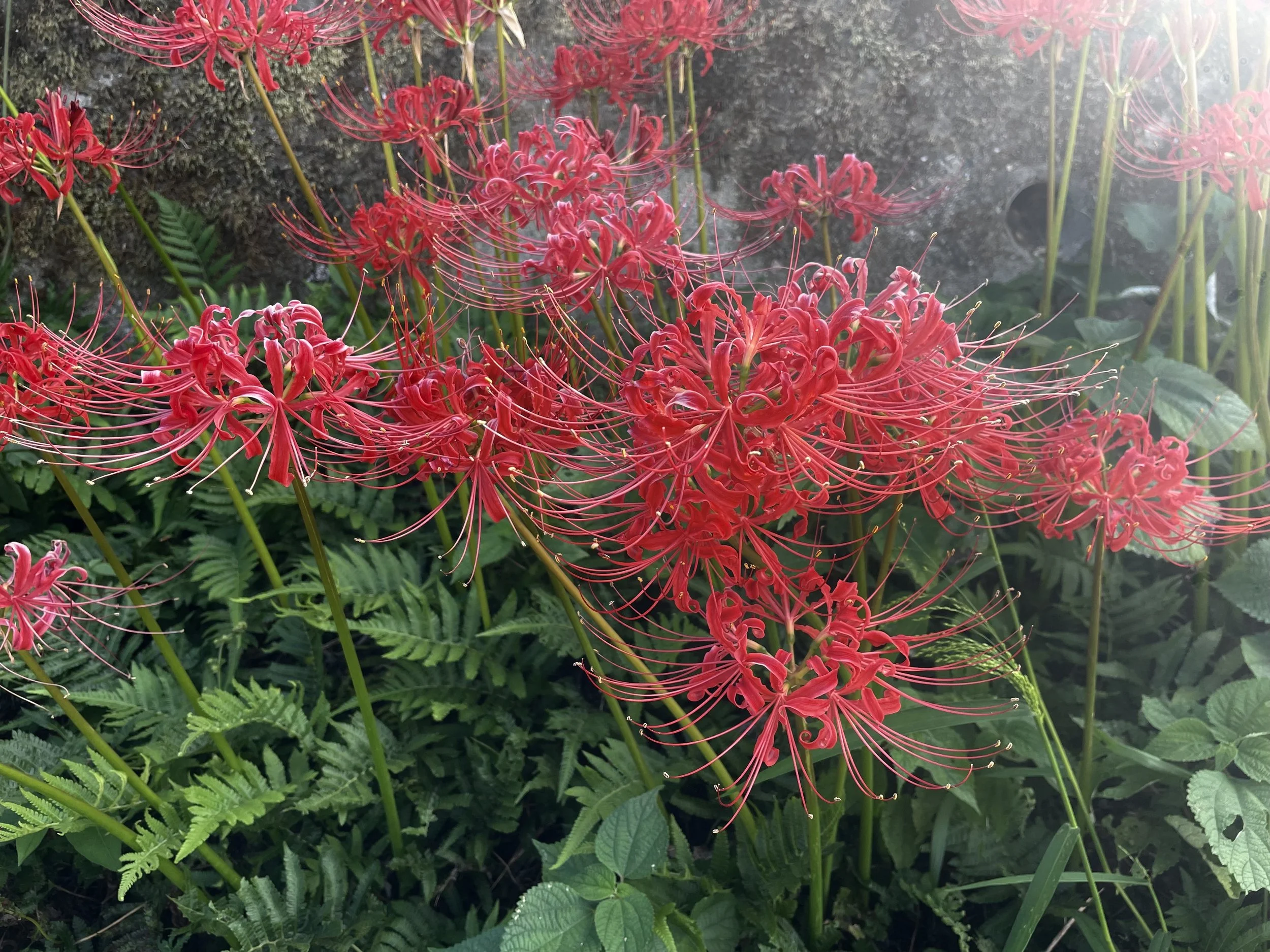
higanbana - 彼岸花- the spider lilies that grow in wild profusion throughout Shikoku and the other islands
Cities are forever remaking themselves such that it is almost always now. But in the boonies even the present arrives at delay. Countryside has to make due with the past and find a way to bear it forwards. It is often every century at once.
Shikoku suggested an age and era I had not experienced since leaving Hokkaido some months before. Hokkaido had been the subject of intense late 19th century integration into the body politic – and for several strategic reasons, namely exploitation of timber and mineral resources for an industrializing nation, for the pacification of a large, freshly unemployed, and newly disaffected samurai class, and then as a door stop to Russia – but Shikoku had never been contested, and been left more-or-less to catch up to its larger brother Honshu and to integrate itself. In Hokkaido, one had the sense the future dropped upon it in a hurry then marked time until the rest of the nation caught up, and then surpassed. In Shikoku it felt more as though prosperity flashed briefly over the island, consumed all available fuel, and departed, leaving only a trail of broadcast televisions and fax machines as exhibit of its passing.
Where westerners favor decades as a metric of historical description, Japan is roughly measured in emperies. And if Hokkaido’s fortunes were Meiji – 1868 to 1912 – then Shikoku is decidedly Showa, the era coincident with Hirohito, from 1926 to 1989. Population peaked in 1953, and economic output sometime just before the opening of the Seto-Ohashi Bridge in 1988.
Connecting Okayama and Kagawa prefectures, officials touted the economic boom this pinnacle of modern architecture would doubtless bring the island. But by reducing the friction of time and distance required to reach the juggernauts of the Kansai region, the result was the exact opposite of every hope, as young people discovered it far easier to leave for more opportunities and better pay in Osaka, while established companies on Honshu found little reason to open new branches – much less relocate – to an under-developed and rapidly depopulating island, no matter how much cheaper the land, how relaxed the regulation. Shikoku has experienced an uninterrupted decline in both population and GDP every year since 1990.
This was, I felt, a lost Japan, the towns frozen somewhere around the promise of 1985, or 1885 to judge by the quaintness of rice paddies half the size of a tennis courts and just barely industrialized with mechanized threshers, or 1785 as seen at the terraces of the tea plantations, where though the farmer may wear a smart blue baseball cap for the Los Angeles Dodgers, all labor is still conducted not just principally but entirely by hand. Or even earlier still. The Henro Buddhist pilgrimage, a circuit of some 88 sacred temples, is older by a century than the famed Camino de Santiago de Compostela of Spain, and the most devout of pilgrims still dress as though penitents at the height of the Heian period (c. 794 – 1185 ACE) – white robes, sedge hat, long wooden walking staves.
Those who truly operate by faith support themselves by alms, and in Kochi I saw several, kneeling in the local fashion that doubles as a seat, eyes closed, patient as unlit streetlamps, awaiting the clink of yen. I was reminded in their postured patience of the country houses of Junichiro Tanazaki’s essay In Praise of Shadows, in which he notes the elegance of “the lonely light of a bulb under an old-fashioned shade, shining dimly from behind the white paper shoji of a thatch-roofed farmhouse,” “seen at dusk as one gazes out upon the countryside from the window of a train.” Shikoku is rich with shadow, though very few trains as it remains the only one of the four main islands unconnected to the Shinkansen – the bullet train – despite more than fifty years of lobbying by officials for integration into the network. Yet considering the effectiveness of a single bridge to sap away youth, wealth, and future prospects, one trembles to think on the consequences of courting a silver bullet.
The entirety of the island had a stillness that appealed to me, but it was the stillness of the unplowed field, the unlit forge, the grade school closed for lack of students. The nights brimful of a potent, depopulate darkness. Sounds of insects and not engines. Mountains quieted in groves of timber bamboo as lovely as those of Arashiyama, if more savage and untended and for this more beautiful still. An island dense with mystery and lore of a shadowed, totemic past – moss grown houses, temples, castles, and hydro-electric plants, each in various states of operation and abandonment. Shikoku is the only one of the four main islands that lacks a city of at least a million inhabitants. Its largest – Matsuyama – barely surpasses five hundred thousand. I saw perhaps ten other westerners in my trek - from Takamatsu to Kochi and then the “big city” of Matsuyama - as I crossed the island twice. Had I wanted I could probably have learned all of their names.
a typical mountain village
As is an occasional annual habit of mine, I spent these transects revisiting The Great Gatsby. I had tried some of the novels of Kenzaburo Oe – not only a Nobel laureate but a native of Shikoku besides – but the works had no charm on me other than as soporifics. I had kept one – Death by Water – purely for sedative value, but being able to manage no more than a page and a half at a time before collapsing into slumber, I was finally ready to admit defeat. The plot was not difficult to follow, as every chapter was a near exact repetition of the one before. So I concluded the novel’s chief failing was simply too much space between the covers. I left it behind at a hostel’s book exchange in Takamatsu, and cleansed my palate with Gatsby, a tight and tidy 47,094 words.
I do not come back to Fitzgerald every summer, but I often have since deciding some time in my thirties to reconsider the required reading of freshman year. I had avoided it in the interim as I felt anyone who named Fitzgerald as their favorite author had likely never progressed beyond adolescence in matters of taste…in anything. They had been seduced by the party, and of lives curiously free from the consequences of action, up to and including the commission of murder. Romantics, or else the heinously wounded and misunderstood – and what teenager isn’t? – for whom women were either children or collectibles. A fine novel for boys, I had concluded, forgetting I myself had once been one yet could remember nothing seductive in the script. But no girl that I knew ever named Fitzgerald among their own favorites, despite the dedication, “once again to Zelda.”
So my surprise and humility were each profound when I realized about the age of thirty-five that this F Scott fellow may have been on to something. And while his other works have never quite landed for me – Tender is the Night, This Side of Paradise, Tales of the Jazz Age – being a one hit wonder is wonder enough when that hit is Gatsby.
And as happens with some frequency when I return to any novel I found my sympathies shift about once more. This time – perhaps on account of my own toil – I felt most tender towards the servants, the nameless Finn, the butler who merits mention only for the sake of his astonishingly productive thumbs, capable of juicing two hundred oranges an hour. Michaelis the Greek proprietor of the cafe across from that cataclysmic mechanic’s shop, and the only truly human character within the entire novel, though his existence is compressed to a single chapter.
It might have been on account of my own setting that I thought of the kuroko, the stage hands of kabuki theater, who enter the performance clad entirely in black, such that even their faces remain obscure behind a charcoal veil, but who partake of an unacknowledged yet mutually agreed upon invisibility in their contract with the audience. In an artform of the garish and tempestuous gesture, of flamboyant costume and high ego, the kuroko are agreed to be separate, as they rearrange scenery, manipulate robes, or even reposition the actors themselves. Witnesses perhaps to history and myth, but not worthy of witness themselves. Even further down the chain than peasantry compared to the lordly flare of the principals. Shadows perhaps, and that is all, though they light lamps, operate machinery, perform the motions of the world as though spirits, to which they might also be compared. The most interesting productions toy with the ambiguity.
There is no easy division between ghosts and gods within Japanese understanding. And that even more slippery term kami - 神– might be applied to seemingly anything. A storm might be seen as the work of kami – such as the famous kamikaze typhoons of the 13th century 神風 which twice turned back invasion – but so too it is kami itself. It is both quality and entirety. Among the Abrahamic faiths the burning bush is understood purely as a conduit of communication. Bullhorn of the Great I Am. To ask ‘what does the bush want?’ is like asking what are the desires of a sheet of paper? Or of a telephone wire? The question makes no sense. Yet if Moses had been Japanese the bush would have been evidence, emissary, and also individual, unconfined by any limit of grasp or definition. Practitioner of its own free will.
If ever one such bush existed I felt sure it could be found somewhere on Shikoku. There was scarce a kilometer without a roadside altar to guide or protect the pilgrim, ostensibly Buddhist but with the trappings of Shinto. Buddhism in Japan – like Irish Roman Catholicism – may occasionally swallow other faiths but will still set them up comfortably within its stomach. And the island seemed akin to those places I have visited where spirituality and superstition embrace and procreate. Portions of Mexico. Portions of my own country. It felt gravid with kami. I would not at all have been surprised to have encountered painted calaveritas, or some local who might have crooked a finger in gesture towards the distance and declared ‘up yonder’ to describe a point of origin. Pilgrims on the Henro remember the tenets of the eightfold path, and also to guard themselves against tengu and inugami and other such spirits of mischief, of hunger, and of vengeance. Idly I wondered which one I might be.
The air grew noticeably cooler though not exactly cool as I labored upwards, only less oppressive. Some change had happened, not of temperature, but in quality of air. The wind had shifted as a door upon a hinge, and I felt distinctly that something rather weighty and with about the heft of a Saint Bernard had just been left behind.
Crossing into Ehime prefecture I tumbled into the minute, elevated basin of Kumakogen, and after such long stretches of near vacancy this nexus of contained activity and habitation charmed me. The rice fields – almost never square in outline but of crisp, uneven shards, as though each were crafted from the scattering of a single, shattered pane – were mostly cut to stubble. Throughout the remainder, operators of small threshers sat astride their devices, lumbering across the muck, their grazing machinery consuming and separating the grain from the grass, which exited the further end. The air held the haze of harvest, the smell of burning straw, of diesel mechanics, of seasons turning over. I found it all deeply touching and felt a great tenderness towards such soundly tended and tenanted land. A few kilometers back I had reached the end of Gatsby, and the ascent to the final lines had moved me once again to tears. Like the prelude of the Bach cello suite, no matter how many times I hear it, I still gasp in that beat just prior to the end when, having been drawn gently along to some calm and peaceful promise of a place just beyond the present reach, it then lets slip its grasp.
Insects chirped but with a distinctly lesser vigor, while in the ditches beside the fields the flames of spider lilies bloomed with undiminished abundance. Upwards from the valley, the slightest bit of red just flared along the tips of leaves that grew upon the peaks, and soon these two plot points of ember – in rise and fall – would unite into a single blaze and sweep the slopes in fire. I had just touched the hem of autumn, at the quaking edge of a fresh beginning, for summer also ends in spring.
The town’s emergency broadcast system switched on and played a calliope version of some indistinguishable melody intended to signal to the closing of the day. These types of systems are common throughout Japan, and while kept at the ready in the event of earthquake or evacuation, are more often deployed at about five PM daily in the dispensation of baroque chaconne, the Beatles catalog, or the collected works of Rodgers and Hammerstein. Inoffensive selections as appeal to those who like shiny red apples and fluffy white clouds. For Japanese children, this is the equivalent of ‘come back when the street lights turn on’ and in their smart school uniforms they could be seen dutifully evacuating playgrounds (the younger ones) and convenience store parking lots (the older) and then dispersing home.
The doppler effect is detectable even at the slower speed of a bicycle, and the music distorted with passage into a carnivalesque audio funhouse that contrary to indication, did not sound very amusing at all. There was only an hour and a half of daylight remaining, one more final mountain pass, and then nothing but a downward slope, an increase in warmth and weight of air, a return to the caper of crickets, to tea plantations and bamboo groves, to summer and to insect song, and by dark, perhaps, the sea.
Just give me one more turn about the carousel, I thought, as I pedaled away in the gathering dark. I’m not ready yet to leave the fair.
~C