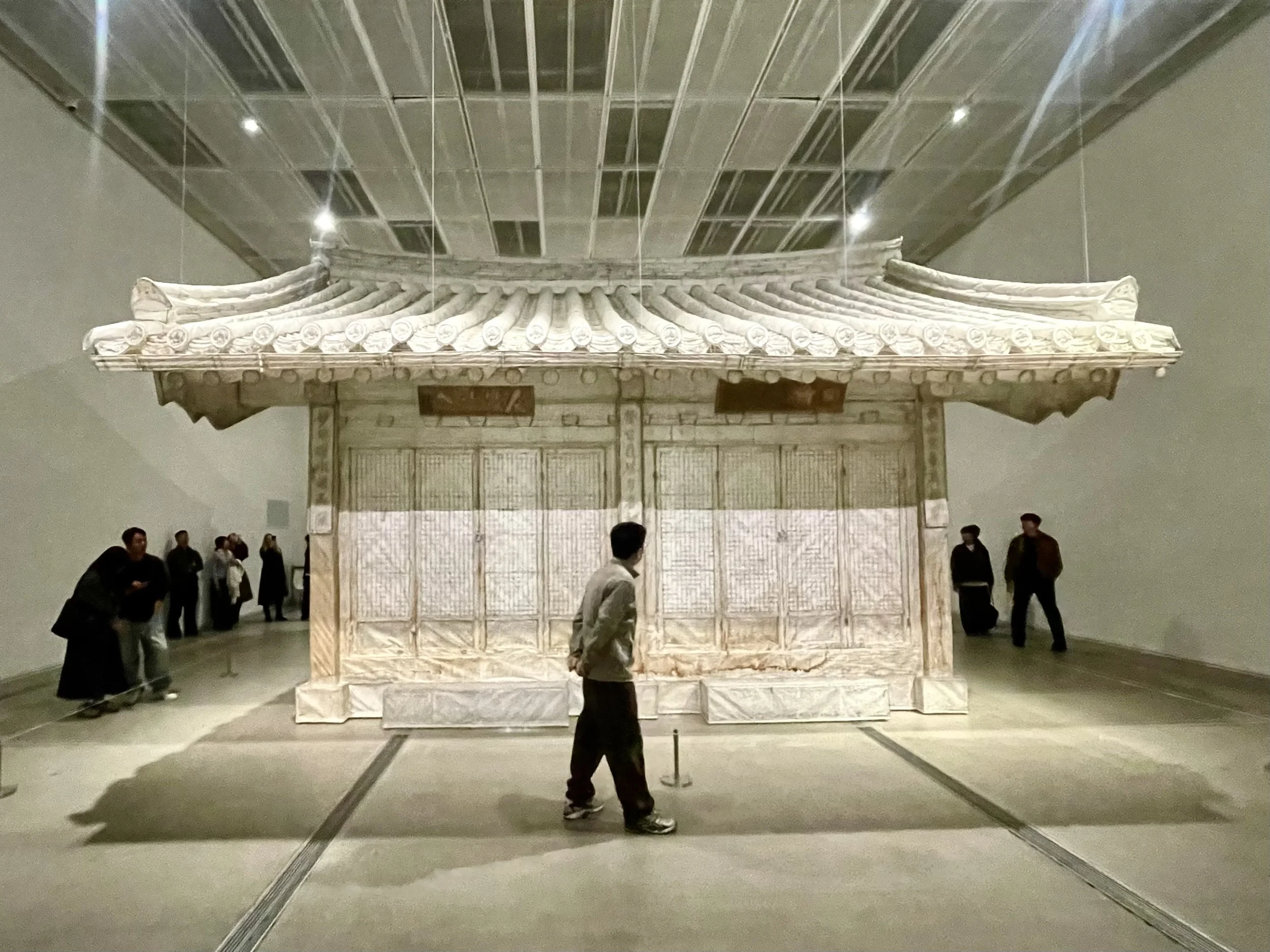
a paper hanok, installation by artist Do Ho Suh at the National Museum of Modern & Contemporary Art
It was on my second day in South Korea that I got slapped. An ajumma was attempting to guide a personal shopping cart, heavily laden with vegetables, down a set of stairs. As I do not speak Korean, I tapped her on the shoulder and indicated by gesture that I would assist in bringing the cart safely to the bottom without disturbing any cabbages. With one hand gripping the cart, she batted me away with the other and shouted, and then struck at me again. I retreated in shock and surprise, her alarums of discontent echoing behind me as I fled, and not a single cabbage out of place.
I learned later that it is considered quite rude to tap a stranger on the shoulder in South Korea, but in my defense I did not yet know how to say ‘excuse me.’ (I have since learned - 실례합니다sillyehamnida – to avoid such future misunderstandings) But I was also, and this may sound strange, relieved. Because after three months in a country where silence is the cultural norm, and one must wait for others to anticipate their mind than ask directly for what one truly wants, the ajumma knew exactly what she wanted, or in this case did not want, and made sure that I understood, and felt no reason whatsoever to sugarcoat any of it. I was still following the old script of anticipation. She assured me – with a slap – that particular script does not translate.
Almost immediately the anxiety and restraint I had felt since arrival evaporated. There was no need to go about on tiptoe. Here the social order can withstand being struck, even cursed, and the vegetable cart will still remain upright. I practically skipped the rest of the day.
In general I find comparisons between people of different nations not only inaccurate but tedious. Not to mention, Japan and Korea have a long, complicated, intertwined history of devastation, largely inflicted by the first and suffered by the latter. But with that said, it’s hard not to note particular differences from my own experience.
My Japanese is far from perfect, but functional. Certainly up to snuff when it comes to ordering off a menu or making a reservation. But I would still on occasion – rarely, I do want to stress, really no more than five times on this past trip and always by someone elderly – be told that there was no room at the inn, the restaurant was full, or they were just about to close, even if you could see that none of that was true at all.
In Aomori, I had entered an izakaya behind two other patrons, father and son if I had to guess, or perhaps employer and employee. At any rate, two men of different generations. Once the masuta had seated them he turned to me and said in English, “Ah sorry, closed.”
“You are…closed?” I asked in Japanese (いま閉めていますか - ima shimete imasu ka) as my eyes drifted to the two men he had just seated, and the vacant table just beside.
“So sorry,” he continued in English. “Closed,” and crossed his arms into an X, the universal gesture of closure in Japan.
I nodded, stepped outside, and slid shut the shogi screen behind me. Then I reached up, grabbed the noren curtain - the blue curtains that hang just above the door and the traditional signal that a shop is open for business - tore it from the holder, rolled it around its staff, and threw it down a stairwell. If the izakaya was closed, afterall.
The defense I have been presented by Japanese speakers – and my fellow western Japanophiles – is that Japanese hospitality requires strict observance of certain social codes. The proprietor wants to be able to provide the best service possible, which requires not only linguistic but cultural fluency. How would you be able to ask a question? What if you wanted to have a conversation? Or a refund? If an emergency happened it could be quite difficult to communicate. So you see, it would be very troublesome for the staff to serve you, especially if they were older, and it was really a kindness on their part to direct your business elsewhere.
I find this a rather disingenuous defense of cultural inflexibility and of xenophobia, not to mention exquisitely bad customer service. A Korean friend was more direct in his assessment.
“Bullshit.”
Having worked in the service industry, where English fluency was never a condition of welcoming the stranger, I agree.
I speak maybe five words of Korean, and read even less of it. Yes, English is far more common here than in Japan, but there are still plenty of people, especially older, who only speak Korean. Yet having now been in Korea for a month it has been remarkably refreshing that not a single person has ever once let a language barrier stand in the way of commerce and communication, whether in a village of a few thousand or a city of ten million. “Hello” and “thank you” get you halfway there - 안녕하세요 annyeonghaseyo; 사합니다 gamsahamnida - and the remaining ground is covered through gesture.
I have realized since arrival that much of what I thought were the first pangs of homesickness while I was still in Fukuoka, awaiting the ferry to Busan, were really just chafing against restraint and a desire for the genuine. In Japan one is always on edge, fearful of misstep, that I found myself involuntarily mirroring the behavior of those occasional proprietors. I chose to self-exclude from certain activities I might have enjoyed because of the uncertainty of welcome for one unacquainted with the rules. There is also such a strong taboo against outright refusal, that I came to doubt the authenticity of positive response. Did they truly want me? Or did they just consider it rude to tell me no? Just what did that fellow mean when he said “yes”? I was contracting into a smaller version of myself.
There is no need for any of that in Korea. If I blundered and violated a social norm, I was informed – and directly. (Even literally having the sense slapped into me.) But that also meant that when people said nothing at all, then they were not bothered. When they were welcoming it was genuine, not mere toleration hidden by a smile. There was simply so much less guesswork of just where one stood. A strange physical feeling crept over me. It was, I realized, relaxation. I had arrived someplace where, though still a foreigner, I was not a complication.
I remembered the line from a Japanese friend who now lives in Oakland, California but who landed in Los Angeles at the age of forty, following a marriage that wouldn’t last, but entering another kind of relationship that would.
“I spoke no English, I had never left Japan,” she said, “and within minutes I saw that for the first forty years of my life I had been holding my breath.”
I was experiencing something similar for myself. Though, mercifully, at a much reduced time scale.
I am not a scholar of either Japan or Korea, and there’s a joke which seems to circulate in both countries regarding long term foreign visitors – “they spend a week and write an article, they spend a month and write a book, they spend a year and make it their profession” – but I’ve been astounded by how much more flexible, dynamic, and forward-facing Korea feels. It feels like not only a more amicable culture, but one that conceives of itself as capable of expression and expansion.
Here’s an example. On my second day in Seoul there was a mass protest against President Lee Jae Myung. I have no idea if the man deserved it, but seeing hundreds of people publicly – and loudly – demonstrating discontent was something I hadn’t seen in months. Granted, most of my travels in Japan this past trip were in the countryside, only rarely straying into cities. But I couldn’t imagine anything similar just across the water, where such displays would likely be discouraged as disruptive, even selfish.
But Koreans have good reason to stay engaged. On December 3rd, 2024, at 10:23 PM South Korean president Yoon Suk Yeol declared martial law. The intention was to silence political opposition, dodge allegations of corruptions, and put an end to a bribery scandal involving his wife. The order lasted six hours, and was blocked – unanimously – by the National Assembly. But during those six hours, and despite the lateness of the declaration, thousands of Koreans rushed to the National Assembly, blocked streets, and with their own bodies physically impeded military vehicles from deployment. They did not shrug off a direct assault on their democracy, nor wait for those in charge to make it right.
Yoon Suk Yeol was swiftly charged with inciting insurrection, impeached and removed from office on December 14th, tried and sentenced in January of the following year to life in prison, where he remains. The 2025 anniversary drew a march of 11,000 protesters through Seoul to commemorate this particular failure of governance and discourage repetition. I found it inspiring to be among a people who consider dissent a patriotic duty and a necessary condition of progress.
Japanese politicians accused of criminal enterprise and facing imminent investigation favor “resignation as atonement” rather than accept the consequences for engaging in scandal. Legally, the dodge doesn’t shield anyone from prosecution, or forfeiture of ill gained assets. Effectively, however, investigations of high-profile public figures, even once out of office, are considered in poor taste, disruptive to the public image of a steady, sturdy, ship-of-state, and rarely pursued. Resignation is – nominally – a shameful enough dereliction of duty and implicit acknowledgement of guilt. And really isn’t that enough? Now…let’s just put this all behind us and move on, mm? Really there’s no need to make a fuss. All’s well that end’s well…
This is not a piece about which country “does it better.” But it may be a piece about which country can imagine their future as something other than an onward plod. Which has a robust enough sense of self it can withstand exceptions and dissent.
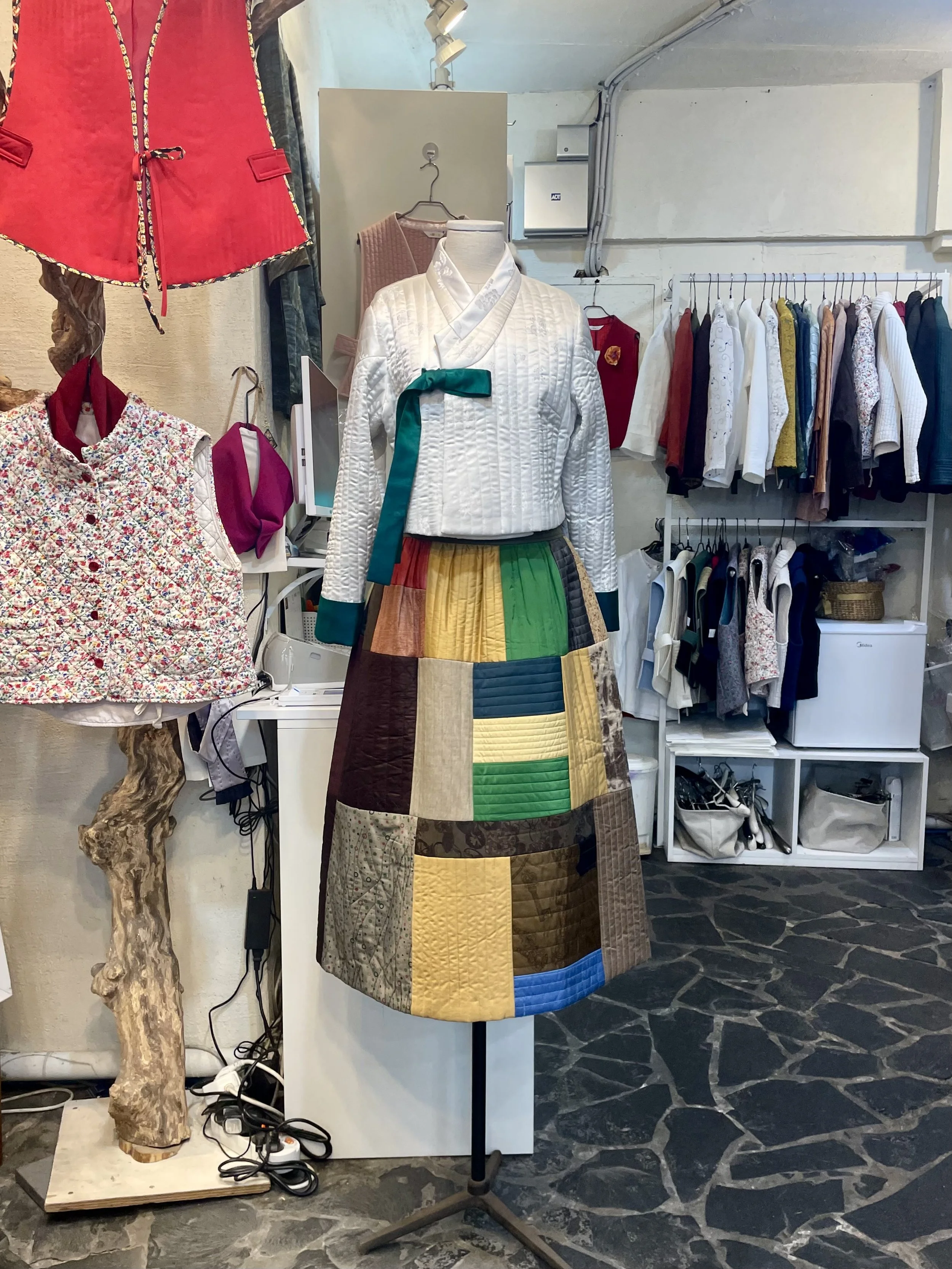
an example of jogakbo - traditional Korean style patchwork - on a hanbok at a boutique in the Ikseon neighborhood of Seoul
I keep thinking of two pieces of art. The first I have already written about. The second is included in an exhibit by the Korean artist Do Ho Suh at the National Museum of Modern and Contemporary Art in Seoul. The majority of the exhibit focused on the shifting idea of home, but I was particularly enamored by an early work from his student days. I don’t know the exact intention of Do Ho Suh, as the piece was unlabeled, with neither title nor descriptor, so here is my own: a sword that is nothing but continuous blade. There is no place it could be held without slicing the hand of the one who bears it.
Why a sword, I wondered, why not a knife or a gun? Because a knife can still be utilitarian, and a gun would be too modern. But swords are indicative of authority, ceremony, subjugation, and – critically – history. As so many nations look to an invented past – “back when we were a mighty people” – I think of that blade without a hilt as a cautionary metaphor. The bearer cannot wield it without drawing their own blood. Just to hold it is already to inflict damage on the self.
I have no idea if that is what Do Ho Suh meant, and I’m not primed enough in sword-smithing to know just what kind of sword it was – Korean, Japanese, some other culture’s modified weaponry - I’m just giving my own read, and one towards which I was primed on account of the previous three months.
I think at present, Japan has a very difficult time conceiving of a future for itself, which is why it may prefer retreat to an imagined past. I think the reserve and coolness that I have encountered on my now several visits may be because the nation considers itself complete, both culturally and geographically. Barring the Kuril islands, which were only ever notionally settled before the Soviet Union snatched them up in the waning days of WWII, Japan has saturated and maintained the entirety of its archipelago, and even absorbed and erased all prior occupation (the Ainu in Hokkaido, the Ryukyu Kingdom of Okinawa). Japan may no longer be, as Herman Melville once described, “that double-bolted land”, but it very much holds a rather tight grip on the keys to all its doors, and left them not so much open as selectively unlocked. (“Sorry.” “No room.” “Closed.”)
However, Korea knows itself to be only one half of a country, and still longs for reunion. Any future will have to include outsiders. “Foreigners” is too strong a term for North Koreans, as the South Korean government considers them as natural citizens involuntarily - though indefinitely - detained. I have used both the terms “South Korea” and “Korea” in writing this – and not the more accurate Republic of Korea – as Seoul still claims jurisdiction of the entirety of the peninsula, even if de facto the government only manages the southern half. The nation still understands itself as somewhat ambiguous and ill-defined. There is room for it to grow, change, adapt, expand, absorb, and still remain itself.
Despite facing many of the same issues as Japan – such as a rapidly aging population and a depopulating countryside – Korea has made itself a more welcome destination for immigration. Close to twenty percent of the population of Seoul is ethnically foreign, compared to only five percent for Tokyo. In Korean movies and television programs, immigrants are depicted sympathetically as fellows in the nation – and occasionally even victims of the same unjust forces. That may be more public relations than true policy – I have never tried applying for a long term visa myself and have no intention of doing so – but if any nation understands the impact of good advertising it’s Korea. Meanwhile, in Japanese media, immigrants are only portrayed if they have deep, uncomplicated reverence for long established tradition – the premise of Japanese broadcaster NHK’s Japanophiles series – or else they are not shown at all.
Korea has also made more of a concerted effort to culturally project itself abroad. The absolute explosion of Korean pop culture over the past few decades – Kpop, KDrama, KFashion, KBeauty – basically think of any form of creative expression and put a K in front of it, is not a byproduct of the free market but a deliberate national initiative of the Korea Creative Content Agency, a state-run department under the Ministry of Culture. The agency has an explicit goal of international expansion of Korean culture in a gambit towards soft-power and global goodwill. And while the initial goal was promotion within Japan and Taiwan as ready, nearby markets, they wildly overshot and made the country a newfound darling of the world.
Even, I would argue, supplanting Japan in contemporary cultural relevance.
Japan, meanwhile, has become more protective. With the exception of video games, where Japan maintains elite status, many of its formerly cutting-edge forms of artistic expression – manga, anime, and fashion – haven’t advanced much stylistically beyond their peak in the 1980s through the mid 1990s, and place more demands upon their consumers. There are certain expectations of cultural awareness if not fluency to appreciate the content, in ways that Korea is completely unconcerned. Many of the most influential manuals and periodicals of Japanese design don’t even bother with translation. (examples: Popeye , Tarzan) Some barely even bother with a web presence. Does that matter if your audience is primarily Japanese? No. But it does if you’re losing ground at home, and need to expand just to survive. Contemporary Japanese fashion is practically moribund compared to what’s coming out of Korea. (a topic for another post.)
Even though I am no longer in Japan I am still discovering the country, even as I discover South Korea for myself. And I realize the irony of this piece. That I claim to find Korea a much more accommodating country, despite having been literally slapped upon arrival, and witnessed protests in Seoul. But that’s exactly my point. There appears to be very little fear that someone might slip up and break the thing. Japan prides itself on classical exports like kintsugi and concepts like wabi sabi, wherein the imperfection merits the praise. But these may just be the concepts that find their way out on account of being more palatable to outsiders, as I find it to be a nation overly fixated on rectitude. Good manners at the cost of good sense.
I am still a Japanophile. I am still learning the language, and considering how I would next like to visit. Japan has such a long and rich history of artisanry to explore. But it’s no contest where I would come back to for any kind of extended decompression, for more contemporary inspiration, and for really, really – oh my goodness me – exceptionally good thrifting.
And while I had hoped to find a teacher of bojagi 보자기 – traditional Korean-style patchwork wrapping cloths - here in Seoul, I have instead procured a book, and this is a skill I very much look forward to learning and incorporating into my own work. Bojagi falls under the umbrella of jogakbo - 조각보- by piecing small patches of remnant textile together. (Bojagi is a specific item – a wrapping cloth – while jogakbo is a descriptor for any item constructed in similar piecemeal fashion) Unlike Japanese boro, which is more often used for preservation of existing cloth by reinforcement via integrated patchwork, jogakbo is about the creation of new textile, building new cloth outwards piece by imperfect piece.
The metaphors are hard to miss.
~C