Artistry & Industry
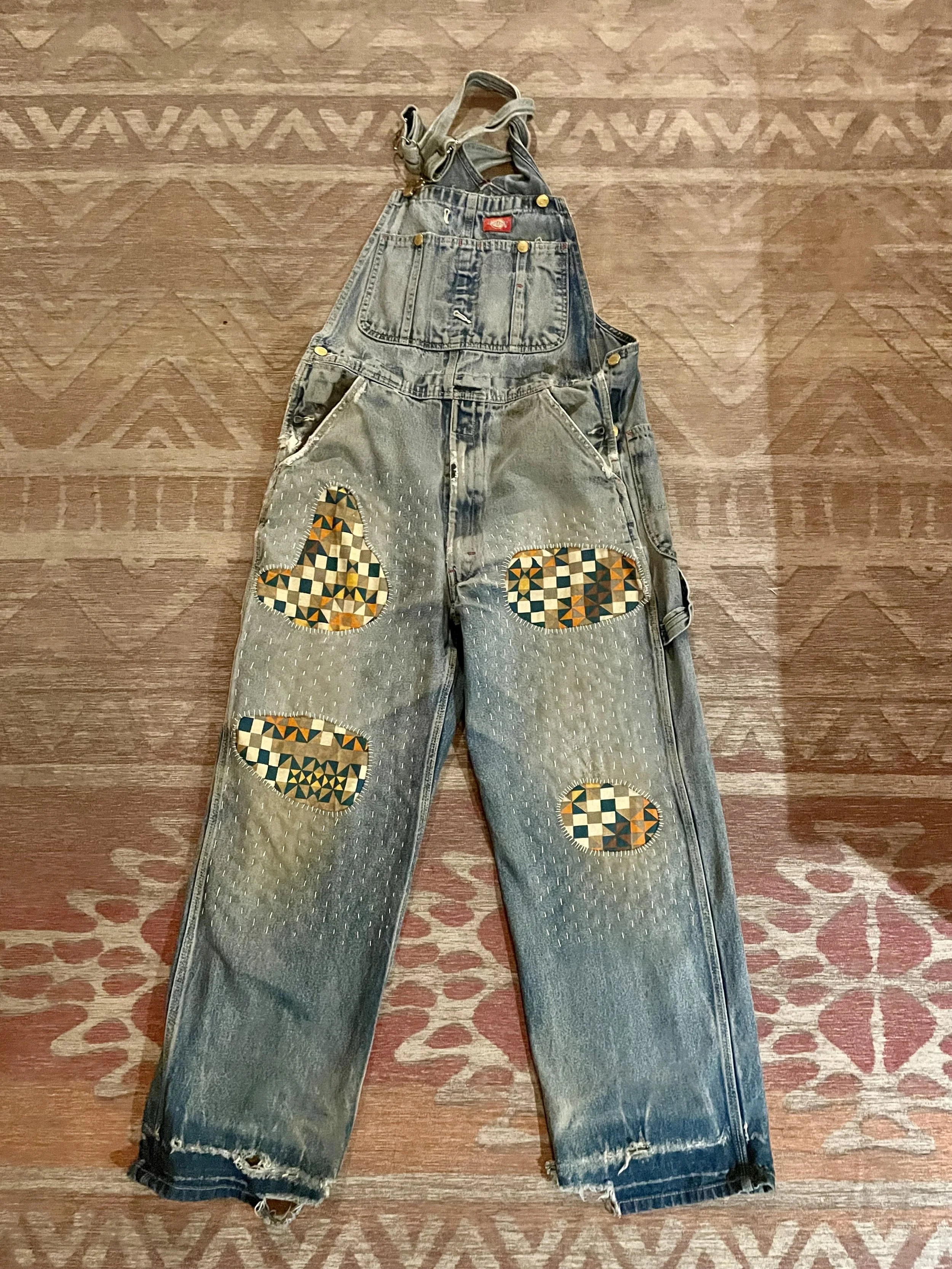
some overhauled overalls - all repairs done by hand
I’m something of a professional peasant. For income, I make and repair clothes, and I brew and sell ginger beer. And my own aesthetic might best be described as urban hobbit, in that my home is a squalid bric-a-brac of colored fabrics, bright buttons, bottles and jars of sundry ferments, and piles of books punctuated with the odd modern convenience of bicycle, laptop, sewing machine, space heater, and electric kettle. I prefer to work with and by my hands - even the most complex repairs - as the more a task relies upon machinery, the less inclined I am to enjoy it. Which likely explains my complete disinterest in driving, as there does not yet exist a way it can be done without a car.
I do have a darning loom, a handy little device that makes a sturdy repair in minutes, but haven’t used it in years, as I now far prefer the simpler tools of one long needle and plenty of good, strong thread. Even though this approach takes longer, and the result is not necessarily any more robust (I have seen some of my early, loom-made darns still holding strong years later) the simplicity is more versatile, and allows a much greater variety of design choices. It is also far less easy to find an excuse for putting off the work as – barring resorting to fingernails and teeth – sewing needle and thread are the smallest and most irreducible tools I could use. My workshop is anywhere I can set myself down.
In rereading Tolkien this winter, I find this disdain of mechanical complexity perhaps a further point in common between hobbits and myself, though a few notable points of difference are my interest in existing - rather than fictive - cultures and my own rather strong, pragmatic and - dare I say - ineradicable capitalist sense. (It has always bothered me that the Shire seems devoid of all financial institutions and that Frodo Baggins profession – and indeed that of nearly all his circle - is ‘hobbit’ whereas his estimable uncle Bilbo at least had the more comprehensible career of burglar.)
But the economy of the Shire appears conceived on the idea of ‘just enough’, as those who lust for more are viewed with great suspicion, while those who built their wealth through thrift are members of genuine esteem (despite a complete lack of mutual aid societies or credit unions, which seem more in line with hobbit values than banks). There are no real estate moguls, no robber barons. The industrial revolution seems a long way off, as no one seems to have figured out yet how to open a factory in Hobbiton. Wealth is to be measured in communal connection, in quiet, and in time. Abundance is in having sufficient and no more.
But let us now leave Tolkien behind, though I must offer a hat tip to Nicole Rudolph for the excellent digression on hobbit-economics. First because I am no scholar of the lore, second because I’m more a critic than a fan (dark complexioned characters are untrustworthy, primogeniture counts for more than political savvy, money is evil, monarchies are good) and third because there are very real cultural examples to indicate comparable values without resorting to fantasy, such as the Japanese mottainai (もったいない or 勿体無い).
The term is much in use of late to indicate the desirability of a minimalist or at least simple lifestyle. But it is also used to express regret over waste, from the unsalvageable (the vegetables that spoil before they can be used, a waste of money, time, and labor) to the potentially redeemable (the sweater with holes at the elbows which could be saved with a little elbow grease). An aversion to wastage and to over-consumption is by no means uniquely Japanese – Islam has the quite similar concept of zuhd (زهد) – and every culture knows what it is to conserve. But the term mottainai is useful as a framing device. It is not merely an admonition to ‘waste not’. It is also ‘this and no more’. Craft, well executed, does not rely on expensive tools but on attention to the material, and a home overflowing with “conveniences” is no indication of abundance.
Perhaps there is no better visual synthesis of all these metaphors than the practice of dorodango (泥だんご) literally “mud dumpling” where the most base of starting materials – mud – is shaped into polished spheres. This common classroom activity for school children in Japan is an exercise in focus, as it can be done with any mud, though does require a deft hand and dedication to first hold the mass together and then keep the ball from cracking as it dries over the course of hours or even days. In the process, the creator gets on quite close terms with the starting material, the finished product, and the path that connects the two. This is the nearest one might come to the true employ of magic. It is also a stern rebuke – as humorously proven in the television program Mythbusters – to the western notion that one can’t polish a turd. Indeed you can.
I wonder if this experience might go some way towards explaining a trait I noticed and greatly admire about Japanese buying habits: that even if not everyone is an artisan, they are at least inclined to buy from one. The average Japanese does not make any more money than the average American. Indeed, they make far less. But they are vastly more likely to buy better items – more durable, more aesthetically pleasing – and to preserve them in good stead. Of course dorodango are not all that robust, as they are merely dried clots of earth and not baked as with brick. But having gone through the long experience of shaping one, I wonder if a person is thereafter more likely to notice the unseen hours of study and labor that artistry requires.
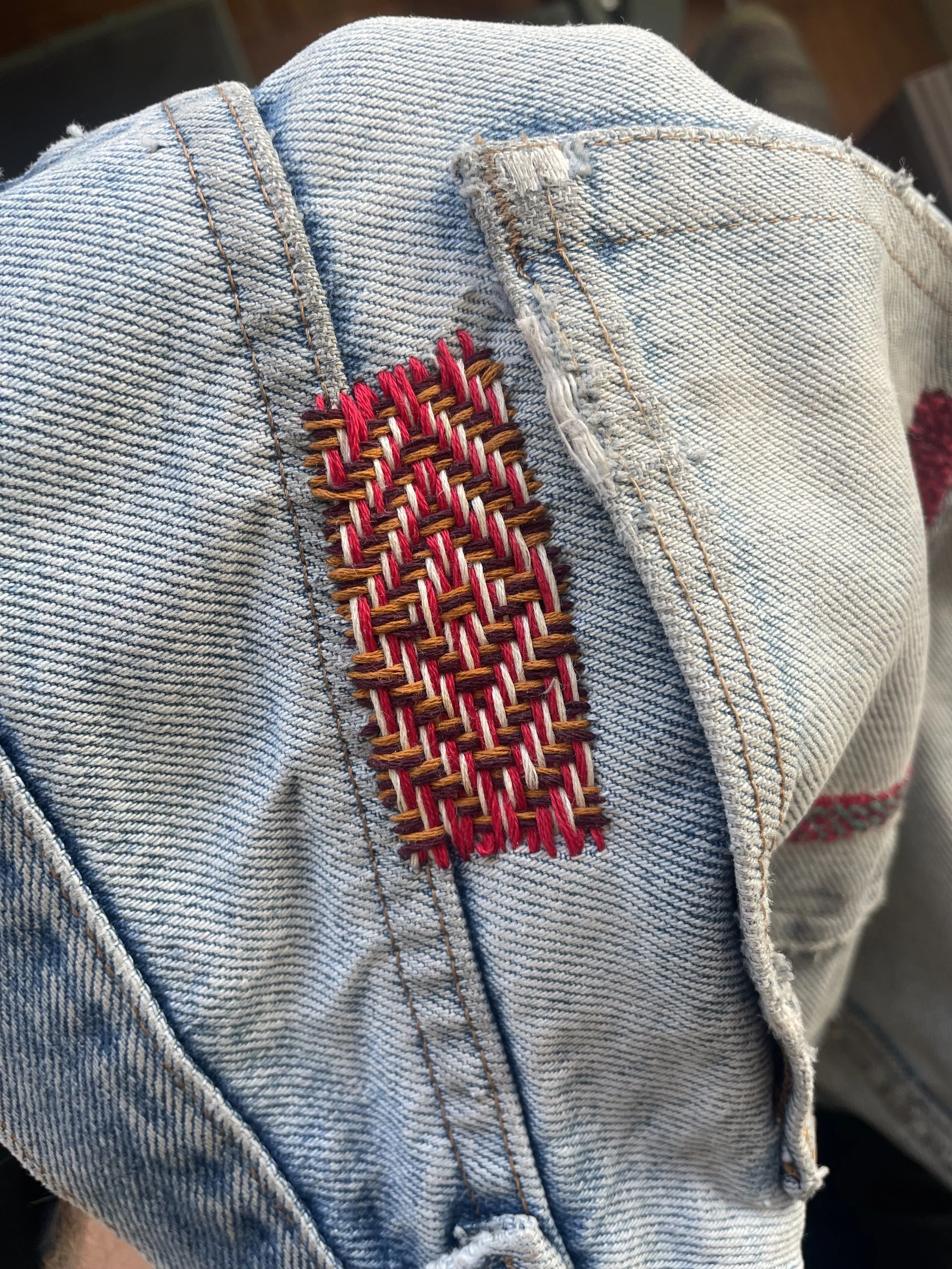
an hour of work to cover a hole the size of my thumb
I think a Westerner – or at least an American – would be more inclined to consider the initial premise of how to make a gleaming mud ball as a problem to be solved rather than as a lesson in humility. To approach in terms of industry and not artistry. Surely there must be a machine that could be built, one capable of churning out perfectly spherical, glistening dumplings by the dozen every minute to address the global shortage of polished mud. How to account for the product while discounting the labor. Which of course removes the entire point. Like trying to smell more roses per hour than to adjust one’s pace for a single bloom.
I am not anti-machine, but I am a machine-skeptic. The tool informs the process, and I think likewise the value. It is not that an item made by hand is inherently of greater monetary value, but it is inherently of greater worth. (the well-documented “Ikea Effect”) And there is a direct and inverse relationship between the simplicity of the tools and the value of the finished product. Famously, violinist Itzhak Perlman performed an entire concerto on just three strings when the fourth one snapped at the start of the concert. He signaled the conductor to begin again, and improvised over top of the existing orchestration. “Sometimes it is the artist’s task to find out how much music you can still make with what you have left,” he said after the affair. Perhaps in one case it is just mud, but through the application of one’s attentions, it becomes something greater, representative of a wealth acquired with time, rather than at once. Perhaps the music was written for four strings, but necessity demands it be done with fewer. Money can be gotten of a sudden, but skill never so. The best, most expensive instrument in the world would not have helped Perlman in the least if he hadn’t already dedicated decades of his life to the way of the violin.
I think of that whenever asked how long it takes to do one of the more complex repairs. I can typically do one in under an hour - using pennies or even fractions of pennies worth of thread - but only after roughly five years of study. And what is complex for me now is still quite simple compared to what I’m sure I’ll be able to do in another five years, or ten, or fifty, should I be lucky enough to live so long. And here is another useful concept, kaizen (改善) continuous improvement.
Perfection is impossible, but practice is no punishment. Every repetition an opportunity to do better than your prior self. So what if Sisyphus has to push a rock for all eternity? He will be the best rock-pusher there ever was. And after so many centuries of handling, the stone must surely sparkle as a second sun when - after all - even mud can be made to gleam.
While I have yet to make a dorodango, I engage in some figurative mud polishing each time I set myself down to darn. Thread is cheap. The least expensive material available to a designer. Yet also the most fundamental. It is the addition of intentioned labor that transforms the humble origin and gives the finished product value. There are machines that speed the process, and I have one. But I prefer the needle alone. And when the work is done the threads are cut, the ends tucked in, and no further ornament is added. It is sufficient, and no more.